Transfer of Critically Ill Patients
This has been developed to provide robust guidelines to all involved in the care of critically ill patients, as well as those seeking critical care for appropriate patients for the Western Cape
Aim of this guideline
Definitions of levels of care
Preamble and duties of clinicians
The role of hospital management
Policy considerations including constitutional rights
Equity of access to critical care beds
The principles of triage regarding critical care admission
The principles governing critical care bed resources
Assessment of need for admission
General statement regarding critical care admission
Specific issues with regard to critical care admission
The acute admissions process
Discharge and transfer of patients from critical care beds
Patients requiring critical care after elective surgery
Withdrawal of critical care support
Documentation in clinical notes related to critical care bed referral
Monthly data returns
Notes on this policy guideline
Appendix 1
Appendix 2
Aim of this guideline
This guideline has been prepared and is proposed following the input and consideration of all pre-existing admission policies operative in the Western Cape. Representation of all stakeholders has been achieved through review by individuals involved in the provision of critical care within the confines of the Western Cape. In addition consideration has been given, where appropriate, to similar documents that are available internationally. International documentation, although consulted and considered, deals with critical care provision in different socio-economic circumstances that are not always applicable to local circumstances.
The Critical Care Admissions, Discharge and Transfer Policy Document (Circular H 67 of 2007) has been developed to provide robust guidelines to all involved in the care of critically ill patients, as well as those seeking critical care for appropriate patients. This guideline relates specifically to those patients seeking care in intensive care, high care and specialised support units.
It is emphasised that the allocation of resources and triage of patients is primarily the responsibility of clinicians involved in the care of patients. The role of managers within the health care system is the securing of resources for the care of patients within the proposed framework and to participate in the governance of critical care services.
Both clinicians and health care managers are responsible for the governance of this guideline.
Every effort has been made to ensure that the contents of this guideline confirm to the conventional four pillars of ethical practice. These are namely:
- Patient autonomy – the patients own decisions and directives above all others.
- Beneficence – care must be to the patient’s benefit in terms of quality outcome and comfort.
- Non-maleficence – there must be no deliberate harm or undue suffering to the patient.
- Social/distributive justice – cognisance must be made of other patients demands and rights to access appropriate levels of care.
The various levels of critical care are detailed in the provincial document detailing Definitions of Levels of Care (Circular H 68 of 2007).
This guideline is to be appreciated in conjunction with the Provincial policy document on Acute and Emergency Case Load Management (Circular H 23 of 2007).
Definitions of levels of care
This policy guideline relates to levels of critical care as outlined in the provincial policy document, Defining Critical Care for the Western Cape (Circular H 68 of 2007). As a brief summary the following levels of critical care are provided in the Western Cape:
- Intensive care
- This level of care is for patients demanding support of multiple failed or dysfunctional organ systems. As such it represents the highest level of care that can currently be offered within given resource restraints. This tier of care includes, but is not limited to: ventilation, haemodynamic support and monitoring, and dialysis. The emphasis is on high patient acuity, demanding frequent and complex monitoring, or investigation and intervention.
- High care
- This level of care serves patients with single organ failure, or those patients requiring intensive monitoring. Such patients may in addition require support of other organ system dysfunction, but not failure.
- Specialised support units
- This category is included to cover dialysis units, coronary care facilities, neonatal care units, post anaesthesia care units, or units providing support directed at a specific organ or endpoint e.g. burns, spinal injuries, head injuries, neurosurgery and cardiothoracic surgery.
- Holding areas
- These areas are designated for the temporary care of patients potentially demanding critical care. Such units primarily function as triage and transport areas, facilitating the movement of patients potentially requiring critical care. Holding area beds may not be occupied by any single patient for more than 24 consecutive hours.
Each unit, as described above, should develop its own supplementary admission, discharge and transfer policy documentation. Such documentation must clearly define the niche each unit serves, and must cover specific issues not covered by this policy guideline.
Preamble and duties of clinicians
This guideline relates to the admission, discharge and transfer of patients requiring critical care within the Western Cape Province. Clinicians involved in the care of such patients are reminded that they remain responsible and accountable for the care of a patient until such time as care is formally handed over to a referral unit or individual clinician.
It is the duty of each clinician responsible for the care of a patient requiring the support of a critical care unit to ensure that appropriate referral takes place. It should be clearly documented in the patient notes the avenues and results of the referral process followed. The decision regarding patient referral, the relevant clinicians involved, and the time of all instructions must be clearly documented. Both referring clinicians and receiving clinicians are reminded that they are accountable for their decisions and clinical directives.
While both referring, and receiving clinicians and units, strive to provide the highest level of patient care, it is appreciated that resource limitations exist. Patients denied access to higher levels of critical care due to resource limitation should have this clearly documented in their notes.
The triage of patients requiring access to critical care beds is the responsibility of referring clinicians and receiving units alike. Where decisions are taken with respect to the triage of patients with respect to available resources, these should once again be clearly documented.
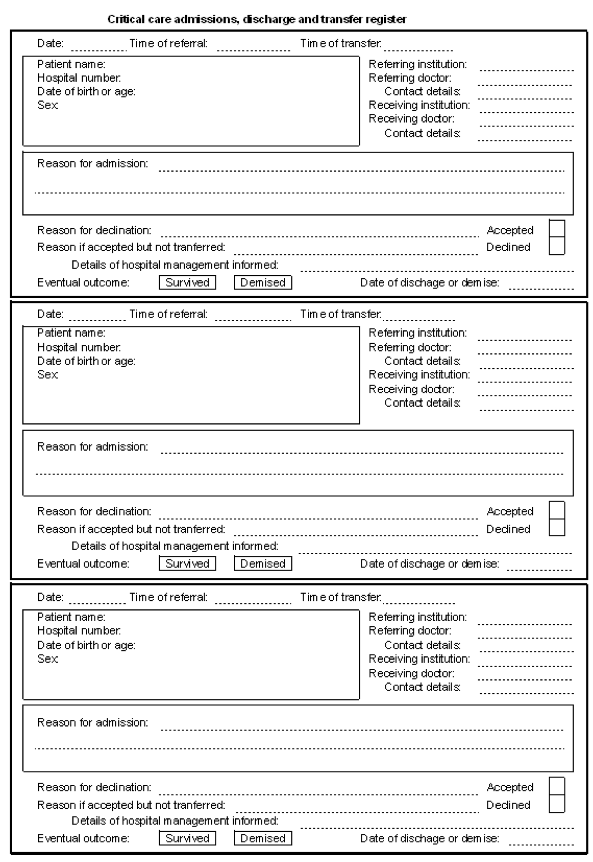
A register, See Appendix 1 below, should be held at each and every facility clearly documenting the outcomes, results and decisions taken with respect to referral of patients to acute care beds.
The role of hospital management
Following the identification of patients who are eligible for admission and cannot be transferred due to resource limitations, it is the duty of clinicians to inform the appropriate hospital managers of the circumstances. Clinicians are not primarily responsible for resource identification and recruitment. A combined effort on the part of hospital managers and clinicians should attempt to either make additional resources available, or identify an alternative place of critical care.
Hospital managers are urged to contact their relevant counterparts at other hospitals, and confirm the unavailability of resources. If resource limitation is truly a problem this must be documented in the patient notes and any further avenues pursued recorded.
The referring hospital’s management must contact the management at the receiving institution to ascertain whether any additional resources can be called upon. This is to be done in consultation with the receiving unit’s clinicians.
It must be emphasised that patient referral is the responsibility of clinicians.
Patients in district hospitals and community health care centres may be transferred subject to the terms of the provincial policy, Acute and Emergency Case Load Management (Circular H 23 of 2007). Such patients will be managed by emergency medicine practitioners in designated emergency centres. Emergency medicine practitioners, in keeping with the aforementioned policy, will seek transfer of appropriate patients to relevant critical care units.
Policy considerations including constitutional rights
The South African Constitution guarantees the right of access for all patients to emergency care. It is important that all clinicians appreciate that this is not a guarantee of access to critical care beds. It is however appropriate that all patients are subjected to an equitable triage process for access to critical care resources.
This guideline interprets the constitution, to guarantee the right of every citizen presenting for care to be assessed, have a clinical diagnosis made, and be considered for admission to a critical care bed, should the referring clinician deem this appropriate. It is thus mandatory that assessment, triage and appropriate referral be made.
Equity of access to critical care beds
It is a reality that not all patients seeking critical care facilities can be accommodated. In order to allow the maximum benefit to the largest number of patients a system of triage and evaluation is necessary. Admissions should be decided on in a fair and equitable manner. This holds irrespective of where a patient is located at the time that a critical care bed is sought. Critical care beds are a provincial resource and must be equally accessible to all patients.
The principles of triage regarding critical care admission
The purpose of triage is the immediate provision of the highest level of care to those most in need of it, and in whom the care is most likely to have benefit. In order for appropriate resource triage to take place, it is essential that clinicians appreciate that the medical background of each patient is crucial in the decision making process. While such information may not be immediately available, clinicians and nursing staff must actively seek it out.
With regard to patients requiring critical care the following must be taken into account:
- Critical care must be essential to patient survival.
- While it may be desirable to admit a patient to a critical care bed for a variety of reasons it must be established that the level of intervention and monitoring sought is truly warranted. “It would be nice for the patient to be in ICU”, is simply not good enough. There must be documentation of the level of monitoring and intervention sought, in the patient notes. The level of monitoring and intervention must be agreed upon by both referring and receiving clinician.
- There is a good chance of the patient surviving.
- Acute, reversible insults or diseases are ideal criteria for admission. A patient who has a very slim chance of surviving (poor reversibility), given high level care, is not necessarily an appropriate admission to a critical care bed. Unfortunately resource constraints do not allow for the provision of a high level of care purely to give a patient a “chance”. There must be a reasonable prospect of the patient recovering.
- Patients demanding of admission who are suffering the ravages of long standing chronic ill health are frequently not good candidates for admission.
- Quality of life following critical care.
- Although critical care may make patient survival possible, this has to be balanced against the likely outcome in terms of quality of life. A patient who is easily salvaged with the prospect of being permanently vegetative would not be an appropriate admission to a critical care bed.
- Difficult decisions frequently need to be made with regard to patients in whom a poor quality of life is a likely outcome. Where possible this must be discussed with the patient, if appropriate, and family members or care givers.
- Ideally a patient should be able to return to an independent life at a level of function not lower than that prior to admission. Where a patient is declined a critical care bed on the grounds of poor outcome, this needs to be documented.
- Anticipated resource utilisation.
- Cognisance must be taken of the amount of resource a patient is likely to consume. Also worthy of consideration is the likelihood of an ongoing need for additional care post survival or discharge from hospital.
The principles governing critical care bed resources
Critical care facilities (high care, intensive care and specialised support units) have the following focus with respect to utilisation and patient service provision:
- Equitable access to critical care facilities.
- All patients who may potentially benefit from critical care admission should have equal access, regardless of place of residence, place of presentation etc.
- Optimisation of the benefit of critical care resources for all who may need to make use of these resources.
- Appropriate assessment and triage.
Assessment of need for admission
All patients considered needy of admission to a critical care facility should receive the highest possible level of assessment. This mandates the attendance of the most highly qualified medical practitioner available in the assessment process. Junior staff must consult with senior covering staff regarding appropriateness of referral or need for admission.
The attending medical practitioner should have the following objectives in mind:
- The interests of the patient at hand.
- The likely benefit to be derived from critical care admission relative to those of staying in the current place of care.
- The appropriate utilisation of available resources.
- Good motivation for appropriate allocation of resources for critical care admission.
General statement regarding critical care admission
Patients who have a long stay in critical care beds and then eventually die are costly in terms of resource utilisation, and deprivation of resources to other patients. Such patients are frequently emergency admissions, with underlying chronic ill health. Patients with a poor prognosis from the outset, and who have an extended stay in the ICU before death, also have a very negative effect on the morale of all staff caring for them.
The patient's and family's wishes as regards aggressive intervention (which may be unpleasant and undignified) should be sought. No mentally competent patient may be admitted against his or her wishes.
The following general points apply to the admissions process:
- Patients will be considered for admission in terms of the chronological order in which requests for admission are made.
- Although consideration for admission is given in chronological order this applies only where equally deserving patients are concerned.
- All patients will be given equal consideration for admission irrespective of place of presentation or the facility from which the request is made.
- Preference will be given to patients who have conditions that are amenable to therapy, with good outcome, and preferably a relatively short stay.
- No patient may be refused admission to a critical care bed without discussion with the most experienced medical practitioner responsible for such beds.
- Junior staff may not make final decisions with respect to admission to critical care beds.
- Admission or refusal of admission to intensive care beds must be by a qualified, specialist medical practitioner.
Specific issues with regard to critical care admission
Age
Age cannot be used as a sole criterion for the granting or refusal of admission. Young patients are not necessarily better candidates for admission purely on the basis of their age. Disease acuity, resource utilisation and likely outcome are to be used as admission discriminators.
With respect to the elderly: Elderly patients are not to be disadvantaged purely on the basis of their age. Nevertheless, it is a fundamental reality that elderly patients have a higher degree of co-morbidity with a lesser life expectancy. Great care must be taken to discern the older patient with an acute reversible illness, from one who is suffering disease acuity related to an age dependent decline in organ function.
Severely ill patients who are in the process of dying cannot be considered for admission irrespective of their age.
Futile care
Patients will not be considered for admission to critical care beds where further therapy is deemed to be futile. Futility is not necessarily related to the degree or pattern of acute organ dysfunction, but takes into account long term outcome.
In general the following patients are not to be considered for critical care admission:
- Any patient who has had a cardiac arrest and has not re-established a normal respiratory pattern, or who has fixed dilated pupils.
- Patients with a cardiac arrest resulting from an immediately correctable physiologic dysfunction are better candidates for admission than those suffering an arrest as a result in a progressive decline in physiologic function.
- Patients who are brain dead in terms of legally defined criteria.
- All possible confounding illnesses, therapies and situations must have been taken into account.
- The patient with such severe head injury that there is no chance of recovery with reasonable neurologic function.
- An exception would be a patient who is expressly considered as an organ donor for transplantation purposes.
Patients with underlying lethal conditions
Patients will not be admitted to critical care beds when they have a potentially lethal underlying condition that is not currently amenable to therapy. This includes:
- Patients with established Acquired Immunodeficiency Syndrome (AIDS) as result of HIV infection. The World Health Organisation defining criteria for AIDS are to be used.
- Patients should not be discriminated against purely on the basis of a known HIV positive status.HIV positive patients, whether on established antiretroviral therapy or not, where the reason for admission is not related to their underlying retroviral disease may be considered as suitable candidates for admission.
- Patients should not be discriminated against purely on the basis of a known HIV positive status.HIV positive patients, whether on established antiretroviral therapy or not, where the reason for admission is not related to their underlying retroviral disease may be considered as suitable candidates for admission.
- Patients with chronic renal failure who are not eligible for long term dialysis or renal replacement therapy.
- Patients with established chronic hepatic disease, now in failure, for whom transplantation is not an option.
- Patients with end stage cardiac decompensation for whom transplantation is not an option.
- Patients with known malignancies that are incurable, or not responding to therapy.
- Patients with incurable malignancies, yet a reasonable life expectancy, may be considered for admission, where their admission acuity is not related to the underlying malignancy.
Patients unlikely to benefit from critical care intervention
Patients with an anticipated poor prognosis or those unlikely to benefit from critical care are not considered for admission. This includes:
- Diseases for which outcomes in intensive care are known to be poor.
- Patients for whom intensive care holds little benefit.
- This includes patients who may not have disease acuity deserving of acute care intervention. These are patients who are “too well” to demand the allocation of critical care resources.
As indicated in section 2 of this guideline, each critical care unit must provide its own supplementary admission, discharge and transfer criteria. It may be inappropriate to admit a patient to a unit that can factually prove poor outcomes for a given subset of patients.
The acute admissions process
Patients requiring critical care are to be referred to an appropriate critical care unit. This may take the form of a high care, intensive care or a specialised support unit.
Referring clinicians should have as much pertinent patient data and information at hand as is possible. It is possible that during the referral process the need to ascertain further information or data may be identified. This is often crucial in the prioritisation and triage of potential admission candidates.
At each stage of the referral process, written documentation of the process and the outcome should be made.
Accepting referral units and referring clinicians are made aware of the following:
- A register of all requests (See Appendix 1 below), with pertinent details must be kept.
- The outcome of the referral request with substantiating information must be detailed in a register.
- The outcome of a request for transfer must take the form of one of the following:
- Patient accepted for transfer.
- Patient not accepted – not a suitable candidate.
- The reason for non-admission must be documented.
- Patient accepted for transfer.
- Patient accepted but cannot be transferred due to resource limitation.
- In such cases detailed clinical support and clinical management directives must be given together with assistance in securing the next most appropriate critical care bed available. This is the responsibility of the clinician at the receiving hospital.
- A request for a critical care bed cannot be handed off on the simple basis that there is no bed available. This gives no advice and leaves little directive for staff caring for the patient at hand. This is not to be condoned.
Patients in district hospitals and community health centres may be transferred in accordance with the provincial policy governing Acute and Emergency Case Load Management (Circular H 23 of 2007). This guideline provides information for the transfer and management of patients in institutions not in possession of critical care beds or resources.
Discharge and transfer of patients from critical care beds
Patients in critical care beds are evaluated and considered for discharge, or transfer out, based on the following criteria:
- Reversal of the disease process, or resolution of the unstable physiologic condition, that prompted admission to the unit.
- When it is determined that the need for complex intervention exceeding general ward care capabilities is no longer needed.
- Where further critical care and resource utilisation will not benefit the patient in terms of likely survival or outcome.
Transfer or discharge will be based on the following:
- Stable haemodynamic parameters not requiring infusion of pharmacologic agents.
- Stable respiratory status (patient extubated with reasonable arterial blood gases or saturation) and airway patency.
- Minimal oxygen requirements that do not exceed ordinary general ward capabilities.
- Intravenous inotropic support, vasodilators, and anti-arrhythmic drugs are no longer required or, when applicable, low doses of these medications can be administered safely in otherwise stable patients in a designated ordinary ward.
- Cardiac dys-rhythmias are controlled.
- Intracranial pressure monitoring equipment has been removed.
- Neurologic stability with control of seizures has been achieved.
- Removal of all haemodynamic monitoring catheters. Central venous lines for purposes of intravascular access are not grounds for continued admission.
- Chronically mechanically ventilated patients whose critical illness has been reversed or resolved and who are otherwise stable may be discharged to a designated patient care unit that routinely manages chronically ventilated patients, when applicable, or to home.
- Routine peritoneal, or haemodialysis, with resolution of critical illness, not exceeding general ward care capabilities.
- Patients with mature artificial airways (tracheostomies) who no longer require excessive suctioning.
- The health care team and the patient's family, after careful assessment, determine that there is no benefit in keeping the patient in a critical care bed, or that the course of treatment is medically futile.
Clinicians requested to take transfer of patients from critical care beds must do so as soon as possible. The failure to take transfer of a patient from a critical care bed frequently delays or blocks the admission of another patient to said bed.
Patients requiring critical care after elective surgery
Patients undergoing large elective surgical procedures may need intensive monitoring and support, or the provision of major conduction or regional analgesia.
These patients should not be discriminated against purely because the procedure is elective and may be delayed. Cancellation of elective procedures on the grounds that emergency admissions have a higher acuity cannot be condoned. Repetitive delay of elective procedures leads to greater patient acuity, morbidity and even mortality.
Key in dealing with such critical care requests is that patients be admitted to units providing appropriate levels of care. The majority of elective surgical patients do not demand intensive care but intensive monitoring, while the majority of emergency admissions demand intensive and not high care. It is crucial that independent units providing a variety of levels of care be established. Combined intensive and high care units are not optimal, and a key reason that patients seeking elective admission are delayed. To this end consideration must be given to the allocation (“ring fencing” or proportional bed allocation) of beds for elective admissions. Specialised support units catering for post anaesthesia care are to be considered in all tertiary and large regional hospitals where major surgery is undertaken.
It is unfair that patients requiring elective admission compete with emergency admissions for the same resource. A tiered critical care system with clear demarcation of beds must be instituted.
Withdrawal of critical care support
Although not desirable, it may be necessary to consider the withdrawal of support from a patient either already in a critical care bed, or one being considered for admission. Withdrawal of therapy, although considered in a negative context by many clinicians, can be a positive decision.
It is fruitless in terms of resource expenditure to continue resource investment in a patient that is unlikely to benefit from care. Withdrawal of support is a moral, ethical and legally defensible stance to take. It is immoral, unethical and indefensible to continue to allocate resources to a patient in whom a successful outcome is a distant possibility. There is no positive attribute to the extension of life purely because it is scientifically and medically possible. This may be associated with undue suffering to no sensible purpose.
Where withdrawal of therapy is considered, such a decision needs to be taken by the patient (if possible, or if advance directives exist), family members, and treating clinical staff. Every opportunity must be given for all of the above to express their standpoint. The most senior available clinician should preside over such decisions. The eventual decision to withdraw medical support, the reasons for such decision and the details of those consulted must be documented in the patient notes.
Withdrawal of life sustaining therapy is not to be equated with withdrawal of care. Comfort care must continue until such time as the patient demises. It may be appropriate that a patient is discharged from a critical care bed for comfort care to take place elsewhere. This may free a desperately needed critical care bed for a candidate who meets admission criteria in terms of this guideline.
In light of the above, careful consideration must be made in cases where life sustaining therapy is instituted. It may be inappropriate to institute advanced critical care if patients are not eligible for transfer to critical care units.
Documentation in clinical notes related to critical care bed referral
As indicated previously, all health care facilities and all critical care units must make documentation of each and every referral and the outcome of the process.
This documentation must include the following information:
- Date and time and place of referral.
- Referring and accepting clinician contact details.
- Patient identification, age and current place of care.
- Indication for referral to critical care bed.
- Outcome of referral (as detailed in the acute admission process above).
- It is desirable that eventual patient outcome also be documented.
A template for an admissions, discharge and transfer register is included with this guideline: See Appendix 1 below.
Monthly data returns
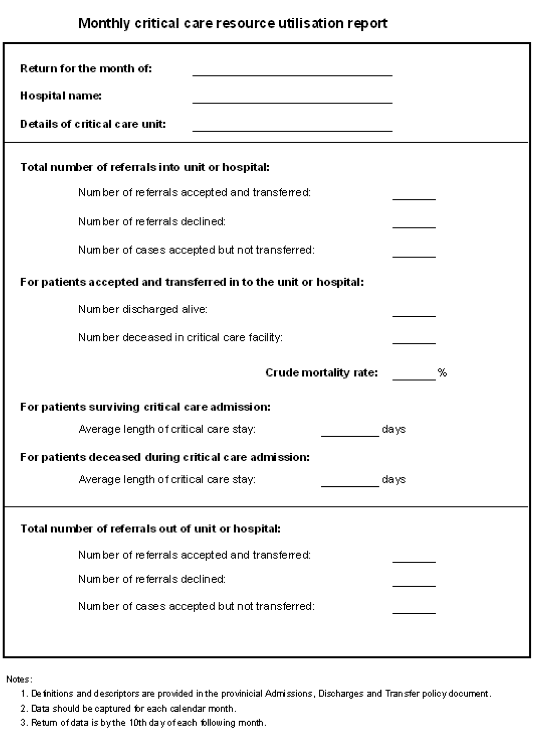
To facilitate the improvement of the delivery of critical care, and in order to audit critical care resource utilisation, a monthly return of admissions, discharges and transfers must take place. A template is attached: See Appendix 2 below. While it is the unit director, or an appointed clinician’s duty, to ensure completion of a monthly return, it is the facility manager’s responsibility to enforce the data return. A monthly return must be submitted to the Deputy Director General Secondary Tertiary and Emergency Care, or appointed deputy, by the 10th day of the following month.
Each critical care unit must provide such information. This can be summarised to represent the admissions, discharges and transfers of an entire hospital.
Notes on this policy guideline
This policy is set out to provide a framework for the admission and transfer of patients to and from critical care beds. It is in no way intended as an absolute list of who should, or should not, be admitted to critical care resource units. Each critical care unit must develop its own specific documentation with respect to admission, discharge and transfer criteria, where these are not adequately defined by the scope of this policy guideline.
In addition each unit must have specific written orders or policies relating to the management of set clinical conditions. It is appropriate that local expertise and experience are reflected in such policies.
All clinicians, managers, members of the public and patients are reminded that while it may be desirable to admit all severely ill patients to a critical care bed this is not a feasible reality. Despite resource limitations not all patients are appropriately looked after in a critical care bed irrespective of disease acuity.
Detailed description of the defining criteria of critical care, the necessary resources, applicable unit practice policies and essential resources are provided in the provincial document Defining Critical Care for the Western Cape (Circular H68 of 2007).
This guideline is to be seen as a document, subject to review, alteration and annual revision.
Appendix 1
The template for admissions, discharge and transfer register page details. A template is provided below. Different critical care units may have different means of collecting this data. The template is a suggestion as far as data collection is concerned. Alternative means may be pursued as long as the essential elements outlined are collected.
Appendix 2
The template for monthly summary of data return. A template is provided below. Once again, alternative means of collecting the data are acceptable. The essence is the collection of relevant data allowing for the planning and audit of critical care resources.