Transfusion
SANBS Guideline - Updated August 2023
Essential transfusion knowledge
Blood, platelet, plasma products and albumin
Paediatric administration sets
In terms of the Standards of Practice for Blood Transfusion in South Africa,
- Transfusions of blood, red cell components and other components shall be prescribed in the medical records of the recipient by the doctor in charge and administered under medical direction.
- The transfusionist shall be a medical practitioner or a registered professional nurse who is working under his delegated authority.
- The recipient shall be observed during the transfusion and for an appropriate time thereafter for possible adverse reactions.
- The patient shall be positively identified and this identity verified against that on the accompanying documents and the units to be transfused.
Essential transfusion knowledge
Warming and thawing of blood and blood products
Warming of blood is a much-debated issue and impacts on the safety of a transfusion. Incorrect heating (or storing) of blood may cause haemolysis of red blood cells and may lead to severe transfusion reactions or death.
Cold blood administered slowly (one unit over 4–6 hours) will not have any detrimental effects on the patient. Routine warming of blood is not recommended as it exposes patients to unnecessary risks.
Clinical indications for warming of blood:
Massive transfusions when blood is administered at a rate of >50ml/kg/hr.
- Infant transfusions at a rate of >15ml/kg/hr.
- All neonatal transfusions.
- Transfusions to hypothermic patients.
- Transfusion of units that contains high-titre cold heamagglutinins.
- Transfusions administered via central lines.
Further safety, logistic and cost implications that need to be remembered:
- Overheating the unit of blood above the warmer specifications may cause extensive haemolysis and/ or possible death.
- Only approved warming methods / equipment may be used to warm blood. Blood warmers should be serviced and maintained properly. It is recommended that warmers be equipped with visible temperature-monitoring devices and audible alarms.
- Bacterial contamination of ports (and products) should be avoided at all times.
- The total time from removal from cold storage to completion of the transfusion may never exceed 6 hours for whole blood or red cell products.
- The temperature at which we thaw or heat must be monitored, controlled and of such a nature that the viability and quality of the product is not compromised.
- Physical damage to the blood product must be avoided.
- The logistic implications of choosing a method should include an evaluation of the human resources, equipment available and urgency of the transfusion.
- Platelets, plasma products and granulocyte products must never be warmed.
To avoid thawing of plasma in the ward, request the blood bank to thaw before issuing. This service may not always be available in smaller blood banks.
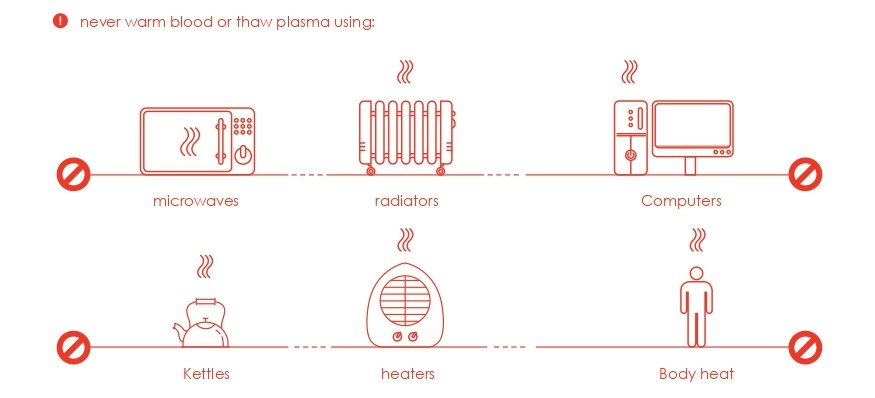 Click on image to enlarge
Venous access
Venous access should be obtained and maintained according to aseptic techniques stipulated in your facility’s policies. Blood may be administered via peripheral or central lines according to the physician’s instructions.
Large-bore needles (16–18G) are used when transfusing adults; paediatric transfusions are done with 22–27G needles. Avoid using needles <28G to transfuse products with a haematocrit >60%.
| Convert French to Gauge | |
| French | Gauge |
| 1.5 | 25 |
| 107 | 24 |
| 2 | -23 |
Administration sets
Only sterile administration sets may be used to transfuse blood or blood products. Ensure that the appropriate set is chosen for the product that you will be transfusing. Never piggyback transfusion sets onto other lines.
Blood, platelet, plasma products and albumin
Blood, platelet, plasma products and albumin are administered via a normal / standard blood administration set fitted with a 170-micron mesh filter. Standard blood administration sets may be primed with the blood product or normal saline. The blood product should cover the total length of the filter membrane while priming the set and during the transfusion.
Paediatric administration sets
Paediatric transfusion sets are available at most hospitals. Blood banks do not issue paediatric transfusion sets. Use of paediatric sets will prevent unnecessary wastage of smaller volume products (due to bigger space of tubing and chambers) and they allow for accurate volume and flow-rate control.
When to change administration sets:
- If a reaction is suspected / confirmed, to prevent further infusion and harm to the patient.
- Between different blood products e.g. red cells and platelets.
- Between red cell transfusions of different ABO groups.
- Before infusing IV fluids such as Dextran, Ringers Lactate, etc.
- Every 10 -12 hours or after every 2 units to prevent bacterial growth and transfusion of haemolysed blood.
- When flow is hampered by debris in the filter.
| Nothing except normal saline may be administered through the same line as blood products. (See Additives and drugs) |
Additives and drugs
No drugs or IV fluids may be added to the unit as these may react with the blood product or anticoagulant and preservatives in the unit. Fluids that may be given concurrently:
- Normal saline
- 4% albumin
- Plasma protein fractions
- ABO-compatible plasma
Pressure infusion devices
Pressure bags may be used when blood needs to be transfused rapidly, e. g. massively bleeding patient. Manufacturer’s instructions must be followed to ensure correct use.
Infusion pumps
Before using infusion pumps to transfuse blood or blood products, confirm with the manufacturer if the device is registered for this purpose. Staff must be trained on the correct use of infusion pumps as red cell haemolysis may occur if the rate of transfusion does not take into account the lumen size of the needle / catheter (especially important in the paediatric setting).
Filters
Leucodepletion filters
Bedside filtration is not recommended because:
- Hospital staff are not technically trained. Technique and results will be less adequate.
- Temperature control is not as effective as in a laboratory.
- Units will be older, and white cell fragmentation will already have taken place.
- Especially for platelet products, the prevention of Febrile Non Haemolytic Transfusion Reaction (FNHTR) and alloimmunization will be less effective than with pre-storage leucodepletion.
- Patients on ACE inhibitors display increased hypotensive reactions to bedside filtered products in relation to products that were pre-storage filtered due to bradykinin activation.
- Quality control measures are not in place to monitor and regulate efficacy and processes.
Night time transfusions
- Transfusions should not be given at night unless the patient is actively bleeding or has some other urgent clinical need.
- Elective transfusions should be done during the day to reduce errors and improve safety for patients.
Leucodepleted blood must be requested from the blood bank if indicated. Bedside filters will ONLY be used in the event of leucodepleted blood not being available from the blood bank. Correct use of leucocyte reduction filters at the bedside is necessary to ensure their effectiveness. Staff need to verify which filter is indicated for which product (as per manufacturer’s instructions).
Leucocyte reduction filters must NEVER be used for granulocyte transfusions.
Micro-aggregate filters
Micro-aggregate filters have a very small pore size (10-40 microns) to filter out microscopic debris in stored blood.
Current medical and nursing literature does not provide evidence in favour of micro aggregate filter use over standard filter (170-260 microns) use for routine transfusions.
The routine use of micro-aggregate filters for neonatal transfusion is not warranted since no convincing studies exist to indicate efficacy, and the relatively fresh red cell products used for most neonatal transfusion contain minimal amounts of micro-aggregates.
Micro-aggregate filters have some intrinsic disadvantages. Of particular concern is the administration of platelet components through microaggregate filters. Micro-aggregate filters, diminishing the therapeutic value of the transfusion and thereby ultimately increasing the patient’s transfusion requirements and donor exposure, trap transfused platelets.
Micro-aggregate filters must NEVER be used for granulocyte transfusions.
Navigation to a Safe Blood Transfusion - Updated August 2023