Transfusion Reactions
SANBS Guideline - Updated August 2023
How to recognize a transfusion reaction
Types of transfusion reactions
Emergency management of transfusion reactions
Further management of a transfusion reaction
Clinical presentation and management of transfusion reactions
Definition
According to the Clinical Guidelines for the use of Blood and Blood Products in South Africa, a transfusion reaction is defined as “any potentially adverse sign or symptom which occurs after the start of any transfusion of blood or blood products”.
How to recognize a transfusion reaction
To recognise signs and symptoms developing (or a change in signs or symptoms), you need to know what signs or symptoms were present before the onset of the transfusion. Baseline observations are essential to enable early recognition of transfusion reactions.
Signs and symptoms are often non-specific and the frequency and type of reactions may vary with different blood products.
Signs and symptoms that may be suggestive of a transfusion reaction:
- chills
- nausea
- itching
- vomitting
- facial/tounge swelling
- headache
- rash
- oliguria
- pain
- rise or drop in blood pressure
- haematuria
- fever
- restlessness
- back pain
- flushing/rise in temperature
- chest pains
- rigors
- breathing difficulty
- wheezing/anxiety
- rise or drop in pulse
A high level of suspicion and quick intervention may be lifesaving to your patient.
Types of transfusion reactions
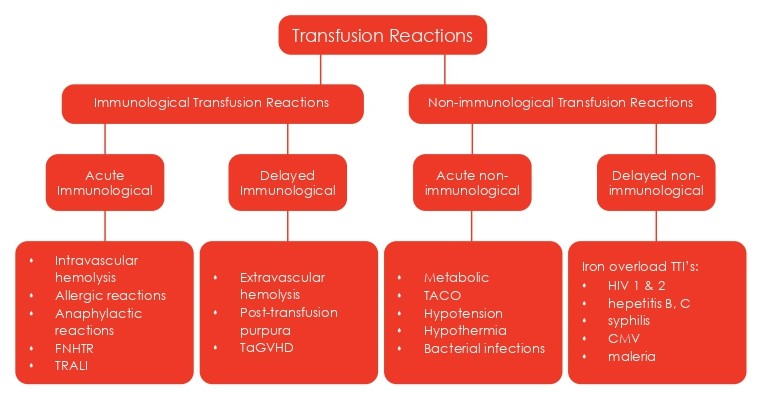 Click on image to enlarge
Emergency management of transfusion reactions
Acute complications usually develop during or shortly after a transfusion (within 24 hours). These can range from mild to severe (life-threatening) and are managed accordingly.
| Category | Management |
Category 1: Mild hypersensitivity reactions:
|
|
Category 2: Moderately severe reactions:
|
|
Category 3: Life-threatening reactions:
|
|
Emergency management of all acute transfusion reactions always include:
- Stop the transfusion.
- Contact the prescribing practitioner.
- Maintain venous access with normal saline through a separate infusion set.
- Maintain symptomatic support of the patient.
- Immediately contact the treating physician.
- Contact the blood bank ASAP.
Further management of a transfusion reaction
Once the patient is stabilised:
- Complete the transfusion reaction form, supplying as much information as possible.
- Collect 1 EDTA sample (bloodbank crossmatch sample).
- Urine to be tested in the ward (indicated on the transfusion reaction form).
- Send the suspect unit and tubing with the samples and documentation to the blood bank as soon as possible.
- Record events in the patient’s clinical file.
- Do not commence the transfusion with another unit before liaising with the transfusion service.
- Report all transfusion reactions to your hospital’s transfusion discussion platform, the Quality Assurance office, and your local blood bank (to assist in planning for future transfusion needs of the patient).
Click here to access the Transfusion Reaction form.
Clinical presentation and management of transfusion reactions
| Reaction | Definition, clinical presentation and management |
| Acute transfusion reactions |
Transfusion-related reactions that occur at any time during or up to 24 hours following a transfusion of blood or components. The most frequent reactions are fever, chills, pruritus or urticaria, which typically resolve promptly without specific treatment or complications |
| Haemolytic transfusion reactions | A reaction where there are clinical and laboratory signs of increased destruction of transfused red blood cells. Haemolysis can be intravascular or extravascular, and immediate (acute) or delayed. |
| Acute haemolytic transfusion reaction |
Transfusion of incompatible red cells or incorrectly heated or stored red cell products causes rapid destruction of red blood cells immediately after or within 24 hours of a transfusion. Clinical and laboratory signs of haemolysis are present: increasing anaemia, haemoglobinuria, back pain, flank pain, abdominal pain, oozing at venous access sites / wounds and rise in LDH and positive DAT. Other symptoms include fever, chills, nausea, vomiting, hypotension, tachycardia, renal failure and DIC. Maintain renal function, monitor vital signs, administer saline, induce diuresis (Furosemide) and refer to haematologist or nephrologist. |
| Allergic transfusion reaction |
This reaction is caused by allergies to plasma proteins. In some instances, infusion of antibodies from an atopic donor may also be involved. Usually mild with muco-cutaneous signs and symptoms: itching, hives, urticaria and erythema. Administer antihistamines. Commence transfusion with a new unit after liaising with the blood bank. |
| Anaphylactic transfusion reaction |
Severe reactions due to antibodies to IgA immunoglobulins or other plasma proteins. Sudden onset with facial oedema, laryngeal symptoms (stridor, hoarseness, glottal oedema), respiratory symptoms (dyspnoea, bronchospasm), hypotension, shock, cardiac arrest and death. Explosive GIT symptoms often present. Administer adrenaline, steroids, oxygen and monitor patient. Plan future transfusions with appropriate products. |
| Transfusion- associated dyspnoea |
Respiratory distress within 24 hours of transfusion that does not meet the criteria of TRALI, TACO or severe allergic reaction (SAR) and is not explained by the patient’s underlying condition. Symptomatic support is indicated. |
| Hypotensive transfusion reaction |
A drop in systolic and / or diastolic pressure of >30mm Hg occurring within one hour of completing the transfusion, provided all other adverse reactions, as well as underlying conditions that could explain hypotension, have been excluded. Administer saline and maintain BP and IV volume. |
| Transfusion-associated circulatory overload |
Caused by volume infusion that cannot be effectively processed / tolerated by the recipient due either to high rates or volumes of infusion or to underlying cardiac or pulmonary pathology. During transfusion, or within 6 hours (may be as long as 24 hours) after transfusion, the patient may present with acute respiratory distress (hypoxemia, dyspnoea, cyanosis), tachycardia, systolic hypertension, positive fluid balance (and increased BNP levels), congested neck veins and acute developing or worsening pulmonary oedema. Patients respond well to administration of diuretics. |
| Transfusion-related acute lung injury |
Caused by leucoagglutinins in donor plasma. Within 4–6 hours of transfusion. Abrupt onset of fever, dyspnoea, hypotension and bilateral pulmonary oedema (in the absence of circulatory overload signs). Maintain blood pressure and cardiac output with fluid support. Ventilation support as needed. Avoid diuretic use. |
| Febrile nonhaemolytic transfusion reaction FNHTR |
Caused by leucocyte or platelet antibodies (in recipient) to donor cells or passively transfused cytokines. Commonly found in multiparous and multi-transfused patients. Within 1–2 hours after transfusion started, the patient presents with fever, chills, headache, myalgia, malaise, tachycardia and hypertension. Isolated fever >39°C or a change of >1°C from pre-transfusion temperature, with or without rigors and chills, but without haemolysis or features of an allergic reaction. Administer antipyretics, maintain venous access and liaise with blood bank to exclude haemolytic reaction after posttransfusion investigation is completed. |
| Bacterial contamination |
Caused by transfusion of contaminated products. Supportive measures: Monitor vital signs, antibiotics, fluid and electrolyte support, steroids and vasopressor when indicated. |
| Delayed transfusion reactions |
Transfusion-related reactions that occur after 24 hours following a transfusion of blood or components. |
| Delayed haemolytic transfusion reactions |
Caused by exposing (often re-exposing) the recipient (with atypical IgG antibodies e.g. anti-Kell, anti-Duffy) to incompatible red cells. Most cases are mild and often unreported. Present within hours with severe Hb drop and jaundice (often anti-Kell) or 2–10 days post-transfusion with mild anaemia and jaundice. Renal failure or DIC may complicate the reaction. Severe reactions are treated according to patient’s needs: haemodialysis for renal failure, transfusions for bleeding diathesis. Mild cases often do not need specific intervention. |
| Delayed serologic transfusion reaction |
Demonstration of new, clinically significant alloantibodies (against red blood cells), 24 hours to 28 days after a transfusion, despite an adequate haemoglobin response to transfusion that is maintained. This is of importance for future transfusions. |
| Post-transfusion purpura |
Caused by recipient alloantibodies against donor platelet antigens. Thrombocytopenia arising 5–12 days following transfusion of cellular blood components. Only 10% of patients present with haemorrhage. Usually presents with purpura, bruising and mucosal bleeding. Requires immediate referral and treatment with IV Gammaglobulins as the reaction may be lethal. Steroids and plasma exchange are additional options in treatment. |
| Transfusion associated graft vs. host disease |
The introduction of viable T-lymphocytes into a susceptible host may cause transfused lymphocytes to engraft, proliferate and destroy host cells and tissues. Within 10–30 days of transfusion, the patient presents with fever, maculopapular rash, liver dysfunction (or severe jaundice), diarrhoea, pancytopenia and bone-marrow hypoplasia. Immediate referral to specialist oncologist unit is necessary as this carries a very high mortality. The engrafted clone of lymphocytes is eradicated by chemotherapy. |
Navigation to a Safe Blood Transfusion - Updated August 2023