Travellers’ Diarrhoea
Travellers’ Diarrhoea, Updated December 2019
Epidemiology
Travellers’ diarrhoea can affect between 30 to 60% of travellers depending on the traveller, the destination, duration of stay, and activities undertaken at the destination.
Classification
Travellers’ diarrhoea is defined as being mild, moderate and severe. This will help travellers determine what treatment to use as treatment is based on this classification.
Destination
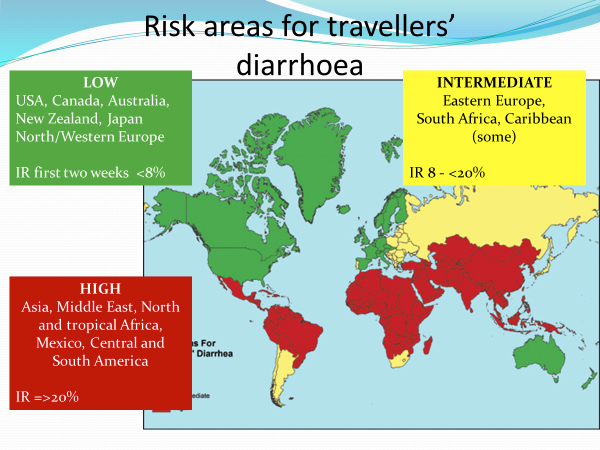
Usually low-income countries where there is a lack of sanitation, safe water supply, and poor hygiene practices, particularly in restaurants.
High risk destinations include:
- Central America
- South America
- Mexico
- Tropical Africa
- The Middle East
- Asia
Incidence
- Males = females
- More frequent in younger travellers
Prevention
Traveller education:
- Be aware of risk factors and risk-taking behaviour
- Safe drinking water
- Avoid high risk foods:
- Seafood
- Salads
- Cold meats
- Unpeeled fruit
- Hand hygiene
- Destination (see above)
- Antibiotic prophylaxis is not recommended for most travellers
Causative organisms
- Bacteria (80-90% of cases)
- ETEC (Entero-toxigenic E. coli ) the most common pathogen
- Campylobacter jejuni
- Shigella spp
- Salmonella spp
- Toxins
- S aureus
- B cereus
- Cl perfringens
- Viral (5 – 15% of cases)
- Norovirus (responsible for outbreaks particularly cruise liners)
- Protozoal
- G. lamblia the commonest pathogen
- Seldom a cause of acute diarrhoea
- Incubation period longer than bacterial and viral infections – usually presents when the traveller returns home
Mild
- The diarrhoea is tolerable
- It does not interfere with planned activities
- Few unformed stools
- No systemic symptoms
Moderate
- The diarrhoea interferes with planned activities
- It is distressing
- There are systemic symptoms
- Dysentery is absent
Severe
- The diarrhoea is totally incapacitating
- Dysentery (fever plus blood) is present
Treatment guidelines
NB: Oral rehydration is essential in all cases.
- ORS: salt/sugar compounds; commercial preparations
- Children < 2 years 1/2 cup after each loose stool.
- Children 2-10 years: 1 cup after each loose stool.
- Older children/adults: unlimited amount.
Mild travellers’ diarrhoea
- Antibiotic treatment is not recommended
- Loperamide may be considered
Moderate travellers’ diarrhoea
- Loperamide as monotherapy may be used
- Antibiotics may be used – azithromycin single dose (1000 mg) therapy or three-day dose of 500 mg per day
- Loperamide may be used as adjunctive therapy
Severe travellers’ diarrhoea
NB Travellers must seek medical attention but start treatment immediately.
- Antibiotics should be used
- Azithromycin, as single dose (1000mg) or a three-day dose of 500mg per day, is advised
For the full text, see: Journal of Travel Medicine, 2017, Vol 24, Suppl 1, S57–S74 doi: 10.1093/jtm/tax026
Mark S. Riddle, Bradley A. Connor, Nicholas J. Beeching et al. Guidelines for the prevention and treatment of travelers’ diarrhea: a graded expert panel report.
See also: CDC Yellow Book 2020. Health Information for International Travel, Chapter 2:
https://wwwnc.cdc.gov/travel/yellowbook/2020/preparing-international-travelers/travelers-diarrhea
Image: http://www.greatamericantrek.com/travellers-diarrhoea/
Last checked for updates with SASTM: Aug 2023