Treatment
This guideline provides an overview of the recommended Adult ADHD assessment steps, differentials to be considered and options for treatment according to the best available evidence based guidelines.
Cost-effectiveness of treatment
Non-pharmacological interventions
Treatment Goals
According to the WHO,59 mental health is ‘a state of wellbeing in which every individual realises his or her own potential, can cope with the normal stresses of life, can work productively and fruitfully, and is able to make a contribution to her or his community’. The initial goal of any intervention is therefore symptoms relief, followed by ongoing alleviation of symptoms accompanied by decreasing functional impairment and working towards optimal functioning. This will include the prevention and treatment of comorbid disorders, relapse prevention and the improvement of the quality of life of patients and their families.
General Aspects of Treatment
As highlighted by the British Association for Psychopharmacology (BAP) guidelines,50 Maudsley guidelines60 and Schoeman,19 a comprehensive assessment and diagnostic certainty prior to initiating pharmacological treatment is crucial and treatment should be initiated at specialist level.
Good long-term clinical care is contingent on adequate patient education about the nature of the disorder and effects of treatment. Once the diagnosis has been confirmed, clinicians should provide sufficient information to empower patients to make informed decisions with regard to treatment options and designing interventions that meet the patient’s individual needs.
Pharmacotherapy remains the cornerstone of treatment. Contrary to the treatment of ADHD in children, pharmacological interventions are always first line in adults – based on the lack of efficacy of non-drug intervention in the absence of medical treatment.60 Drug treatment should be continued as long as clinically effective and should be reviewed at least annually. Effects of missed doses, planned dose reductions and periods of non-treatment should also be evaluated.50
Although pharmacotherapy plays a primary role in the treatment of ADHD, psychosocial interventions form an integral part of a comprehensive, multi-modal, management approach for adults with ADHD. Meta-analysis and systematic reviews have confirmed the superiority of combination (pharmacological and psychosocial) interventions. A multi-modal approach is also encapsulated in international guidelines (e.g. BAP and National Institute for Health and Care Excellence (NICE)) which recommend psychosocial treatments as complementary to psychopharmacological interventions to provide support, improve acceptance of diagnosis, and treat comorbidities and residual symptoms (which do not require additional psychopharmacological treatments).
Cost-effectiveness of Treatment
Few economic evaluation studies could be traced – all of them cost-effectiveness studies in children with ADHD. In a costeffectiveness study, costs are related to a single common effect that may differ in magnitude between the alternative options or programmes61 (i.e. comparing treatment option A with treatment option B with regard to a certain outcome measure).
The first cost-effectiveness study in children with ADHD dates back to 2005.62 In this study, 579 children with ADHD were assigned to 14 months of medication management, behavioural treatment, both combined or community care. Services were tallied throughout the study, including medication, healthcare visits, behavioural treatments and rental costs. Provider specialty, total time and number of visits with providers were used to calculate costs, adjusted to FY 2000 dollars with the consumer price index. The authors found that treatment costs varied fourfold, with psychopharmacological management being the least expensive, followed by behavioural treatment, and then combined treatment. They concluded that medication only, although not as effective as combined treatment, is likely to be more cost-effective in routine treatment for children with ADHD.
Wu, Hodgkins, Ben-Hamadi, et al.63 did a systematic literature review of 13 economic evaluations of pharmacotherapies for children and adolescents with ADHD conducted between 1990 and 2011 in North America, Europe, Australia or New Zealand. There was consistent evidence that pharmacotherapies are cost-effective compared with no treatment or behavioural therapy. However, the data were not comprehensive enough to draw conclusions regarding the relative cost-effectiveness of different pharmacological agents.
Pharmacological Treatment
The first evidence for the effectiveness of stimulants in the treatment of ADHD dates back to 1937, when Bradley conducted a trial with Benzedrine in children with ADHD.64 The first double-blind placebo controlled trial in ADHD examining the efficacy of Dexedrine was done in 1967.65 Since then, many studies have been conducted and established the efficacy of both stimulant- and non-stimulant medications in the treatment of ADHD in children and adolescents, and more recently also in adults. Consistent with the catecholamine hypotheses of ADHD, the drugs that effectively treat the disorder are known to modulate catecholamine pathways.
Medications used in the treatment of ADHD include psychostimulants [e.g. methylphenidate (MPH) and amphetamines] and non-stimulants [e.g. atomoxetine, alpha2 -adrenoceptor agonists (clonidine and guanfacine), tricyclic antidepressants (TCAs), bupropion, modafinil and venlafaxine]. Enhancement of dopaminergic and noradrenergic neurotransmission in the prefrontal cortex is probable critical to the therapeutic efficacy of ADHD medication66 (see Table 1 for the pharmacological classification of medication used for the treatment of ADHD).
Although pharmacotherapy plays a primary role in the treatment of ADHD, psychosocial interventions [psychoeducation, cognitive behavioural therapy (CBT), supportive coaching or assistance with daily activities] are an integral part of management. Discussions on clinical efficacy are limited by the lack of head-to-head studies with adequate and unbiased methodology. In general, dopaminergic and noradrenergic agents can reduce the core symptomatology, though specific effects and side effects may vary between agents. Treatment choice would therefore also depend on factors such as patient preference and comorbid conditions, abuse potential, side effect profile and toxicity in overdose.
In terms of treatment, stimulants are by far the best studied (and most effective) treatment for ADHD across the lifespan.67 The three stimulants – MPH, pemoline (withdrawn from the market because of liver toxicity) and dextroamphetamine – have similar effects, with an average response rate of 70%. 8
Methylphenidate (Ritalin® IR & LA, Concerta®, HCL Douglas-methylphenidate®)
Various controlled studies have confirmed the effectiveness of MPH in about 57% of adults with ADHD.68 Meta-analyses of MPH in adults demonstrate similar drug response rates and effect sizes to those seen in children, although slightly lower. For direct comparison with placebo, effect sizes were calculated as 0.9 in favour of MPH.69 In a recent metaregression analysis of 18 studies (2045 patients),70 MPH, at a mean dose of 57.4 mg/day, had a moderate effect on ADHD symptoms compared with placebo [standard mean difference (SMD) 0.57–0.58]. MPH improved ADHD symptoms in adults in a dose-dependent fashion, with an increase in efficacy (SMD 0.11–0.12) for every 10 mg increment of MPH. In another systematic review and indirect comparison metaanalysis of 22 placebo-controlled trials of 2203 adults with ADHD,71 conventional shorter-acting stimulants had a more favourable risk–benefit ratio than longer-acting stimulants and non-stimulants in adults. Short-acting stimulants also reach effect sizes of 4.32 versus an effect size of 1.35 for longacting stimulants.
In addition to reducing the core symptoms of ADHD, stimulants improve associated features of ADHD, such as ontask behaviour, academic performance and social functioning. These effects appear to be dose-dependent and are evident across settings. In adults, emotional regulation, occupational problems and marital discord also tend to be reduced on treatment. Side effects (headache, reduced appetite, palpitations, nervousness, initial insomnia and dry mouth) are usually mild and transitory.67
The BAP guidelines50 and the NICE guidelines37 recommend stimulants, specifically MPH as the first-line treatment choice in adults. The European Network Adult ADHD (ENAA) consensus statement67 specifically recommends the use of extended release stimulants as treatment of choice for adults with ADHD. Long-lasting, extended-release formulations are preferred because of non-adherence, a lower abuse potential, fewer rebound symptoms and frequent dosing with shortacting formulations. The Maudsley guidelines recommend the use of modified-release MPH (because of the convenience of single-day dosage – therefore improving adherence) or multiple doses of immediate-release (greater flexibility in controlling time course of action and closer initial titration) as the second-line treatment for adults with ADHD. The Canadian ADHD Practice (CAP) Guidelines indicates amphetamine mixed salts (not available in SA), MPH OROS® technology and atomoxetine as the first-line treatments, whereas other MPH preparations are considered second-line options.72
Currently, combinations of immediate and extended release preparations are often prescribed in adults – where the immediate release formulations are used as ‘top-up’ when the extended release formula is wearing off. The dose of stimulants should be individually adjusted, based on efficacy and tolerability – with a general recommended dose of 1 mg/ kg.73 The range of half-lives of medications suggest that it is more practical to consider maximum dose in terms of the maximum taken at each time point, the length of effect of each dose on the control of ADHD symptoms and the number of doses required to provide sufficient control throughout the day – rather than a maximum based on mg/kg per day.67
TABLE 1: Pharmacological classification of medication used for the treatment of ADHD.
| Neurotransmitter | Mechanism of action | |||
| Noradrenaline selective | Noradrenaline and dopamine | Monoamine reuptake inhibitors | Monoamine releasing agents | Stimulant reuptake inhibitors |
| Atomoxetine | Methylphenidate d-amphetamine Lisdexamphetamine | Atomoxetine | d-amphetamine Lisdexamphetamine | Methylphenidate |
Source: Dvorsky et al.49
Lisdexamphetamine (Vyvanse®)
Lisdexamphetamine is a prodrug metabolised by red blood cells to yield its active metabolite, d-amphetamine and L-lysine.74 A number of randomised, double-blind, placebo-controlled trials and open-able long-term studies have confirmed efficacy and tolerability for adults with ADHD,75,76,77 whereas a metaanalysis confirmed an effect size of 0.8.70 Furthermore, Jasinski and Krishnan78 documented a lower liability for recreational abuse – which would position this drug as one of the treatments of choice for patients with a dual diagnosis of ADHD and a substance abuse disorder. The NICE guidelines37 recommends dexamphetamine as the second-line treatment for adults who develop intolerable side effects to MPH. Common side effects of lisdexamphetamine include insomnia and irritability, whereas dizziness, appetite suppression with weight loss, headache and other gastrointestinal side effects have also been reported. There have been post-marketing reports of psychosis, aggression, depression, exacerbation of tics and cardiovascular side effects such as palpitations, hypertension and myocardial infarction with sudden death.
Atomoxetine (Strattera®)
For adults who do not respond to stimulant treatment or who have a condition in which a stimulant is contra-indicated, the non-stimulant atomoxetine is an appropriate alternative.67 The BAP guidelines50 and Maudsley guidelines60 recommend atomoxetine as the first-line treatment in patients with comorbid SUD and as the treatment of choice in patients with comorbid anxiety disorders, severe tics or when there is a risk of diversion of medication. The NICE guidelines37 as well as ENAA67 considers atomoxetine as a second-line agent for patients with insufficient response to, or those who cannot tolerate MPH.
In a meta-analysis of atomoxetine in the treatment of ADHD in children and adolescents, non-stimulants had a significant lower effect size than those of short-acting and long-acting stimulants (0.39, 0.96 and 0.73 respectively).79 However, in a meta-analysis comparing pharmacotherapeutic options in adults with ADHD, the effect size of atomoxetine was 0.59 versus an effect size of 0.67 for stimulants. However, in a recent systematic review,80 criticism against previous studies was raised. When the duration of studies was increased, and treatment naïve patients analysed separately, the effect size of atomoxetine improved to 0.9, which is very similar to the effect size of 1.0 of MPH. In SA, atomoxetine is still being underutilised19 – which may be a reflection of lack of knowledge and experience with regard to efficacy and effectiveness. It may also reflect patients’ preference for a medication which leads to immediate results – which stimulants provide.
Side effects of atomoxetine appear reflective of increased noradrenergic tone and include dry mouth, insomnia, nausea, decreased appetite, constipation, decreased libido, dizziness, sweating and rare cases of hepatotoxicity.81
Other agents
Although other drugs such as clonidine, guanfacine, TCAs, modafanil and venlafaxine are mentioned in international guidelines as the third-line treatment for ADHD,50,67,72 none of these are registered for the treatment of adult ADHD in SA and use will be off-label – at the discretion of the treating physician. Anticonvulsants, mood stabilisers, selective serotonin reuptake inhibitors and antipsychotic drugs have not been shown to be effective for primary symptoms of ADHD. They may, however, be useful in treating some comorbid conditions that patients with ADHD have.
α2 - noradrenergic agonists: Clonidine (Dixarit®) has demonstrated efficacy in childhood ADHD, especially for cases marked by severe hyperactivity and aggression.82 However, there is an absence of literature on efficacy and tolerability in adults with ADHD.
Results from clinical trials have demonstrated efficacy for guanfacine (not available in SA) in combined (hyperactiveimpulsive-inattentive) ADHD in children and adolescents, but it appears to be less effective in the inattentive subtype of ADHD. The response rate in children was 50% – 60%. 83,84 Inadults, the effect size was comparable to placebo.85 Potentially problematic side effects include hypotension, bradycardia, dizziness, somnolence, sedation, fatigue, dry mouth, nausea and abdominal pain. Guanfacine is the only ADHD medication which is associated with moderate weight gain.
Tricyclic antidepressants: Most studies of TCAs found a moderate to robust reduction in ADHD symptomatology in children with a moderate to strong treatment effect. The more selective noradrenergic drugs, that is, imipramine (Ethipramine®, Tofranil®) and the active metabolite desipramine, are more effective and better tolerated. A target dose of 200 mg/day is indicated. TCAs have negligible abuse liability and efficacy for comorbid anxiety and depression.86
Modafanil (Provigil®): Although efficacy for this wakepromoting drug in the treatment of ADHD in children has been demonstrated,87 studies in adults failed to demonstrate efficacy in reducing ADHD symptoms.88,89
Selective serotonergic and noradrenergic reuptake inhibitors: Venlafaxine (e.g. Effexor®, Venlor®) appears to be mildly efficacious in moderating ADHD symptom, with studies indicating a measurable reduction in symptoms at doses of 75 mg/day – 150 mg/day.5,90,91
Noradrenergic dopaminergic reuptake inhibitors: Bupropion hydrochloride (Wellbutrin®) has demonstrated moderate effect in the treatment of ADHD with a 42% reduction in ADHD rating, with 52% of subjects considered responders at a mean dose of 362 mg/day.92,93,94,95 Dosing appears to be optimal at 400 mg/day – 450 mg/day and there is a delay in onset of action. In a meta-analysis96 found the number needed to treat 4.6 with a discontinuation rate no higher than placebo. In a systematic search of studies,Peterson, McDonagh and Fu71 found the pooled effect size for bupropion to be 1.87. Side effects include insomnia, edginess and a low risk for seizures. Bupropion should be considered in adults with comorbid mood disorders (depression or bipolar disorder) or SUD.
Monoamine oxidase inhibitors: Some studies97,98 have suggested effectiveness of monoamine oxidase inhibitors (such as pargyline, deprenyl and selegiline) in the treatment of adult ADHD, but their potential to cause hypertensive crisis and the dietary restrictions pertaining to tyraminecontaining foods, seriously limit their use.99,100
Non-pharmacological Interventions
Psychotherapy
Pharmacotherapy alone is not sufficient to stabilise the many problems of adults with ADHD, nor does current research support the efficacy of psychotherapeutic treatments as sole treatment for adult ADHD.68 The multimodal treatment study in ADHD101 has confirmed definitive evidence for the beneficial effect of psychotherapeutic interventions in childhood ADHD. However, evidence in adult ADHD is sparse. Various forms of structured, intensive and skills-based treatment may improve the likelihood of attaining remission, especially when combined with medication.53 The effects of therapy on the core symptoms of ADHD seem substantial, with potential effects on comorbid symptoms.
The NICE guidelines,37 ENAA67 and BAP guidelines50 recommend a multi-modal treatment approach with psychosocial treatments as complementary to psychopharmacological interventions to provide support, improve acceptance of diagnosis, and treat comorbidities and residual symptoms (which do not require, or do not tolerate, additional psychopharmacological treatments).
Although different approaches have been used, the majority of evidence is for structured CBT interventions, with modified CBT plus medication demonstrating greater benefits than psychotherapy or medication alone particularly on the core symptoms of ADHD, with lesser effect on anxiety and depression.102,103 CBT strategies are focused on improving the core symptoms of ADHD through self-instructional training and memory aids to improve attention, techniques to reduce impulsivity (e.g. ‘stop and think’), diaries and time schedules to improve organisational skills, and assertiveness and social skills training to improve communication skills. Group and individual CBT demonstrated similar outcomes.104
Mindfulness awareness therapy is a complementary intervention that not only improves affect and mood regulation in adults with ADHD, but also sustained attention and quality of life.105 There is also some evidence for the use of dialectical behaviour therapy,106 psychoeducation and organisational skills teaching107 and cognitive remediation programmes.108 Cognitive remediation provides techniques focussing on retraining cognitive function, teaching internal and external compensatory strategies, and restructuring the physical environment to maximise functioning. However, it is important to note that skills-based therapy and psychodynamic therapy109 may have a negative effect on self-esteem.
Formal studies of the effectiveness of coaching and psychoeducation have not been performed, but many adults with AHDD report that they gain benefit from these approached. Coaching is a structured, supportive therapy that can be offered individually or by group sessions. The purpose of coaching is to learn new problem-solving skills for identified practical problems.
It is optimal to pursue an individually tailored problemoriented approach to psychosocial interventions. This may include individual, family, and group therapy, social skills training, occupational therapy and liaison with employees and academic institutions, and coaching.
Neurofeedback
Neurofeedback (NF) has been investigated as a possible alternative treatment for ADHD in children.110 NF is thought to reduce behavioural problems associated with the core symptoms of ADHD through enabling the patient to acquire skills to self-regulate certain brain activity patterns. In a meta-analysis, large effect sizes for impulsivity and inattention, and a medium effect size for hyperactivity were reported for theta and beta, sensorimotor rhythm and slow cortical potentials (SCP) protocols in ADHD.111 A recent study112 has evaluated the effectiveness of 30 sessions of SCP NF in 24 adults with ADHD. In this study, significant symptom reduction (self-rated and third-party rated) was observed with medium to large effect sizes after treatment and 6 months post treatment with regard to clinical symptoms, as well as reaction time, reaction time variability and contingent negative variation. Fourteen participants experienced a symptom reduction of over 25% and symptoms of six participants remitted, that is, they did not meet criteria for an ADHD diagnosis anymore. However, in a systematic review and meta-analyses of randomised controlled trials,113 NF did not demonstrate any statistically significant improvement on ADHD measures with blinded assessment in placebo- and non-placebo controlled trials.
Exercise
A recent meta-analysis investigating the effects of acute exercise on cognitive performance in healthy adults revealed that cognitive performance, particularly executive functioning tasks, was improved after 20 minutes of exercise.114 In humans and in animal models, exercise has been found to have wide-ranging cellular, structural, functional and cognitive benefits. These include enhanced frontal lobe volume, executive functioning, brain-derived neurotrophic factor (BDNF) levels, cerebral blood flow, and dopamine and other monoamine modulation.115
There is also growing body of research indicating positive effects of acute aerobic activity and longer-term activity on neuropsychological function in ADHD. Existing studies examining effects of physical activity on ADHD have generally studied children and adolescents, with some emerging work in adults with ADHD. Studies have shown that in children with ADHD, moderate-to-vigorous physical activity improves planning, and working memory, inhibitory control, novel problem-solving, processing speed and academic performance,116,117,118,119 whereas acute high intensity physical activity can improve sustained attention independent of stimulant treatment.120
In adults with ADHD, there is preliminary evidence that individuals who report more frequent physical activity experience reduced impulsivity, worry and intrusive thoughts,18 whereas acute moderate intensity exercise facilitated performance on executive functioning.121,122 Although specific recommendations regarding frequency, intensity or duration of exercise in ADHD have not been established,123 there is growing consensus that regular exercise engagement is a powerful nonpharmacological treatment for management of ADHD symptoms and promotion of cognitive health.
Complementary and alternative medications
In a systematic review and meta-analyses of randomised controlled trials of dietary and psychological interventions,113 2904 published randomised controlled trials of dietary (restricted elimination diets, artificial food colouring exclusion and free fatty acid supplementation) and psychological interventions (attention and working memory training, cognitive training, NF and behavioural interventions) for ADHD were screened. Of these, 54 trials met inclusion criteria for the analysis. Two different analyses were performed: one where the outcome measure based on ADHD assessments was completed by parents or teachers, and the other where the best possible blinded assessments (i.e. placebo- and non-placebo controlled trials where the assessments were made by individual blinded to treatment) of improvement on ADHD measures were included. Although all dietary and psychological interventions produced statistically significant effects, in the latter group only free fatty acid supplementation and artificial food colouring exclusion remained significant. It therefore seems that free fatty acid supplementation produced small but significant reductions in ADHD symptoms even with probably blinded assessments, although the clinical effects of these effects remain to be determined. Artificial food colouring exclusion produced larger effects but often in individuals selected for food sensitivities.
N-3 omega-3 polyunsaturated fatty acids (n-3 PUFAs) are promoted as cognitive enhancers in the general population, as well as for patients with neurocognitive deficits such as ADHD. In a recent systematic review and meta-analysis,124 only marginal evidence was found for n-3 PUFA supplementation in those who are n-3 PUFA deficient. No significant benefit was found for the general population, nor those with ADHD.
Although many individuals, with and without ADHD, report benefits from ‘brainsmart food’ such as mentat, zinc, l-carnitine, vitamin B6, magnesium, ginkgo biloba, ginseng, passionflower, acetyl l-carnitine(ALCAR), dimethylethanolamine (DMAE), L-theanine, dosahexaenoic acid (DHA), citicoline, curcumin, phosphatidylserine, vincopetine, L-alphaglycerylphosphorylcholine, bacopa monnieri and huperzine A, formal studies of the effectiveness of these agents are lacking. At present, there is no consistent evidence from randomised control trials for the use of any food supplements.67
Algorithm
See Figure 1 and Table 2.
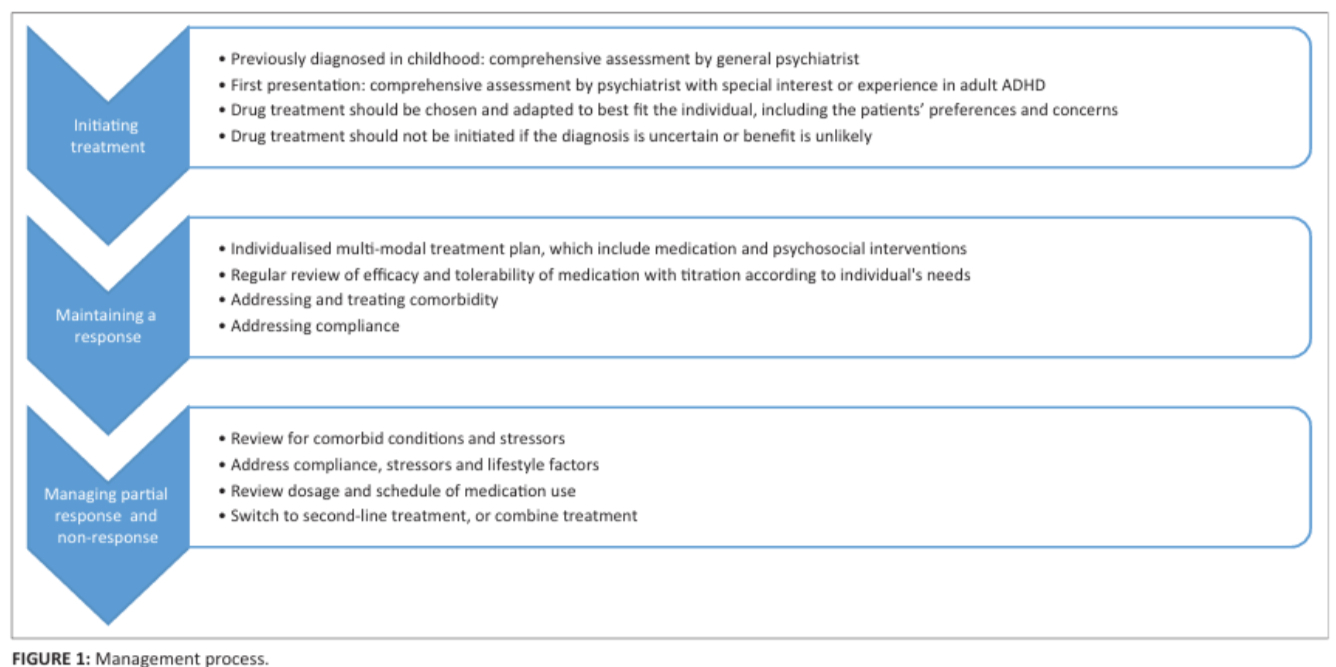
TABLE 2: Medication schedule.
| Substance | Trade name | Formulation | Dosing strategy |
| Methylphenidate |
Ritalin® IR Ritalin® LA Concerta® |
Immediate release. Extended release. |
Approximately 1 mg/kg/dose. Initiate at 5 mg bd or tds with daily or weekly increments according to efficacy and tolerability (max 100 mg/day po) Once or twice daily dose at equivalent of total daily dose of IR Once or twice daily dose at equivalent of total daily dose of IR. |
| Atomoxetine | Strattera® | Available in 10 mg, 18 mg, 25 mg, 40 mg, 60 mg and 80 mg capsules | Initiate at approximately 0.5 mg/kg/day in patients 70 kg initiate at 40 mg/day with monthly increments of 20 mg/day to a maximum of 100 mg/day (maintain at least for 12 weeks before judging clinical response) |
| Lisdexamphetamine | Vyvanse® *not available in South Africa | Available in 10 mg, 20 mg, 30 mg, 40 mg, 50 mg, 60 mg and 70 mg capsules | Initiate at 30 mg/day po. May be adjusted in increments of 10 mg or 20 mg at approximately weekly intervals up to maximum dose of 70 mg/day. In patients with severe renal impairment, the maximum dose should not exceed 50 mg/day po. |
| Bupropion | Wellbutrin® | Available in 150 mg slow release and 150 mg and 300 mg extended release tablets | Initiate at 150 mg/day po. Dosage may be adjusted in increments of 150 mg approximately monthly intervals up to maximum dose of 300 mg/day. |
| Venlafaxine | Effexor® Venlor® |
Available in 75 mg and 150 mg extended release capsules | Initiate at 75 mg/day po. Dosage may be adjusted in increments of 75 mg at approximately monthly intervals up to maximum dose of 450 mg/day. |
| Imipramine/Desipramine | Tofranil®, Ethipramine® | Available in 10 mg and 25 mg tablets | Initiate at 20 mg to 70 mg/day (10 mg in elderly patients) and increase gradually to a maintenance dose of 100 mg to 150 mg/day po (50 mg in elderly patients) |
| Clonidine | Dixarit® | Available in 0.025 mg tablets | Initiate at 0.025 mg bd po and increase gradually to a maximum dose of 0.075 mg bd po. |
| Modafinil | Provigil® | Available in 100 mg tablets | Initiate at 100 mg/day po. Can be increased to 200 mg/day po. |
Special Populations
Comorbidity
The order of treatment of ADHD and comorbid disorders depends on the severity of the different disorders and clinical judgement on which disorder is driving the current level of behavioural impairments or mental state changes. The presence of comorbidity increases the likelihood of the need for combination therapy – both in terms of psychopharmacological agents and psychotherapeutic approaches. In initiating medication for comorbid conditions, an individualised approach with regard to effectiveness, riskbenefit profile and tolerance should be considered.
In the presence of comorbid disorders, a risk assessment should be done. Severe mood disorders, severe anxiety disorders (with panic attacks) and psychotic disorders should be treated prior to treating ADHD. Milder disorders (e.g. mild depression and anxiety) may be deferred until after treatment of ADHD as treating the ADHD might alleviate other symptoms.67 A sequential approach to initiating medication is recommended. In the case of psychotic disorders or severe bipolar disorders, stimulants should be used with caution.
Patients with ADHD and comorbid SUD often present with more severe SUD characterised by early onset, extended duration of the SUD, greater impairment and shorter transition from substance use to dependence. In cases of comorbid SUD, the SUD can be treated either before initiating treatment for ADHD, or simultaneously. Close supervision is advised when treating ADHD patients with SUD with stimulants and in cases where diversion or abuse is a particular concern, atomoxetine may be selected as the firstline treatment. The concerns of some professionals that use of stimulants in ADHD may lead to drug abuse either by sensitisation or as a gateway to other drugs is not supported by evidence. Long-acting stimulants with a lower abuse potential, lisdexamphetamine and bupropion are preferred over short-acting stimulants. Concomitant psychosocial interventions are crucial.
Pregnancy and lactation
All the stimulants, atomoxetine, bupropion, modafinil and other pharmacological agents discussed in these guidelines (see section Pharmacological treatment) are considered ‘category C’ by the FDA, that is, animal studies have reported some harm, without having any robust evidence in human studies.125 Although continuation of treatment during pregnancy may therefore pose a risk to the child, discontinuation may increase harmful behaviours related to the mother’s mental state.50 It is therefore important to consider the risk–benefit profile of not treating the mother, for example, poor risk management, dangerous driving, illicit drug use, alcohol and tobacco use, increased levels of distress and self-injurious behaviour. Non-pharmacological strategies should be explored, and liaison with the obstetrician is important.
Click here for the ADHD Treatment Armamentarium in South Africa
Schoeman R, Liebenberg R. The South African Society of Psychiatrists/Psychiatry Management Group Management Guidelines for Adult Attention-Deficit/ Hyperactivity Disorder. S Afr J Psychiat. 2017;23(0), a1060. https://doi.org/10.4102/sajpsychiatry.v23i0.1060 - An Update on the ADHD Treatment Armamentarium in South Africa., Prof Renata Schoeman
South African Journal of Psychiatry; The South African Society of Psychiatrists/Psychiatry Management Group the Management Guidelines for Adult Attention-Deficit/ Hyperactivity Disorder, 28 April 2017_An Update on the ADHD Treatment Armamentarium in South Africa, 2023