Treatment
These are the approved guidelines published by the South African Society of Psychiatrists to provide an overview on treatment and management of commonly diagnosed psychiatric illnesses. The guidelines include consensus recommendations, based on peer contribution and using the international evidence based guidelines that are suitable for the local South African health service.
Please note that parts of this guideline may be out of date, an update will be published as soon as it is available.
Managing partial and non-responders
Treatment goals in PTSD
There are several specific goals of treatment that should all be borne in mind: reducing symptom severity; preventing the occurrence of, and/or treating, comorbid disorders; decreasing functional impairment; modifying pathogenic fear schemas; building resilience; preventing relapse; and improving quality of life of patients.[10] The most common definitions of treatment response in PTSD patients are a decrease of 30% or more[11] in the Clinician Administered PTSD Scale (CAPS) score[12] or a score of 1 (‘very much’) or 2 (‘much improved’)[13] in the Clinical Global Impressions Scale-Improvement item (CGI-I).[14]
General aspects of treatment
The treatment of PTSD has been the subject of several recent meta-analyses and systematic reviews. Several treatment guidelines are available and these together have informed the treatment guideline that is recommended here. They include guidelines from the World Federation of Societies of Biological Psychiatry,[15] the US Institute of Medicine (IOM),[16] the American Psychiatric Association,[17]the UK National Institute of Clinical Excellence (NICE),[18] the Australian National Centre for PTSD,[19] the British Association for Psychopharmacology,[20] and the International Psychopharmacology Algorithm Project (IPAP).[7] All of these guidelines acknowledge that there are two distinct approaches that are of proven benefit in PTSD: pharmacological and psychotherapeutic. Therefore, the first choice to be made is whether to offer medication, psychotherapy, or both. Psychotherapeutic treatments, if not used initially, can be added to, or replace pharmacotherapy.
Chronic PTSD is defined as PTSD of more than 3 months’ duration. Most treatment guidelines recommend the use of either selective serotonin reuptake inhibitors (SSRIs) or exposure-based, trauma-focused cognitive-behaviour therapy (TF-CBT) as first-line therapy. However, it should be mentioned that both the US IOM guidelines[16]and the UK NICE guidelines[18] on the sum of data suggest that evidence for the efficacy of pharmacological therapies, namely SSRIs, is at best tentative. The NICE guidelines,[18] for example, do not recommend drug treatments as a routine first line for adults with PTSD (for prescription either by a general practitioner or psychiatrist), but rather advocate for the use of TF-CBT.
Acute treatment
An adequate trial requires 6 - 12 weeks, but the clinician should expect some response after 4 - 6 weeks with adequate dosage. A minimum course of exposure-based, TF-CBT is 8 - 12 weekly or biweekly sessions for exposure to a single-incident trauma. More sessions may be required in instances of multiple traumatic exposures or the presence of comorbidity.
Maintenance treatment
PTSD is a disorder that is characterised by symptom persistence and long-term treatment for at least 12 - 24 months is recommended. The SSRIs and the serotonin-norepinephrine reuptake inhibitor (SNRI), venlafaxine, have demonstrated long-term efficacy.
Pharmacological treatment
The SSRIs and SNRIs are the two groups of antidepressants that have, to date, been the most rigorously studied in placebo-controlled randomised controlled trials (RCTs) and are considered as first-line agents for PTSD. Long-term efficacy (treatment for at least 12 - 24 months) has also been demonstrated with both classes of agents.[15]
Of the SSRIs, paroxetine, sertraline and fluoxetine currently have the best evidence for efficacy.[7,15-17] Paroxetine and sertraline are the only two that are US Food and Drug Administration (FDA) indicated for PTSD. In a meta-analysis of 35 RCTs (of 14 weeks or less in duration) involving a total of 4 597 participants, evidence for efficacy was most convincing for the SSRIs, across all symptom clusters and for co-occurring depression and disability.[13] However, the SSRIs as a class seem to be less effective in combat-related PTSD than in non-combat-related PTSD.[17] Even when treated with this class of agents, response rates in PTSD rarely exceed 60% after a first trial of medication and less than 20 - 30% of patients achieve full remission.[7,15-17] This suggests that currently available, efficacious agents still fall short of the ideal because of limited response and remission rates, and tolerability issues.
Non-pharmacological treatment
There are now more than 50 published RCTs examining the efficacy of CBT for PTSD.[20] TF-CBT has the best established research base of well-designed RCTs. Prolonged exposure has been found to be highly effective in the treatment of women with PTSD following sexual or physical assault. A minimum course of 8 - 12 weekly or biweekly sessions is recommended.
The components of CBT associated with the largest treatment effects are cognitive therapy (CT) and prolonged exposure; they have been shown to be superior to waitlist, supportive counselling, non-specific therapies; and treatment as usual.[21] Eye movement desensitisation and reprocessing (EMDR) which combines imaginal exposure with lateral eye movements, like exposure and CT, also has established efficacy, but critics of this procedure cite poor methodological quality and evidence that the procedural component, which is purported to differentiate it from exposure, is in fact ‘inactive’.[22] A recent Cochrane review[22]concluded that EMDR was more effective than traditional therapies or no therapy but not different from CBT and stress management.The IOM found the quality of the body of evidence for EMDR to be too low to inform conclusions regarding treatment efficacy.[16]
Special populations
Pregnancy and lactation
The risks of drug treatment during pregnancy need to be weighed against the risks of withholding treatment for PTSD. During the first trimester, SSRIs do not increase the risk of birth defects; the exception to this is paroxetine, which is associated with a 1.5-fold increased risk of congenital heart defects.[23] Clinical guidelines recommend that paroxetine be discontinued during pregnancy. SSRIs taken after 20 weeks’ gestation may be associated with an increased risk of persistent pulmonary hypertension in the neonate, and all antidepressants administered in the third trimester may cause discontinuation effects (e.g. increased muscle tone, irritability, disrupted sleep, jitteriness) although these tend to be mild and self-limiting. Newer antidepressants, such as venlafaxine, have been associated with poor neonatal adaptation syndrome (tremors, irritability, shivering, feeding disturbances, increased muscle tone, respiratory difficulties) although it is unclear whether this is the result of medication withdrawal or toxicity. Treatment is supportive and symptoms usually resolve within 2 weeks. Tricyclic antidepressants (TCAs) are regarded as relatively safe in pregnancy although there is an increased risk of preterm delivery compared with SSRIs or no antidepressants. Desipramine is the preferred TCA during pregnancy owing to its relatively weak anticholinergic effects.[24] Lithium (Ebstein’s anomaly) and antiepileptic medications such as carbamazepine (neural tube defects, craniofacial defects, cardiac malformations) and valproate (neural tube defects, spina bifida, pulmonary atresia) carry an increased risk of birth defects. To date, lamotrigine has not been associated with intrauterine growth defects or neurobehavioural toxicity. No significant risk of teratogenicity with the older atypical antipsychotics (olanzapine, risperidone, quetiapine) has been documented. However, the aforementioned antipsychotics are associated with maternal hyperglycaemia, impaired glucose tolerance and weight gain which could contribute to maternal complications during pregnancy.[24]Newer atypical antipsychotics (e.g. aripiprazole, ziprasidone) have been associated with delays in skeletal ossifications, increased fetal weight and fetal mortality. Long-term safety data on the use of antidepressants in pregnancy are lacking. Important factors to consider include the time between medication administration and feeding, and infant size and infant metabolism. Most SSRIs do not attain detectable levels in breastmilk and are not associated with disturbed infant development or neuropathology. Sertraline and paroxetine may be good choices for lactating women as these SSRIs have specifically been associated with undetectable levels in infants. TCAs have been associated with few adverse effects in breastfed infants, while newer antidepressants such as venlafaxine and mirtazapine are considered to be moderately safe.
Children and adolescents
Young children with PTSD, rather than reliving the trauma through repeated intrusive memories, may re-experience the trauma through repetitive play. Avoidance phenomena may also be more difficult to elicit in very young children who may struggle to verbalise their experiences. In addition to PTSD and acute stress disorder (ASD), traumatised children and adolescents may have a broad range of other psychopathological outcomes, in particular mood and anxiety disorders, behavioural disorders (e.g. attention-deficit hyperactivity disorder, conduct disorder), and substance use disorders. As with adults, interventions comprising psychotherapy (e.g. TF-CBT, family therapy) and pharmacotherapy (e.g. SSRIs, alpha-adrenergic agonists) are used. Practice parameters developed by the American Academy of Child and Adolescent Psychiatry[25] recommend that the treatment of mild PTSD begin with TF-CBT. Treatment studies suggest 12 sessions of TF-CBT where PTSD is uncomplicated, but a number of children and adolescents may require longer-term treatment. Currently little is known about the effectiveness of pharmacotherapeutic agents in paediatric PTSD as there have been few controlled studies of SSRIs. Children and adolescents with more severe PTSD and with comorbid mood and anxiety disorders are likely to benefit from an SSRI.[25]
The elderly
The assessment and treatment of PTSD may pose challenges for psychiatrists involved in treating PTSD in older adults. Specific symptom profiles may differ in the older adult, particularly in those individuals with chronic PTSD. Distress when exposed to trauma-related cues appears to be potentially salient and it is possible that this symptom motivates other features of PTSD in older adults, such as avoidance and emotional numbing.[26] This constellation of symptoms may lead to misdiagnosis, for example, major depression or dysthymic disorder. Several factors should be considered when selecting a medication for an older patient with PTSD. These include prior treatment response, target symptoms, concurrent physical illness and medications, and drug tolerability. In order to reach the optimal dose for an older patient without causing intolerable side-effects, it is well worth remembering the adage ‘start low and go slow’. Important considerations in pharmacological treatment also include the heightened sensitivity for anticholinergic drug effects, increased sensitivity for extrapyramidal symptoms, an increased risk for orthostatic hypotension and electrocardiograph changes, and the possibility of paradoxical reactions (e.g. aggression) to benzodiazepines. SSRIs have been shown to be relatively safe in the elderly and are generally better tolerated than TCAs. Recommended doses of SSRIs for PTSD are the same as for younger adults. However, the potential for SSRIs to cause gastrointestinal and other bleeds, hyponatraemia, postural hypotension, and falls needs to be borne in mind in this age group.
Managing partial and non-responders
See steps 3 and 4 of algorithm below.
Algorithm
Step 1. Initiating treatment
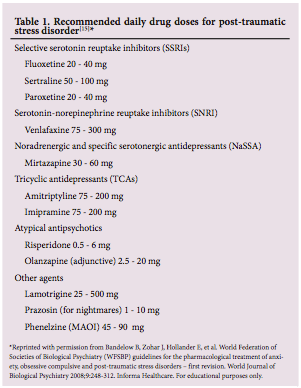
The starting dose can be low (fluoxetine 10 - 20 mg; sertraline 25 - 50 mg; paroxetine, 10 - 20 mg; venlafaxine 37.5 - 75 mg). Other SSRIs include citalopram (10 - 20 mg), fluvoxamine (25 - 50 mg) and escitalopram (5 - 10 mg), for which there is less evidence. Based on currently available data for the SSRIs and SNRIs, statistically and clinically significant improvement is often seen by weeks 2 to 4. An adequate trial typically requires 6 - 12 weeks at an adequate dosage (e.g. fluoxetine 20 - 40 mg; sertraline 50 - 100 mg; paroxetine 20 - 40 mg), but some response should be expected after 4 - 6 weeks.[7]
Other antidepressant options for which there is less robustevidence include mirtazapine, bupropion, and nefazodone. The older antidepressants, such as TCAs, e.g. amitriptyline, imipramine and the monoamine oxisase inhibitors (MAOIs, e.g. phenelzine) have demonstrated efficacy in placebo-controlled studies that have primarily included individuals with combat-related PTSD. In light of the safety profiles and concerns of toxicity with these agents (cardiotoxicity, seizure risk, and anticholinergic effects with the TCAs, and dietary restrictions and risk of hypertensive crisis with the MAOIs), they should preferably not be used as a first or second choice.[7,15-17] Table 1 lists recommended drug doses.[15]
Step 2. Maintaining a response
It is important to note that while many patients will experience symptom improvement within 12 weeks with at least a 50% reduction in PTSD symptoms, further improvement in core symptoms, disability, and overall functioning often occurs with continued treatment. If a patient is adequately responsive (at least a 50% improvement) after 12 weeks of treatment and demonstrates no intolerance, medication should be continued for at least 1 - 2 years .
Step 3. Managing partial response
If the patient is only partially responsive to the first trial of medication (25 - 50% or more reduction in symptoms), it is prudent firstly to optimise the dose of medication (i.e. titrate up to the maximum allowed or tolerated dose). Before doing this, it is important to reassess for persisting core PTSD symptoms (intrusion, avoidance, numbing, and hyperarousal), sleep disturbances, other PTSD symptoms (e.g.irritability, hostility, aggression, panic, psychotic symptoms), bipolar spectrum disorder, and substance abuse.[7]
These ongoing symptoms can be saliently targeted through augmentation strategies although it must be noted that the evidence-base for augmentation strategies is limited. For example, olanzapine and risperidone (for which there is double-blind, placebo-controlled evidence for efficacy) can be used to target associated psychotic symptoms (e.g. paranoid ideation), and aggression. It is important to mention that since augmentation studies of antipsychotics were essentially short-term trials, the possibility of occurrence of severe adverse effects (viz. metabolic effects, cardiac effects, tardive dyskinesia) remain a concern. Anticonvulsants (e.g. valproate, lamotrigine, carbamazepine, topiramate), given their well-known anti-kindling properties, may also be effective as augmentation for symptoms of irritability, impulsivity, labile mood, and anxiety, while alpha-1 inhibiting agents (e.g. prazosin, guanfacine) have shown promise in the treatment of nightmares, insomnia and other sleep-related disturbances in PTSD.[27] Hypotension, syncope and tachycardia are potential side-effects with prazosin; hence medical history, risks of hypotension and blood pressure monitoring should be considered. No data exist on the efficacy of benzodiazepines as augmentation treatment, although there are some data indicating their lack of efficacy as monotherapy (e.g. alprazolam) in chronic PTSD.[28]
Exposure-based, TF-CBT (8 - 12 sessions) may also be considered as an augmentation strategy at this point. However, there are currently no published controlled studies of combined pharmacotherapy and psychotherapy in PTSD.
Step 4. Managing non-response
If there is no response (i.e. less than 25% improvement) to an SSRI and core PTSD symptoms persist after 4 - 6 weeks of an adequate medication dose (e.g. fluoxetine 40 mg/day, sertraline 150 mg/day), then it is advisable to switch to another SSRI, SNRI, or noradrenaline and specific serotonergic antidepressant (NaSSA) such as mirtazapine, bupropion; or alternatively to augment the same medication with another agent. The choice of an augmentation agent will depend on the presence of comorbid disorders; for example, the presence of a comorbid anxiety or mood disorder would probably necessitate the utilisation of an agent (e.g. antidepressant) that is effective for both PTSD and that disorder.[20] It is not known whether a sequential trial of a second SSRI is as effective as switching to an SNRI or NaSSA after the first unsuccessful SSRI trial.[20] If there is still no response after 6 - 12 weeks, then it is recommended that one add an atypical antipsychotic, anticonvulsant, a TCA, or CBT. If the patient fails on all of the above, it is essential at this point to re-evaluate the diagnosis and to consider switching (e.g. to a TCA or MAOI if these have not been tried already) or to add a third medication.
Early interventions for PTSD
TF-CBT is the only early intervention (i.e. given 1 - 3 months after trauma) that at the present time has convincing evidence of efficacy in ASD and acute PTSD.[20] There is no good evidence that psychological interventions (i.e. psychological debriefing), either single or multiple sessions, given routinely to everyone following a traumatic exposure, irrespective of symptoms, work. At present there is no conclusive evidence for the use of drug treatments to prevent PTSD in the early aftermath of trauma. Benzodiazepines are frequently prescribed in the aftermath of a traumatic event to control associated nonspecific behavioural disturbances (e.g. marked anxiety or agitation, insomnia) and/or to reduce active post-traumatic symptoms (e.g. hypervigilance). However, there is no compelling scientific evidence of the effectiveness of benzodiazepines either in the prevention of PTSD or in the treatment of core PTSD symptoms once they have developed.[22] In fact, there is evidence to indicate that benzodiazepines may contribute to the development and/or chronicity of PTSD symptoms.[28,29]