Treatment
These are the approved guidelines published by the South African Society of Psychiatrists to provide an overview on treatment and management of commonly diagnosed psychiatric illnesses. The guidelines include consensus recommendations, based on peer contribution and using the international evidence based guidelines that are suitable for the local South African health service.
Please note that parts of this guideline may be out of date, an update will be published as soon as it is available.
Acute pharmacological treatment
Managing partial and non-responders
Treatment goals
Therapeutic goals are to relieve symptoms, prevent relapse, promote recovery and improve quality of life.[6] More specifically, this includes:
- Achieving and maintain symptom alleviation
- Achieving and maintain treatment adherence
- Minimising treatment side-effects
- Monitoring physical health and drug-specific adverse event risks, e.g.
- White cell count (WCC) (acute neutrophil count) with clozapine
- Metabolic syndrome risk factors with olanzapine
- Tardive dyskinesia with haloperidol
- Managing smoking and substance abuse
- Managing risk of harm to self and others.
General aspects of treatment
At the outset of management, an integrated treatment plan including pharmacological, psychological and social interventions should be formulated in terms of available resources. Pharmacological treatment remains the mainstay of therapy, while psychosocial interventions are crucial in promoting recovery and improving quality of life.[6]
While both the classification and relative efficacies of the so-called ‘typical’ first-generation antipsychotic (FGA) agents, such as haloperidol and chlorpromazine, and ‘atypical’ second-generation antipsychotic (SGA) compounds, such as risperidone and olanzapine, remain controversial, current evidence supports the following:
- Drugs from both groups are equally effective in alleviating psychosis[8]
- SGAs may have benefit in negative syndromes, and with mood and cognitive impairments[4]
- Where differences exist, the effect sizes are small to modest, except for clozapine which is more effective in treatment resistance and reducing suicide risk[4]
- SGAs, largely because of less severe extrapyramidal side-effects(EPS), are more tolerable[9]
- Each drug has a unique side-effect profile
- The choice of drug is informed by[6]
- Access and availability
- Shared patient-centred decision making
- Previous experience (efficacy and side-effects), if any
- Tailoring the side-effect profile to the individual patient
- Choice of mode of administration (oral or parenteral)
- Recommended dosage is in the range of 300 - 1 000 mg chlorpromazine (CPZ) equivalents.[4]
Oral therapy is advised. Should parenteral therapy be considered for maintenance on the basis of patient preference or convenience or to manage non-adherence, this can be planned in the acute phase. It is logical to convert from an effective oral agent to its parenteral equivalent, and a test dose of the oral equivalent of the agent should be used before administering a long-acting injectable antipsychoticagent.
Monotherapy is recommended. There is no advantage to combining antipsychotics, which should only be done for short periods when switching agents, or in treatment-resistant settings.[4,6] Doses should not exceed 1 000 mg CPZ equivalents and/or the manufacturer’s instruction as there is no additional therapeutic benefit in doing so, with added cost and side-effects.[4,6]
Loading doses or ‘rapid neuroleptisation’ is ill-advised as it confers no therapeutic benefit with added risks.[6] Adjunctive benzodiazepines (the evidence supports lorazepam[10]) can be used liberally to attenuate disruptive behaviour in the acute setting.[4]
Continuous dosing is advised, as intermittent or targeted dosing leads to increased risk of relapse.[4] A trial of 4 - 6 weeks is required before considering another agent.[4,6,11]
Acute pharmacological treatment
First episode
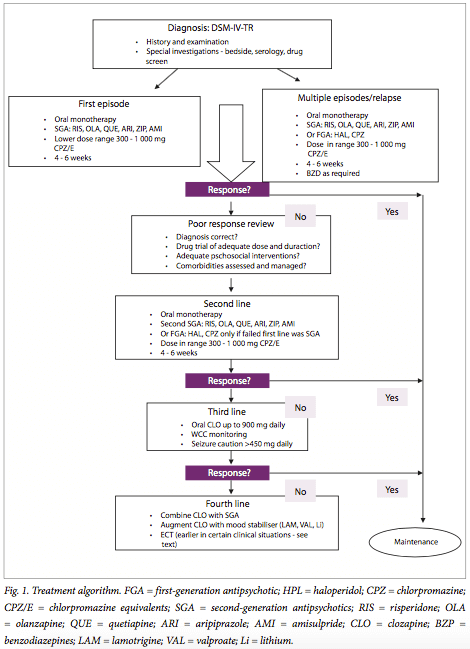
A recent meta-analysis[12] found no differences between FGAs and SGAs in efficacy in this population, but a clear difference in side-effect profile. In view of the vulnerability of drug-naive first-episode psychosis patients to develop EPS and tardive dyskinesia, the drug of choice is an SGA other than clozapine. Risperidone, olanzapine, quetiapine, aripiprazole, ziprasidone and amisulpride are supported by the evidence base.[4,6,13] Dosing should start low with incremental upward titration, with the target dosage at the lower end of the therapeutic range for each agent according to the package insert.[6]
Multi-episode/relapse
The drug of choice will be influenced by any prior agents’ efficacy and tolerability. If SGAs are available, they are generally preferred and risperidone, olanzapine, quetiapine, aripiprazole, ziprasidone and amisulpride are supported by the evidence base.[13] Haloperidol and chlorpromazine are FGA alternatives.
Second-line treatment
If response to the first-line agent above is unsatisfactory, then a second trial should be considered after review of potential contributors to non-response.[6]
This second-trial agent can be another SGA or an FGA, but should be an SGA if there was a failed response to an FGA in the first trial.[4,6] Switching strategies includes cross-titration, overlap-and-taper, and abrupt change. Other than for switching to clozapine (see below), there is no evidence of difference in efficacy or tolerability.[14]
Oral monotherapy at doses not exceeding 1 000 mg CPZ equivalents and/or the manufacturer’s recommendation in a continuous dosing strategy is advised for a further 4 - 6 weeks before considering the third line of treatment.[4,6,11]
Third-line treatment
Clozapine oral monotherapy is the next treatment of choice, at the highest tolerable dose (≤900 mg daily) for 6 months.[11] Switching requires tapering and stopping the extant agent prior to initiating clozapine, to minimise haematological risk.
Because of a non-dose-dependent risk of agranulocytosis, WCCs –absolute neutrophil counts in particular – should be monitored prior to treatment, weekly for the first 18 weeks and monthly thereafter. Considering the risk of dose-related seizures, caution and careful monitoring should be exercised at doses above 450 mg daily.[15]
Long-term maintenance
Half of all patients stopping medication will relapse within 6 -10 months, compared to one-fifth on treatment.[6] Long-term antipsychotic treatment reduces the risk of relapse over several years by two-thirds.[16]
Continuation of pharmacological treatment that was effective in the acute and stabilisation phases is advised. While many practitioners attempt dose reduction during maintenance, the evidence suggests that even gradually decreasing doses increases the risk of relapse.[17] Continuous dosing is advised as intermittent or targeted dosing leads to increased risk of relapse.[4]
Oral therapy is usual, but long-acting intramuscular preparations should be considered for maintenance on the basis of patient preference or convenience, or to manage non-adherence.
The minimum duration of treatment for first-episode patients is 1 year symptom-free if the episode is of mild severity and responds well to treatment, and 2 years symptom-free in severe cases or those slow to respond initially.[17] Second-episode patients require at least 2 and up to 5 years symptom-free before drug withdrawal can be considered. Indefinite treatment is advised after a third episode.[17]
Non-pharmacological treatment
Psychological interventions
These are focused on the individual (cognitive behaviour therapy, psycho-education, supportive psychotherapy) and the family (psycho-education, family therapy). These can be introduced during the acute phase of illness, but are more usually commenced in the stabilisation period.[6]
Social interventions
Long-term goals of treatment adherence and symptom reduction, limitation of injurious behaviours (smoking, substance abuse, suicide risk) and improved quality of life are supported by social interventions, including assertive community programmes, social skills training, appropriate housing, supported employment and adaptation to life in the community. These may be required during the acute phase of illness, but are more usually commenced in the stabilisation period.[6]
Special populations
First-episode psychosis
In view of the vulnerability of drug-naïve first-episode psychosis patients to develop EPS and tardive dyskinesia, the drug of choice is an SGA other than clozapine. Dosing should start low with incremental upward titration, with the target dosage at the lower end of the therapeutic range of each agent according to package insert.[6] Oral therapy is recommended.
Electro-convulsive therapy (ECT)
While ECT is considered a last-line treatment[4] in uncomplicated schizophrenia, it has a role in early acute treatment in the context of extreme psychomotor agitation, catatonia, pregnancy, or when life is at risk.
Managing partial and non-responders
Non/partial response
If response to any line of treatment is unsatisfactory, then a further line of intervention should be considered after review of potential contributors to non-response.[6] This includes:
- Review of the diagnosis
- Review of treatment adherence
- Drug choice
- Dosage
- Duration
- Adequacy of psychosocial interventions
- Presence of comorbid:
- Substance abuse
- Psychiatric illness
- Physical illness
- Pharmacotherapy
Treatment resistance
While there are many definitions of treatment-resistant schizophrenia, for the purposes of this guideline it is taken to mean ‘insufficient improvement in target symptoms despite treatment at the recommended dosage for at least 6 weeks with at least 2 antipsychoticagents, one of which was an SGA other than clozapine’.[4]
In addition to a review of potential contributors to non-response as above,[6] a multidimensional assessment of positive, negative, affective and cognitive symptoms, as well as social and vocational function and quality of life, is indicated.[4]
With ongoing insufficient response to maximum dose clozapine, the options (for which there is only limited evidence) are:
- Combining clozapine with another SGA that does not compound its side-effects
- Augmentation with mood stabilisers
- Benzodiazepines can be added in cases of agitation, for short-term use
- ECT is a last-line treatment.[4]
Fig. 1 outlines the treatment algorithm.