Treatment
Factors to consider in choosing attention-deficit/hyperactivity disorder medication Pharmacological treatment Monitoring of treatment Non-pharmacological interventions for attention-deficit/hyperactivity disorder Complementary and alternative medications Transitioning from child and adolescent to adult services Good long-term clinical care is contingent upon adequate patient education about the n
Factors to consider in choosing attention-deficit/hyperactivity disorder medication
Non-pharmacological interventions for attention-deficit/hyperactivity disorder
Complementary and alternative medications
Transitioning from child and adolescent to adult services
Good long-term clinical care is contingent upon adequate patient education about the nature of the disorder and the effects of treatment. Once the diagnosis has been confirmed, clinicians should provide sufficient information to empower families to make informed decisions about treatment options. While published guidelines such as these are important, it must be stressed that a strictly algorithmic approach to treating ADHD is not advised, and management should be holistic, multidisciplinary and tailored to meet the individual needs of patients and their families.
Although pharmacotherapy plays a primary role in the treatment of ADHD, psychosocial interventions form an integral part of a comprehensive, multi-modal management approach for children with ADHD. This multidisciplinary approach is also encapsulated in various international guidelines that recommend psychosocial treatments as complementary to psychopharmacological interventions to provide support, improve acceptance of diagnosis and treat comorbidities and residual symptoms.24,25,64
Factors to consider in choosing attention-deficit/hyperactivity disorder medication
A detailed history outlining previous trials of medication is important to facilitate rational decision-making around medication choice. However, it must be stressed that an individual child may respond very differently to a given medication at different stages of development. Very young children may tolerate the shorter-acting preparations better than the longer-acting ones because of the reduced risk of appetite suppression and insomnia. Of particular importance is the management of preschool children with ADHD. It is well recognised that children below the age of five are more vulnerable to the side effects of ADHD medications. Therefore, it is appropriate to implement environmental modifications and parent management training before considering medications in this age group.24
Comorbid conditions must be managed concomitantly with ADHD and decisions regarding which to treat first depend on the severity of each condition. The more severe condition should generally be addressed first while balancing functional impairment and possible worsening of the comorbid condition.65,66 It is highly recommended that ADHD with comorbidity be managed at the specialist level.
Access to medication is not a given. Most South Africans are reliant on the state healthcare sector and thus do not have access to the full range of locally available medications. Even in the private sector, stock shortages periodically impact medication choice. Many families struggle to afford the ongoing costs of ADHD medication, and increasingly, more than one individual in a family may be on treatment. Most medical aids do not offer chronic benefits for ADHD and its medications, and most South African families are not covered by medical insurance.67
There is increasing interest in the use of pharmacogenetic testing to guide medication choice for ADHD. However, to date, effect sizes have been small, and few consistent findings have been reported. Given the poor adherence to ADHD medications, perhaps a more appropriate target for pharmacogenetic studies is tolerability. Because many common adverse events are dose-related, pharmacogenetic studies associated with inter-individual variability in drug metabolism may be helpful, such as CYP2D6 for amphetamines (AMP) and ATX and carboxylesterase-1 gene (CES1), which is the sole enzyme involved in methylphenidate (MPH) metabolism.68 While this emerging field of precision medicine holds promise, there remains no substitute for a thorough clinical assessment and decision-making process that incorporates the factors outlined in this section.
Pharmacological treatment
Medication remains the cornerstone of treatment for most children and adolescents with ADHD.24,45,64 As with all pharmacological treatments in medicine, the risk-benefit ratio should be considered before initiating any medication. The high morbidity of ADHD makes it essential to consider the risks of not treating the condition, which has been associated with decreased social, educational, and vocational functioning, and poorer self-care, as well as higher rates of accidental injury.69 From a pharmacoeconomic perspective, it is also now well established that pharmacotherapy of ADHD is cost-effective compared to no treatment or behavioural therapy.70
Medications used in the treatment of ADHD in children include stimulants (MPH and AMP) and non-stimulants (ATX, alpha2- adrenoceptor agonists [clonidine and guanfacine] and tricyclic antidepressants [TCAs]). Enhancement of dopaminergic and noradrenergic neurotransmission in the prefrontal cortex is considered critical to the therapeutic efficacy of ADHD medications.71
Stimulants
Stimulants are the best-studied pharmacological treatment for ADHD across the lifespan. Methylphenidate and AMP have similar effects, with an average response rate of 70%.72 In addition to reducing the core symptoms of ADHD, stimulants have been shown to improve associated features such as defiance, academic performance, social functioning, as well as fine and gross motor functioning.11 These effects appear to be dose dependent and are evident across multiple settings.24,25,64 Internationally, most treatment guidelines recommend one of the stimulants as the first-line pharmacological treatment for ADHD.24,25,64
However, it must be stressed that treatment choice depends on a variety of factors, which may vary between individual patients and the choice of medication ultimately resides with the prescribing doctor in collaboration with the patient and his or her family. Of the two stimulant groups, MPH would generally be used before AMP in South Africa because of greater prescriber experience and availability of the former in both public and state sectors. See Table 1 for stimulants available in South Africa.
It is important to note that both classes of stimulant medication have similar efficacy and tolerability profiles at the population level. However, at the individual level, patients may respond to or tolerate one class better than the other.73,74 It may therefore be appropriate for an adequate trial of both classes of stimulants to be given before engaging in a trial of non-stimulant alternatives. Attention-deficit/hyperactivity disorder is a highly heterogeneous condition which affects individual patients differently. Some children may be primarily impaired in the classroom, whereas others may be severely impaired at home and less so at school. The duration of action of the chosen medication is thus an important consideration. Long-acting preparations are usually preferred as they diminish the need for multiple intraday dosing and therefore augment adherence, symptom coverage and treatment response.75
TABLE 1: Stimulant medications available in South Africa.
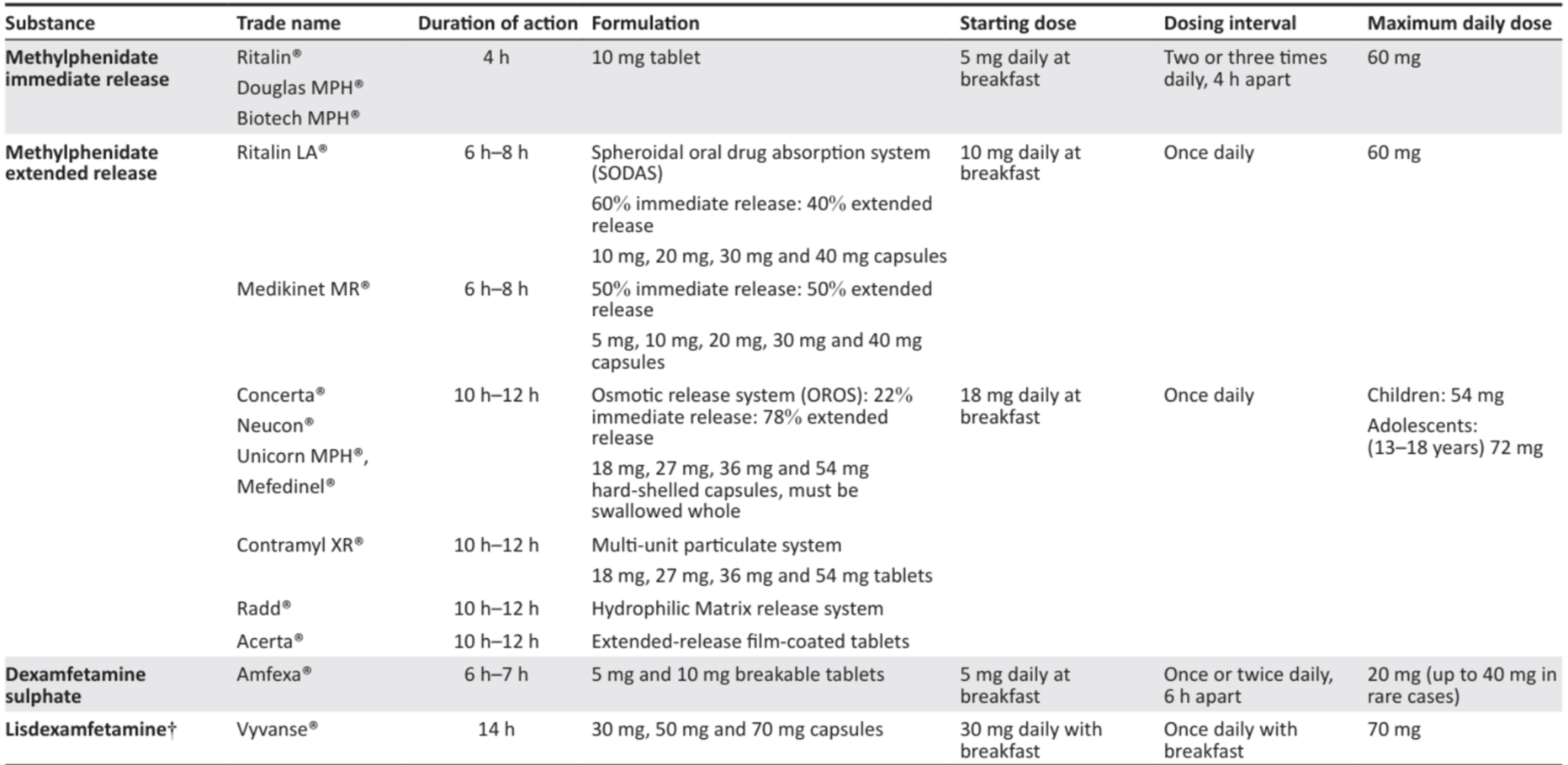
MPH, methylphenidate.
†, not registered for use in children below 13 years.
Click on the image to enlarge.
However, longer-acting stimulants increase the risk of certain side effects such as appetite suppression and insomnia, especially in younger, treatment-naive children, in whom initiation with a shorter-acting agent may be preferable. Combinations of immediate and extended-release preparations may sometimes be appropriate, for example, a child at boarding school who is required to do homework after 6 pm may require a ‘top-up’ of a short-acting stimulant in the late afternoon or early evening. Compared to immediate-release psychostimulants, the use of long-acting stimulants may diminish diversion and rebound and are often associated with better tolerability.76
There is very little correlation between body weight and dosage of the stimulant medications. The dosage should be gradually titrated against clinical response and side effects until an optimum response is attained.25 In practice, this may result in dosages that are above the maximum published dosages according to the package insert. In such cases, patients should be under specialist care and frequent monitoring of side effects should be undertaken.
Non-stimulants
Atomoxetine has a slightly lower effect size (overall response rate) compared to psychostimulants.77 The recommended dose of ATX is 1.2 to 1.8 mg/kg/day.78 Atomoxetine may be considered for patients who experience significant side effects or who have had suboptimal responses to stimulants.79
It may also be used in combination with stimulant medication in patients whose response to the latter has been suboptimal as there may be synergistic effects in some patients when these two agents are used together. However, the concurrent use of a stimulant and ATX should be under the care of a specialist and blood pressure and pulse should be regularly measured because of the catecholaminergic effect of both medications. Atomoxetine may also be prescribed when stimulant agents are contraindicated or where there is a high risk of stimulant misuse.80 In patients with significant comorbid anxiety, ATX may also be preferable as it has potential anxiolytic benefits, most notably in social anxiety, and may be less likely than stimulant medications to aggravate anxiety.81
Guanfacine is another non-stimulant for ADHD but not available in South Africa. Other agents used off-label (with lower efficacy profiles and more severe side effects) include clonidine (Menograine®) and imipramine (Tofranil®). There is no evidence for the use of bupropion or modafinil in the treatment of children and adolescents with ADHD. Atypical antipsychotics are among the agents used for comorbidities commonly seen with ADHD, often in combination with other agents. These medications are generally reserved for treatment-resistant cases and require specialised care.
Monitoring of treatment
It is important to clearly identify all ADHD-related impairment and the treatment goals at the onset of treatment. Regular re-evaluations of the efficacy and tolerability of treatment for accurate monitoring of progress are needed. It is also important to systematically identify other potential causes of impaired functioning in a patient. Sleep deprivation, poor nutrition, excessive screen time, lack of routines, psychosocial stressors and comorbid disorders can affect outcomes and should always be considered when assessing the patient’s condition and when measuring clinical response to treatment.25
After initiation of treatment, the patient should be seen within 4–6 weeks to assess the response to treatment and possible side effects. Thereafter, follow-up intervals are at the doctor’s discretion, but legally cannot be longer than six months apart, because of the high schedule classification of the medications involved. Monitoring requires feedback from the child, his or her parents, the schoolteacher and any therapists who may be involved with the care of the child. To this end, rating scales may be useful.25 Height and weight should be monitored because of the appetite-suppressing effects of ADHD medications and potential growth concerns. In children at risk for cardiovascular side effects, blood pressure and pulse should also be monitored.
Interruption in treatment is not recommended. Atomoxetine must be given continuously, inclusive of weekends and holidays, and the same is generally advisable for stimulant medications. Medication may be reduced, temporarily interrupted or completely stopped if the patient experiences unacceptable side effects, ADHD symptoms have improved sufficiently or because of a lack of response. While most children with ADHD will continue to experience symptoms into adolescence and adulthood, there are some whose symptoms remit or in whom the acquisition of coping mechanisms renders the symptoms less impairing.82
In such children, a trial without medication may be warranted, in collaboration with the child, their parents and teachers. This process may be particularly important in adolescence when the child’s emerging autonomy should be accommodated. A trial without medication, or using a reduced dosage, should generally not be done at times of transition, such as the beginning of a school year with a new teacher, or at vulnerable times, such as the lead-up to examinations. If there are concerns about a child’s growth or weight, then drug holidays may be appropriate to allow for catch-up growth and/or weight gain.83 In some cases, medications are stopped for non-clinical reasons such as stigma, lack of financial coverage or lack of access to healthcare.64
Non-pharmacological interventions for attention-deficit/hyperactivity disorder
Attention-deficit/hyperactivity disorder has a heterogeneous group of causal and contributing factors, including biological, psychological and environmental elements.84,85 This increased recognition of factors contributing to ADHD expands possible techniques and outcomes for intervention beyond purely pharmacological methods, which do not target nonbiological contributors that exacerbate the condition. The availability of non-pharmacological treatments is increasing, but the literature on these treatments using gold-standard designs is not keeping pace. Difficulties in creating blinded and unbiased studies, as well as comparison to control groups and accounting for placebo effects, are some of the methodological issues encountered when evaluating non-pharmacological treatments for ADHD.86
Psychoeducation and therapy
Psychoeducation focussed on ADHD is a vital component of the ongoing management of the condition. This should include the guardians/caregivers and the child or adolescent if developmentally appropriate. The focus of psychoeducation should be on information about symptoms of ADHD, treatment options, possible side effects of medication, compliance with medication and discussions around strategic treatment interruption. Other lifestyle factors such as supplements, diet, physical activity, screen time, sleep and discipline strategies may also form part of ongoing psychoeducation. Psychoeducation may also extend to other individuals involved in the child’s life such as teachers, tutors and caregivers.24,25
Behavioural therapy principles including social learning theory and other cognitive techniques form the basis of parent counselling and skills training and may take place over multiple sessions. Other formats include groupbased parent training, teacher training interventions and child training interventions. Topics to be included are organisational skills, social skills, problem-solving and cognitive restructuring.87
Systematic reviews of randomised control trials found small effects on academic outcomes, small to medium effects on parenting and medium to large effects on organisational skills.87,88 Behaviour therapy has a consistently strong effect on the broader well-being and outcomes in children and adolescents as part of the management of ADHD.88 However, research investigating the efficacy of these interventions is complex, and the literature is often difficult to interpret because of the heterogeneity of interventions and lack of adequate blinding in many studies. Therefore, the effect on core ADHD symptoms remains inconclusive.87,89,90,91
Randomised controlled trials of mindfulness-based interventions compared with no treatment have shown some improvement in ADHD symptoms at 6-month follow-up.92,93 However, other studies have demonstrated positive effects on child emotional regulation, but not on ADHD symptoms. The literature is growing but currently, more evidence is needed before these interventions could be recommended ahead of medication and behavioural therapy.87,94
Cognitive training, neurofeedback and brain stimulation
The large variation in targeted areas and frequency of dosing make cognitive training difficult to appraise as an evidence-based treatment. If only blinded studies are considered, no effect of cognitive training and neurofeedback on ADHD symptoms is seen. High costs and low efficacy of cognitive training, even in game-like form, do not support this as an intervention.95,96,97
There has been an increasing interest in and the use of computer-based cognitive training (CBCT) as a treatment of ADHD, with some empirical support in recent years from controlled studies.98 However, a review of the current evidence found that the effects were stronger for unblinded measures, while controlled trials with blinded measures could not support any significant effect.99
Trigeminal nerve stimulation (TNS) and transcranial magnetic stimulation (TMS) have been advocated for children with ADHD but cannot yet be recommended because of insufficient evidence.87,100,101
Allied therapies
Children who have difficulties in coordination, both fine and gross motor function as well as visual motor integration problems may benefit from referral to an OT. Sensory processing disorder is also a common comorbid finding, which might necessitate occupational therapy. Speech and language delays and articulation disorders require referral to speech and language therapists for assessment and treatment. Children with motor coordination disorders may require referral to a neurodevelopmental physiotherapist.12
Exercise
Exercise as an intervention for ADHD is appealing, with positive effects on cognitive, motor and socio-emotional development, as well as low cost and safety aspects. Exercise has been shown to enhance dopamine and monoamine neurotransmission, brain-derived neurotrophic factor (BDNF) levels, brain oxygenation and cell metabolism and has been postulated to support brain structural growth and functional neurocognitive development.102
In a recent meta-analysis, exercise was found to improve attention, motor skills and executive function in ADHD children compared to controls but did not significantly improve hyperactivity, depression, aggression and social problems.102 This contrasts with a previous meta-analysis which found that exercise improved anxiety, depression, aggressive behaviour, mindset and social problems in children with ADHD.103
Because of a large difference in study designs and outcome measures, there is still insufficient data to recommend a specific type of exercise, intensity, duration and frequency. Immediate cognitive effects of exercise may not equate to longer-lasting effects of repeated exercise on ADHD symptoms.87 Therefore, physical activity as an ADHD intervention remains inconclusive, but the broader benefits of exercise as part of physical and cognitive health seem clear.
Dietary interventions
Dietary interventions for ADHD are safe but can be laborious to implement and adequate nutrition needs to be ensured. Such interventions have included eliminating artificial food colouring, additives, salicylates and antigenic foods (oligo-antigenic diet), and the Dietary Approaches to Stop Hypertension (DASH) diet, the latter two demonstrating some evidence in improving ADHD symptoms.104,105,106,107,108 There are currently no blinded randomised controlled trials and the general recommendation is to follow a healthy, Mediterranean-type diet. More rigorous studies need to be conducted before firm recommendations can be made.106,107
Complementary and alternative medications
Complementary and alternative medicine (CAM) refers to health and wellness products and techniques not presently considered to be part of conventional Western medicine.109 Complementary medicine is used along with conventional medicine, while alternative medicine refers to approaches instead of conventional medicine. Complementary and alternative medicine includes mind-body medicine (such as meditation, acupuncture and yoga), manipulative and bodybased practices (such as massage therapy and spinal manipulation) and natural products (such as herbs and dietary supplements). Integrative medicine purports to combine the best of conventional medical care with the best of evidence-based CAM.
The World Federation of ADHD International Consensus Statement reiterates that non-medication treatments for ADHD are less effective than medication treatments but are frequently useful to help symptoms that remain after the medication has been optimised.11 Omega-3 fatty acid supplementation demonstrated small to moderate improvements in ADHD symptoms in three meta-analyses.110,111,112 However, there is no evidence of any effect of omega-3 fatty acid supplements on parent- or teacher-rated emotional lability symptoms or oppositional symptoms.113 Barragan et al. have also demonstrated that augmentation of stimulants with omega supplementation allowed for a dose reduction of stimulants.114
Recent studies highlighted the role of micronutrients and vitamins in ADHD management although the findings remain controversial. Vitamin D supplementation (if deficient) has some benefit, but no evidence was found for supplementation with nutrients such as zinc, vitB12, iron and folate.115
Although many individuals, with and without ADHD, report benefits from ‘brainsmart foods’ such as bacopa monnieri, mentat, zinc, L-carnitine, vitamin B6, magnesium, ginkgo biloba, ginseng, Celastrus paniculata, passionflower, acetyl L-carnitine (ALCAR), dimethylethanolamine (DMAE), L-theanine, DHA (dosahexaenoic acid), citicoline, curcumin, phosphatidylserine, vincopetine, L-alpha-glycerylphosphorylcholine and huperzine A, formal studies of the effectiveness of these agents are lacking. At present, there is no consistent evidence from randomised controlled trials for the use of any food supplements, and the use of these products, especially in children, should not be recommended.116
Transitioning from child and adolescent to adult services
It is now well established that ADHD continues into adulthood in most affected individuals and continues to cause significant impairment.80 Thus the transition of care between child and adult services must be carefully managed to avoid patients being lost to treatment at this vulnerable juncture. This process will necessarily differ between the public and private sectors but should involve several key components, including education for patients and their families about the persistence of the condition into adulthood, gradual preparation for the child and their parents, effective communication between child and adult services/ practitioners, clear information on available services and how to access them and, where possible, a period of parallel care.117
Belsham B, Kelly L, Schoeman R_The SASOP/PsychMg child and adolescent attention-deficit/hyperactivity disorder guidelines_South African Journal of Psychiatry; 25 February 2025