Treatment: General Principles
Initial choice of therapy Image 1: Click on image to enlarge Patients presenting with infrequent symptoms and without significant lung function impairment, smoking history or recent hospitalisation should be commenced on as-needed low-dose ICS-formoterol (Evidence B). If this option is not available, a low-dose inhaled corticosteroid should be taken whenever a SABA is used via separate inhalers (
Initial choice of therapy
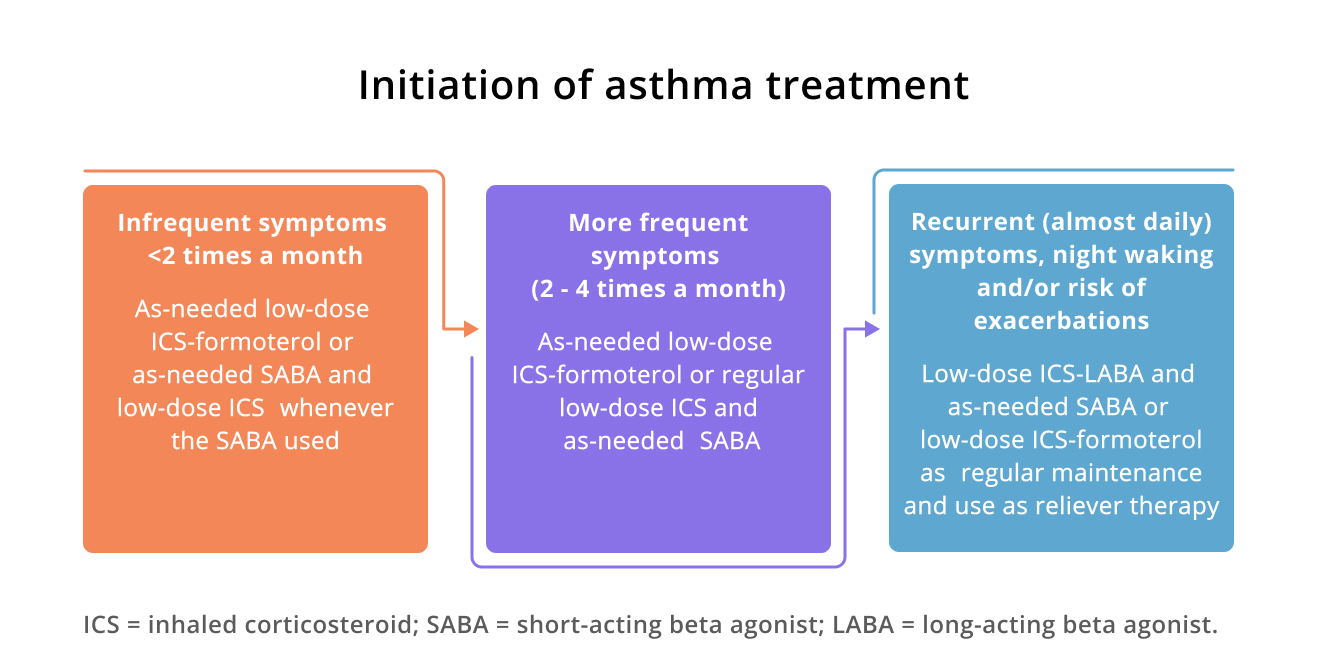
Image 1: Click on image to enlarge
Patients presenting with infrequent symptoms and without significant lung function impairment, smoking history or recent hospitalisation should be commenced on as-needed low-dose ICS-formoterol (Evidence B). If this option is not available, a low-dose inhaled corticosteroid should be taken whenever a SABA is used via separate inhalers (Evidence B).[1] (Image 1)
If patients present with a new diagnosis of asthma with significantly impaired lung function, with symptoms occurring frequently and/or night wakening due to asthma, regular low-dose ICS-LABA with a SABA as reliever, or as-needed low-dose ICS-formoterol should be initiated to gain control of the symptoms and prevent further lung function impairment (Evidence A). In patients who present with an acute exacerbation, a short course of oral corticosteroids may be required to gain control in parallel with the initiation of regular therapy. Where possible, ICS-formoterol may be used as the reliever as well as controller – or a SABA can be used as a reliever in conjunction with the ICS (Evidence A).[1] (Image 1)
Patients should be reviewed within 2 - 3 months to ensure that they have responded to the medication. Inhaler techniques and comorbid conditions – particularly allergic rhinitis and gastro-oesophageal reflux – should be reviewed and treated optimally.
Choice of treatment options for long term - selecting maintenance treatment
Set goals for asthma treatment
The emphasis of modern asthma treatment is to achieve control and minimise future risk. With optimal treatment, patients should be able to live a normal life with a normal life expectancy. Basic goals are to:
- achieve and maintain control of symptoms
- maintain normal activity levels, including exercise, and sleep uninterrupted by asthma symptoms
- maintain near-normal pulmonary function
- prevent asthma exacerbations
- avoid adverse effects from asthma medications
- prevent asthma morbidity and mortality
Patient education and environmental control
Patient education about asthma is a critical step in the management. There must be agreement with patient and care provider about theof asthma treatment. Better long-term maintenance of asthma control and outcomes have been achieved where the patient and clinician have jointly set the goals for asthma treatment. The SA National Asthma Education Programme (NAEP) and GINA have published information leaflets for asthma patients.[11,12]
Wherever possible, identified asthma triggers must be avoided. These include active and passive cigarette smoke exposure, animal dander and pollen. Air pollution, workplace asthma triggers and dust exposure may all trigger asthma symptoms. Routine testing for allergies is not recommended all people with asthma. It should be considered in individuals with difficult-to-control symptoms, specific exposures potentially needing intervention (work related) or suspected dairy or food product/preservatives exacerbating asthma. Maintaining a clean, well-ventilated indoor environment is advisable but expenditure on extensive changes to carpeting, bedding etc. should only be done after consultation with a specialist. Aspirin and non-steroidal anti-inflammatory agents should be avoided in patients known to have aspirin-sensitive asthma. Non-cardio-selective beta blockers (oral) should be avoided and only instituted in exceptional circumstances and under specialist supervision. Even ophthalmic beta blockers may worsen asthma control and should be used with caution. If cardio-selective beta blockers are required for ischaemic heart disease, the decision to prescribe should be discussed, given the potential benefits and risks.[13]
Inhaler technique is critical to ensure optimal delivery of inhaled medication, and significant time must be devoted to ensuring that patients understand and know how to use their inhaler treatment. Inhaler technique must be reviewed at every visit and, if persistent errors cannot be rectified, an alternative inhaler device should be considered. Spacer devices improve the delivery of inhaled medications where inhaler-breathing coordination is problematic. Spacers should ideally be used by all patients using a pressurised metered dose inhaler (pMDI)-type device, particularly for ICS-containing medications to ensure full benefit from the treatment.
Peak flow monitoring and recording of symptoms in an asthma diary are increasingly possible using a variety of electronic Apps in addition to a traditional paper-based diary. These diaries and reminders support adherence and provide the attending clinician with more data to inform management decisions. A personalised asthma plan is an important part of asthma management detailing when to adjust medication and when to seek medical help. These may be of great value to patients with particularly difficult-to-control symptoms.
Pharmacotherapy
Asthma therapy can broadly be classified into three groups:
Controller medication
These medications contain an inhaled corticosteroid and may be paired with a long-acting bronchodilator. The goal with these medications is to reduce airway inflammation and to improve symptoms and lung function, thus reducing the need for a reliever.[14-16] Leukotriene receptor antagonists and theophylline are also considered controller therapies but are less effective and used as third- or fourth-line agents.
Reliever medication
These medications have traditionally been short-acting bronchodilators with rapid onset of action that provide acute relief of symptoms. Recent evidence now allows the use of a fast-onset long-acting bronchodilator – such as formoterol – in combination with an ICS,[15,16] and this is the preferred strategy as put forward by GINA, but may be limited by cost and availability.[1]
Adjunctive controller medication
These medications may be added to the ICS-LABA regimen in patients in whom symptoms remain uncontrolled despite medium-dose ICS-LABA. They generally are reserved for more severe asthma patients not controlled by at least medium-dose ICS-LABA. They include LAMAs, azithromycin, oral corticosteroids, and biologic therapies (monoclonal antibodies to IgE, IL-5/5r, IL-4r etc.)
Inhaled medications for asthma are available as pMDIs, breath-actuated metered-dose inhalers, dry powder inhalers (DPIs), soft-mist inhalers and nebulisers. Patient preference and ability to use a device should, where possible, be accommodated, given cost and formulary constraints. It requires training and practice to effectively co-ordinate activation of a pMDI with inhalation. Patients having difficulty using a pMDI are recommended to use a large-volume (500 mL) spacer to improve drug delivery to the lungs and reduce local side-effects. A pMDI plus spacer, or a DPI, is as effective as a nebuliser for delivering a SABA (Evidence A).[17]
Guidelines for the management of asthma in adults and adolescents, South African Thoracic Society, 2021