Tuberculosis
Tuberculosis
TB is usually suspected in the following circumstances:
- Unexplained loss of weight or failure to thrive
- Coughing for longer than 2 weeks
- Unexplained fever for more then 2 weeks
- Night sweats
- Localised lymphadenopathy (especially cervical, often matted), hepatosplenomegaly, consolidation, pleural effusion and clubbing
- Suggestive appearance on Chest X ray
- Possible TB Contact
- Should always ask, why do we not need to exclude TB?
A history of a confirmed family or close TB contact (including drug sensitivities of contact) is very important. It is essential to define that a confirmed contact is a close or household contact with tuberculosis. Malnourished, immunosuppressed (HIV and AIDS) and children under 3 years with pulmonary tuberculosis (PTB) are always regarded as having a very serious disease.
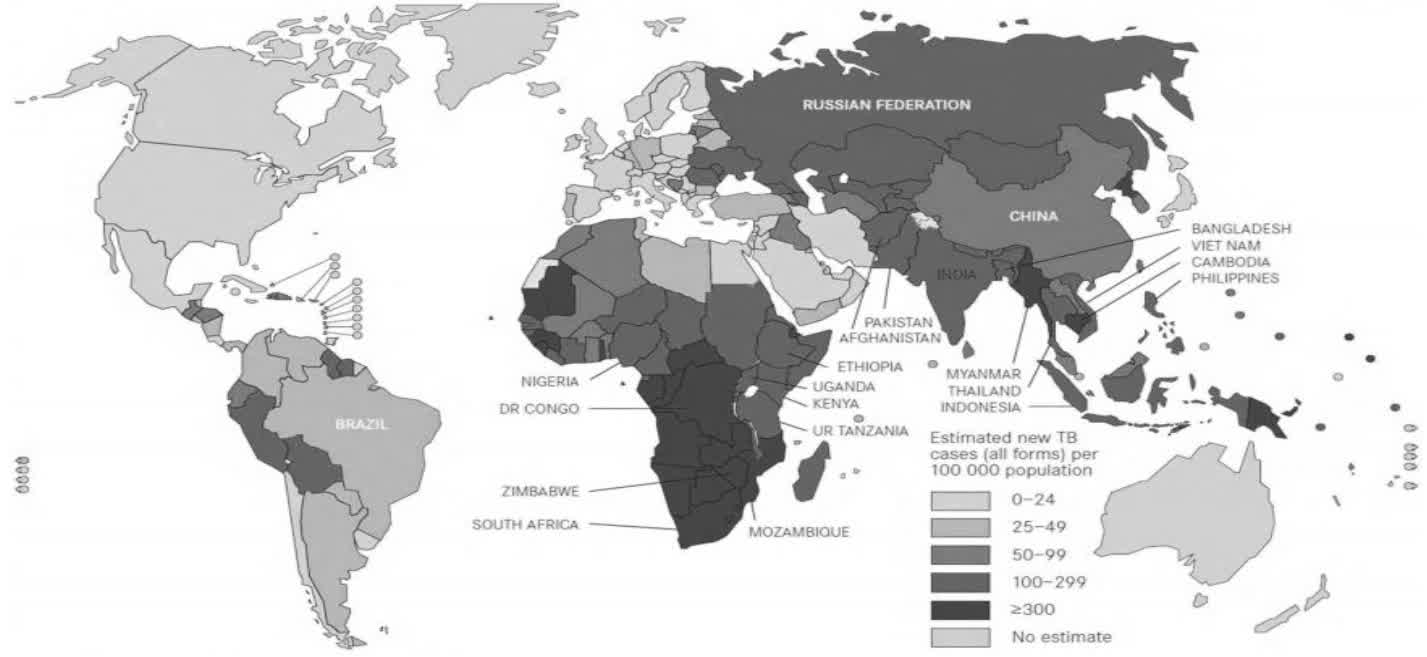
New TB cases per year:
Child with positive TB contact
- A positive history of a TB contact requires a full TB work-up:
- If child is well: Mantoux negative and CXR normal and under 5 years:
- Refer to local clinic for TB prophylaxis and follow up. Refer telephonically and by letter and write the name of the clinic and contact person in the patient’s notes.
- If child is ill: Admit for Mantoux, CXR, 2 gastric aspirates for TB MC&S.
NB: Find out what is the TB sensitivities of the contact.
A routine TB work-up consists of
- Chest X ray
- Mantoux skin test
- Two early morning gastric washings for TB MC&S
- Induced sputum collection for TB MC&S (can be arranged with the physiotherapist)
Diagnoses of TB:
- Suggestive history, clinical picture and TB contact
- CXR: Hilar or mediastinal lymphadenopathy, alveolar shadowing, airway compression, pleural effusion or cavities.
- Mantoux: A strongly positive tuberculin test ( 10mm or more in HIV negative child or 5mm or more in a HIV positive child). If TB is likely and the Mantoux negative consider repeating it after 4-8 weeks.
- Gastric washings positive for AFBs or positive culture (take up to 6 weeks).
- TB Culture can be done from: Early morning gastric aspirate, Induced sputum (younger children), Sputum (older children), CSF, Pleural and Ascitic fluids, Fine needle aspirate biopsies of lymphnodes, ear swabs in chronic otorrhoea.
- Abdominal U/S for lymphadenopathy.
Diagnosis and Evaluation of Extrapulmonary TB
| Site of TB Disease | Practical approach to diagnosis |
| Peripheral lymph nodes (especially cervical) | Fine needle aspiration (FNA) Lymph node biopsy |
| Miliary TB (Disseminated TB) | Chest x-ray Lumbar puncture Bone marrow |
| TB meningitis | Lumbar puncture (and CT scan where available) |
| Pleural effusion (older children and adolescents) | Pleural tap for chemistry and culture Chest x-ray |
| Abdominal TB (e.g. peritoneal) | Abdominal ultrasound and ascitic tap for chemistry and culture |
| Osteoarticular TB | X-ray, joint tap, or synovial biopsy |
| Pericardial TB | Ultrasound and pericardial tap |
TB TREATMENT:
A. Uncomplicated pulmonary TB:
Start combination treatment according to TB drug dosing chart 2013. (See Appendix back of book). Start Rifampicin/Isoniazid 60/60mg Tablets (Rimactazid) according to weight and add Pyrazinamide orally daily dose.
B. Complicated TB (Excluding TB Meningitis):
Start combination treatment according to TB drug dosing chart 2013. Start Rifampicin/Isoniazid 60/60mg Tablets (Rimactazid) according to weight. Add Pyrazinamide and Ethambutol orally daily dose. Refer all complicated TB children for specialist care. These include:
Drug-susceptible or presumed drug-susceptible TB who are smear-positive
- Cavitatory TB, mediastinal lymphadenopathy with airway compression
- Extensive or severe TB (Extra-pulmonary TB, Disseminated disease, e.g. abdominal or military TB)
- All HIV/TB co-infected cases
C. TB meningitis:
Start combination treatment according to TB drug dosing chart 2013. (See Appendix back of book). Need higher doses, with Ethionamide as 4th drug. If nausea / vomiting with daily dose, split drugs 2 drugs in morning and 2 drugs at night. Refer all TB meningitis patients for in hospital specialist care.
D. MDR or XDR TB:
If suspected, refer to TB specialist urgently.
Important notes on TB treatment:
- All children with suspected or proven TB should have an HIV test: if HIV-infected should be commenced on TB treatment and referred to the nearest HIV clinic for assessment for ARVs
- Drug dosages should be adjusted on a monthly basis according to the current weight of the patient
- All children with severe forms of TB (TB meningitis, miliary TB, TB peritonitis, spinal or skeletal TB) and those suspected of having multi-drug resistant (MDR) TB (in contact with MDR TB case or not responding to first-line therapy) should be referred for expert opinion and management
- Prednisone 2-4mg/kg/dose (maximum dose 60mg) orally daily x 4 weeks then tapered over 2 weeks is added to the treatment regimen for patients with TB meningitis, pericardial TB, airway obstruction due to mediastinal lymphadenopathy and miliary TB
- For children who experience persistent vomiting associated with taking TB medication consider dividing the dose and administering twice daily (particularly ethionamide)
- Supplemental pyridoxine (usually 12.5mg (1/2 tablet) in children & 25mg (1 tablet) in adults once daily) is recommended particularly in malnourished patients and patients receiving ARVs
- Complete the TB Register and make a note in the Road to Health Card
- Ask about other children or adults in the household and screen them for TB
On discharge
On discharge write a script for the treating clinic, fill in triplicate referral form, notify case and complete patient summary. Refer to Sonstraal TB Hospital if parents are unreliable. Book follow-up for all complicated TB patients in IDC clinic Paarl POPD. Book with Sr Steyn in POPD Tel number: 021-860 3097.
| Drug doses for TB meningitis: Give 7 days a week for 6 months | ||
| Rifampicin | 20 mg/kg | Max 600mg |
| Isoniazid (INH) | 20 mg/kg | Max 400mg |
| Pyrazinamide (PZA) | 40 mg/kg | Max dose 2g |
| Ethionamide | 20 mg/kg | Max dose 1 g |
| Prednisone | 4 mg/kg | Max 60 mg |
Drugs for the treatment of multidrug-resistant Tuberculosis (MDR TB) in children
| Always discuss with Paarl Consultant or Prof Simon Schaaf: 082 932 4292 | ||
| Antituberculosis Drug | Daily dose (mg/kg) | Maximum dose (mg) |
| Isoniazid* Ethambutol Ethionamide Pyrazinamide† Amikacin Ofloxacin Levofloxacin Ciprofloxacin | 15 - 20 20 - 25 15 - 20 25 - 35 15 - 22.5 15 - 20 7.5 – 10 30 - 40 | 400 2 000 750 2 000 1 500 800 750 2 000 |
| *Additional drug – not to replace any drug in treatment regimen. †Susceptibility difficult to test – given as additional drug for full duration of treatment.Adopted from Drug-resistant tuberculosis in children. H Simon Schaaf. October 2007, SAMJ | ||
TB Drug Formulations
| Rifampicin | 100 mg/5ml | 150 mg capsule | |
| Isoniazid (INH) | 10 mg/ml | 100 mg tablet | (scored into 2) |
| Pyrazinamide (PZA) | 500 mg tablet | (can be divided up to 4) | |
| Ethionamide | 250 mg | (can be divided up to 4) | |
| Ethambutol | 400 mg | (can be divided up to 4) | |
| Rimactizid | Rif 60, INH 60 | ||
| Rifafou | Rif 150, INH 75, PZA 400, Ethambutol 275 | ||
| Rimcure | Rifampicin 60, INH 30, PZA 150 | (not available anymore!) | |
| Ofloxacin | 200 mg or 400 mg | ||
| Ciprofloxacin | 250 mg or 500 mg |