Type 2 Diabetes Mellitus in Children and Adolescents
Type 2 Diabetes Mellitus in Children and Adolescents
Diagnosing diabetes mellitus in children and adolescents
Management of type 2 diabetes in children and adolescents
Screening for complications and associated risk factors
(See Strength of Recommendations Taxonomy (SORT) for explanation of Grade A-C)
| SEMDSA 2017 Recommendations | |
|
All children and adolescents with diabetes should be referred to a specialist (an endocrinologist or a specialist with an interest in childhood diabetes) at diagnosis to minimise errors in classification and to plan appropriate management
|
C |
|
When there is doubt about the aetiological classification of diabetes in children and adolescents, it is safer to treat for type 1 diabetes until diagnostic clarification can be obtained
|
C |
|
Test for anti-GAD and anti-IA2 antibodies in all patients with clinical type 2 diabetes mellitus under 18 years of age
|
C |
|
Opportunistic screening for type 2 diabetes mellitus may be considered in the patient at risk, and repeated every 2 years
|
C |
|
Hyperglycaemic emergencies must be referred to, or managed in conjunction with a paediatric diabetes specialist
|
C |
|
Metformin should be used as first line in the otherwise well, less symptomatic child with type 2 phenotype
|
B |
|
Initiate insulin if the HbA1C is not controlled after 6 months
|
B |
|
Co-morbidities (hypertension, albuminuria, dyslipidaemia etc.) should be actively sought and treated
|
B |
In children and adolescents, it can be difficult to differentiate between type 1 and type 2 diabetes mellitus (DM), and both type 1 and type 2 diabetes can manifest in the same individual.1 Children and adolescents with diabetes are at risk of ketoacidosis, which carries significant morbidity and mortality if not managed appropriately.
DIAGNOSING DIABETES MELLITUS IN CHILDREN AND ADOLESCENTS
Children and adolescents may present with the classic symptoms of hyperglycaemia which include polyuria, polydipsia, blurred vision, and weight loss in association with glycosuria, and in some cases, ketonuria.
The criteria for the diagnosis of diabetes in children and adolescents are similar to that in adults and include any one or more of the following four:1,2,3,4,5
- Symptoms of diabetes (polyuria, polydipsia and unexplained loss of weight) and a random plasma glucose of ≥ 11.1 mmol/l
- Fasting plasma glucose of ≥ 7.0 mmol/l
- Oral glucose tolerance test using 1.75 g/kg glucose to a maximum of 75 g anhydrous glucose dissolved in water, 2-hour post-challenge plasma glucose ≥ 11.1 mmol/l
- HbA1C ≥ 6.5%
In children and adolescents it is safest to assume that the diagnosis is type 1 DM, but consider type 2 if any of the following risk factors for type 2 diabetes is present:1
- Family history of type 2 diabetes in a first-degree or second degree relative
- High risk race or ethnic group (e.g. South Asians)
- Signs of insulin resistance or conditions associated with insulin resistance (e.g. acanthosis nigricans, hypertension dyslipidaemia, polycystic ovarian syndrome)
Testing for anti-GAD and anti-IA2 antibodies is recommended in all patients with clinical type 2 diabetes mellitus <18 years, as autoimmune beta-cell destruction may co-occur with the insulin resistant features, and obesity/insulin resistance can accelerate the presentation of type 1 diabetes. The presence of antibodies predicts an earlier need for insulin, and the risk of having or developing other autoimmune disorders associated with type 1 diabetes mellitus.1
SCREENING FOR TYPE 2 DIABETES 1,2,3,4,5
There is little published evidence to justify systematic screening of asymptomatic children for type 2 diabetes mellitus outside of the research setting.
Opportunistic testing for type 2 diabetes mellitus should be considered in an overweight patient with:
- BMI >99th percentile for age and sex, regardless of any additional factors or
- BMI at or above the 85th percentile for age and sex and any 2 of the following:
- Family history of type 2 diabetes in a first-degree or second-degree relative
- High risk race or ethnic group (e.g. South Asians)
- Signs of insulin resistance or conditions associated with insulin resistance (e.g. acanthosis nigricans, hypertension dyslipidaemia, PCOS)
General recommendations for screening include:
- Screening should begin at 10 years of age, or at onset of puberty if this occurs at a younger age
- If the initial screening is normal, repeat testing every 2 years
- A fasting plasma glucose test is the preferred screening test
- If the fasting glucose does not meet diagnostic criteria but clinical suspicion is high, then an OGTT is a more sensitive tool
MANAGING OF TYPE 2 DIABETES ON CHILDREN AND ADOLESCENTS
The aim of management in children and adolescents with type 2 diabetes mellitus is to minimise the risk of acute and chronic complications of diabetes by:
- Achieving and maintaining weight loss in obese individuals
- Increasing exercise capacity
- Normalising blood glucose levels and HbA1C to <7%
- Controlling associated co-morbidities e.g. hyperlipidaemia and hypertension
EMERGENCY MANAGEMENT
If the child or adolescent presents in diabetic ketoacidosis (DKA) or hyperglycaemic hyperosmolar non-ketotic coma (HHNK), immediately refer the patient to a paediatric diabetes specialist. If this is not possible, contact a paediatric diabetes specialist telephonically for guidance and assistance.
The risk of cerebral oedema and death is high in childhood and adolescence, and a paediatric protocol for management must be used.
Best practice: ANY diabetes in a child or adolescent <18yrs should be referred to or discussed with a paediatric diabetes specialist.
There are three components to managing type 2 DM in children and adolescents:
- Diet/Lifestyle modification
- The patient and parents must be referred to a dietitian
- Medication
- NB: NO Aspirin is to be used in children and adolescents <21 years
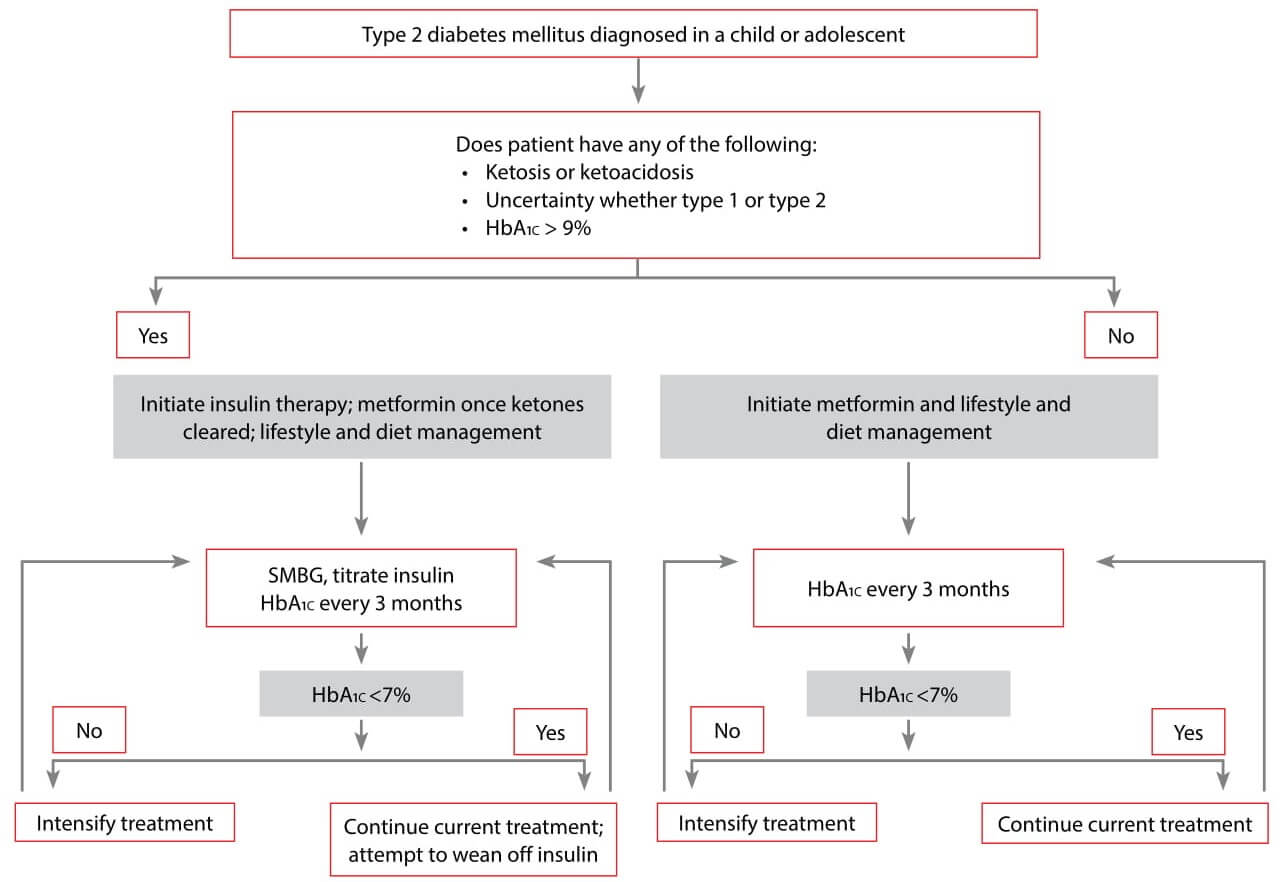
- If ketosis, acidosis, or dehydration is present the management is insulin first, adding metformin later once hydrated and ketone-free
- If the diagnosis is in doubt whether type 1 or type 2 DM, the management is insulin and metformin, weaning the insulin once the HbA1C is controlled
- Ketones (preferably ß-hydroxybutyrate) must be monitored and if they recur, insulin must be reinitiated
- Metformin is used in the otherwise well, less symptomatic child with type 2 phenotype. Initiate insulin if the HbA1C is not controlled after 6 months
- Metformin initiation: Low dose (500 mg) daily, then twice daily (over 3-4 weeks), then increase dose as tolerated to a maximum of 1g twice daily, titrated to HbA1C and self-monitoring blood glucose testing (SMBG)
- Education including SMBG
- It must be emphasised that there is a possibility that the diagnosis is type 1 diabetes, and that insulin may be required. SMBG is essential to prevent DKA/HHNK
Figure I below describes the management algorithm with titration thresholds.
SCREENING FOR COMPLICATIONS AND ASSOCIATED RISK FACTORS1,2,3,4,5
- Albuminuria should be evaluated at diagnosis and annually thereafter. Either micro- or macro-albuminuria may be present at diagnosis. An ACE inhibitor is the first line of therapy. Remember to counsel fertile girls/women about the teratogenicity of ACE inhibitors
- Hypertension (>95th percentile for age, height and gender) may be present at or prior to diagnosis of DM and each individual should be assessed at each visit. HPT is estimated to account for 35-75% of diabetes complications i.e. both micro and macrovascular. An ACE inhibitor is first line of therapy (especially if microalbuminuria)
- Dyslipidaemia is more common in type 2 DM and in family members, and should be screened for when metabolic stability is achieved. Hypertriglyceridaemia and decreased HDLC are hallmarks of type 2 dyslipidaemia. This is primarily treated with weight loss, lower cholesterol diet and improved glucose control. Statins are only to be used under specialist care – and with extreme caution in childbearing age adolescent girls/young women
- Evaluate for non-alcoholic fatty liver disease (NAFLD) at diagnosis and annually thereafter, with a screening ALT level. Hepatic steatosis is present in 25-45% of adolescents with type 2 DM. NAFLD now represents the most common cause of cirrhosis in children and is the most common reason for liver transplantation in the adults in the United States. Metformin must not be used if the liver enzymes are >2.5 times the upper limit of normal
- Screening for diabetic retinopathy is to be performed at diagnosis and annually. The preferred method is retinal imaging by fundus photography, or dilated fundoscopy performed by an ophthalmologist or trained clinician
- A history of pubertal development, menstrual irregularities and obstructive sleep apnoea, should be elicited at diagnosis and regularly thereafter with appropriate management as required
Fertility may improve on metformin and contraception should be emphasised in the sexually active individual. Discuss with or refer to paediatric specialist if any risk factors or complications are present.
Figure I: Management algorithm for type 2 diabetes in children and adolescents 2
Author: Michelle Carrihill, in conjunction with PAEDS-SA
Editors: Ankia Coetzee and Aslam Amod
References
- ISPAD Clinical Practice Consensus Guidelines 2014 Compendium, Type 2 diabetes in the child and adolescent. Pediatric diabetes 2014:15(suppl. 20):26
- Copeland KC, Silverstein J, Moore KR, et al. Management of newly diagnosed type 2 diabetes mellitus in children and adolescents. Pediatrics 2013: 2: 131,364
- Stringer SC, Silverstein J, et al. Management of newly diagnosed type 2 diabetes mellitus in children and adolescents. Pediatrics 2013: 2: 131, e650
- Executive summary. Type 2 diabetes in children and adolescents. Can J Diabetes 2013; 37: s341
- NICE. Diabetes (type 1 and type 2) in children and young people: diagnosis and management (NG18) 2015