Urinary Tract Infections
Urinary Tract Infections
Definitions of different UTI's
Criteria for the diagnosis of UTI
Dipstix tests are routine in all children with acute gastro-enteritis, severe acute malnutrition, oedema or fever without a source. In these cases this is an emergency investigation that aids diagnosis and changes management and should not be deferred. Of only dipstix are required a bag-specimen can be taken. If MC&S is needed or severe nappy rash, a SPU or catheter under aseptic technique should be done for a urine MC&S, so that antibiotic choice can be established.
Dipstix testing of a contaminated bag specimen will give false positive results. A negative result is only helpful in excluding infection. If dipstix on a bag specimen is suspicious of a urinary infection, please collect another bag sample after proper perineum cleaning with alcohol swabs or collect a suprapubic or catheter urine specimen. Only if this specimen suggests infection should the sample be sent for microscopy, culture and sensitivity. Suprapubic puncture will be dry in most dehydrated children. In well hydrated children or children who already had fluid in EC, do suprapubic before taking blood or have assistant ready for clean catch as you take blood. A proper sample should be processed by the lab within 30 min.
Definitions of different UTI’s:
- Uncomplicated UTI: an infection which is limited to the lower urinary tract and there are no associated urological anomalies. It is seen most commonly in girls over two years of age. It presents with localising symptoms of dysuria, frequency, urgency, cloudy urine and lower abdominal discomfort. Urine dipstick test show positive leukocyte esterase, nitrites and haematuria.
- Complicated UTI: an infection of the urinary tract involving the renal parenchyma (acute pyelonephritis) or which is associated with underlying congenital anomalies of the kidneys and urinary tract. It is accompanied by fever and other systemic features as described below. It may result in significant short-term morbidity, including septicaemic shock and acute renal failure, especially in infants.
- Unresolved UTI: no improvement after 48 hours of treatment, ensure compliance, adequate drug dose, resistant organism.
- Reinfection: Recurring UTI with different organism after sterile urine.
- Persistent infection: Same organism isolated repeatedly (nidus)
- Catheter associated UTI: Catheterised patients
- Recurrent UTI: 2 or more episodes of UTI’s with pyelonephritis, 1 episode of pyelonephritis and 1 episode of UTI, or 3 or more episodes UTI’s.
Clinical signs
Signs and symptoms are related to the age of the child and are often non-specific.
Uncomplicated urinary tract infections may cause very few signs and symptoms.
Complicated infections may present with a wide range of signs and symptoms.
- Neonates may present with: poor feeding, fever, hypothermia, vomiting, prolonged jaundice, failure to thrive, sepsis or renal failure.
- Infants and children may present with: frequency, persisting fever, dysuria, failure to thrive, abdominal pain, enuresis or urgency.
Criteria for the diagnosis of UTI
- Any culture from a suprapubic urine sample
- A culture of > 100 col/ml urine of a single organism from a catheter specimen
- A pure culture of > 100 col/ml in a mid-stream clean catch sample
- Or consistent culture of a pure growth even with low counts
Special investigations
- Dipstix: Urine bag specimens are used for screening purposes only.
- When urine dipstick test of bag specimen reveals presence of leukocytes or nitrites, collect urine aseptically for urine MCS.
- Urine MC&S: specimen is collected aseptically:
- Use suprapubic aspiration, transurethral catheterisation (in acutely ill children < 2 years of age or in smaller children who are unable to co-operate) or by mid-stream clean catch method in older children.
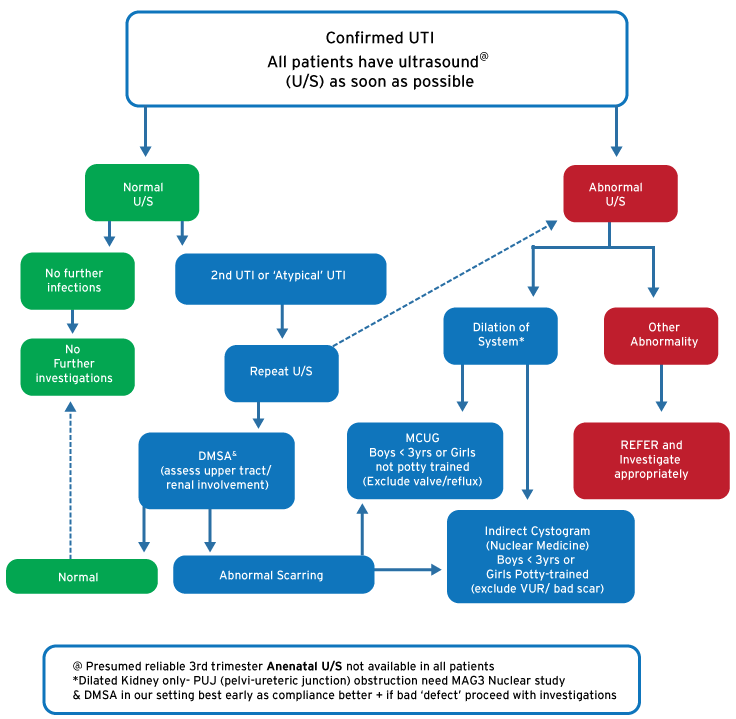
- Ultrasound: Do a renal ultrasound in all children with first culture confirmed UTI as soon as possible, unless a normal ultrasound was previously seen.
- MCUG: Do in children who have abnormalities of the kidneys, ureter or bladder demonstrated by ultrasound.
| How to interpret Urine dipsticks: | |
| +ve leucocytes and nitrites | Treat for UTI (85-90% Chance of UTI) |
| -ve leucocytes and +ve nitrites | Treat only if clinically indicated (If specimens fresh) |
| +ve leucocytes and –ve nitrites | Treat only if clinically indicated |
| Both negative = not having UTI | 85-98% chance of not having UTI |
Treatment
Uncomplicated UTI:
- Children > 3 mo, not acutely ill, not vomiting
- Treated with Augmentin 30mg/kg/dose 8 hourly OR Cefuroxime 15 mg/kg/dose 12 hourly
Complicated UTI:
High fever, rigors, loin tenderness, septic child, generally unwell, vomiting, high CRP, leucocytosis or leucopaenia, or < 3mo of age: Treat with Amoxicillin/clavulanic acid, IV, 25 mg/kg/dose 8 hourly OR Ceftriaxone, IV, 80 mg/kg daily.
Duration of oral antibiotic therapy is for a minimum of 7–10 days. The choice of antibiotics used depends on the expected culture and sensitivity of the organism. Review antibiotic choice once culture and sensitivity results become available. If there is no improvement after 24 hours of IV amoxicillin/clavulanic acid treatment and culture result is pending, a resistant organism may be the cause, ADD Gentamicin IV, 5 mg/kg/dose once daily. If there is evidence of good clinical response to amoxicillin/clavulanic acid alone, change to Amoxicillin/clavulanic acid, oral, 30 mg/kg/dose 8 hourly.
Prophylaxis
The recommendation for prophylaxis has been made in the following cases:
- Children less than 1 year with structural abnormality
- Grade 4-5 VUR
- Obstructive uropathy with recurrent UTI’s
- Single kidney with recurrent UTI’s
- Previous pyelonephritis with renal scarring
- Renal stones
- Neuropathic bladder and recurrent UTI’s
Referral to Nephrology
All children with recurrent UTI’s, abnormal imaging, abnormal renal function with UTI’s.
For further information on the drugs listed in the above guidelines, click on the drug name and you will be directed to the EMGuidance drug monograph.
Amoxicillin/clavulanic acid
Cefuroxime
Gentamicin