Urinary Tract Infections in Children
Guideline to the approach to urinary tract infections in children
Lead Authors: Dr Shaegan Irusen & Dr Christel du Buisson
Acknowledgements: Dr PJ Sinclair, Dr P Nourse, Dr P Gajjar & Prof M McCulloch
These guidelines were developed in May 2015.
Summary algorithm
Introduction
Clinical presentation and examination
Further assessment
Differential diagnosis
Investigations
Management
Summary algorithm
Click on image to enlarge
Introduction
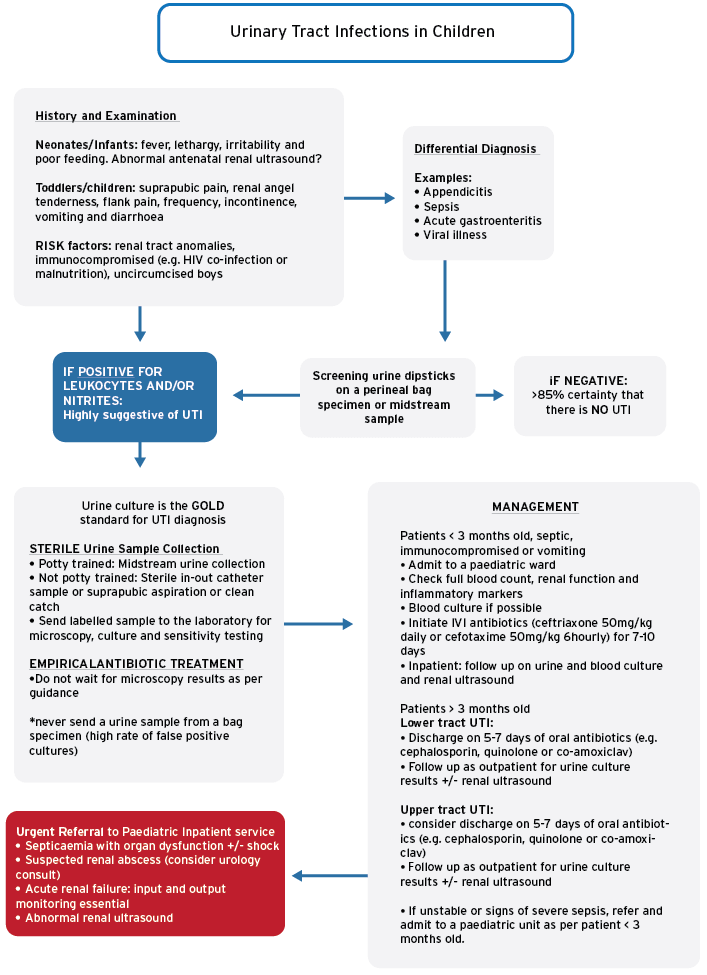
Urinary tract infections (UTI) are very common affecting 3% of boys & 11% of girls. UTI are divided into lower (urethritis and cystitis) & upper (ureteritis and pyelonephritis) tract infections. In infants & toddlers, irritability & fever (> 38oC) is suggestive of an upper tract infection. UTI is often found in patients with acute respiratory illness, gastroenteritis & malnutrition therefore screening with urine dipsticks is essential
Clinical presentation & examination
- Neonates/Infants: fever, lethargy, irritability & poor feeding. Abnormal antenatal renal ultrasound?
- Toddlers/children: suprapubic pain, renal angle tenderness, flank pain, frequency, incontinence, vomiting & diarrhoea
Further assessment
RISK factors: renal tract anomalies, immunocompromised (e.g. HIV co-infection or malnutrition), uncircumcised boys.
Differential Diagnosis
The symptoms & signs of UTI in children can be non-specific, it is therefore essential keep an open mind about the potential underlying diagnosis which could include:
- Appendicitis
- Sepsis/septicaemia
- Acute gastroenteritis
- Viral illness
Investigations
URINE COLLECTION:
Bag urine samples should be used only for initial screening with urine dipsticks.
If a culture needs to be sent a sterile sample must be taken
STERILE Urine Sample Collection
- Potty trained: Midstream urine collection
- Not potty trained: Sterile in-out catheter sample or suprapubic aspiration or clean catch
- Send labelled sample to the laboratory for microscopy, culture & sensitivity testing
Interpreting the Culture result – UTI confirmed if:
- Supra-pubic sample: ANY gram negative or >5000cfu/ml gram positive organism is significant
- Midstream urine sample: >100 000 cfu/ml organisms are significant
- Catheter sample: >10 000cfu organisms are significant
NEVER SEND A URINE SAMPLE FROM A BAG SPECIMEN FOR CULTURE.
THERE IS VERY HIGH RATE OF FALSE POSITIVE CULTURES
IMAGING: Who Need’s Imaging?
- Define the at risk patient:
- Recurrent urinary tract infections
- 2 or more episodes of pyelonephritis
- 1 episode of pyelonephritis and lower tract infection
- 3 or more episodes of lower tract infection
- Less than 3 years with atypical infections
- Failure to respond to treatment within 48hrs
- Poor urine output
- Palpable bladder or renal mass
- Non E. coli uropathogens
- Renal dysfunction
- Severe sepsis
- Recurrent urinary tract infections
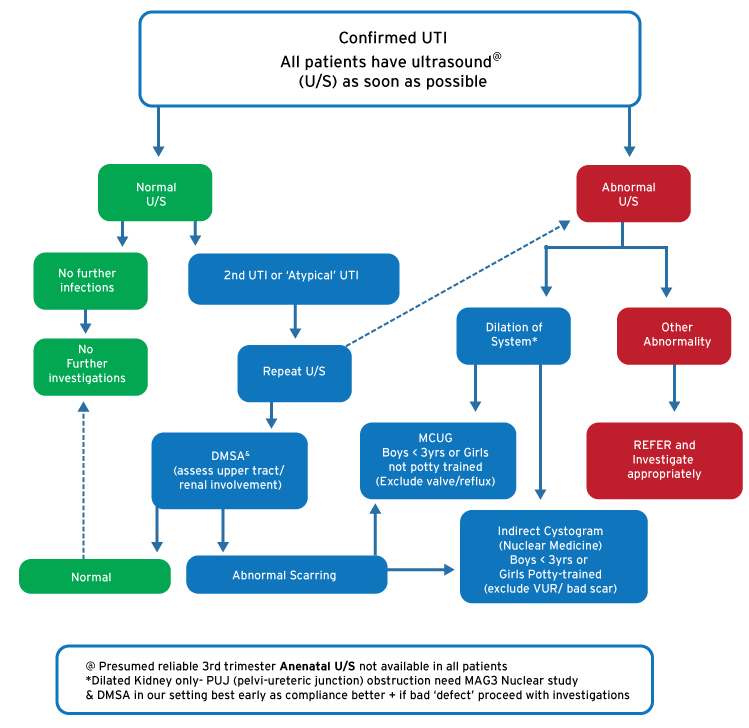
All patients with culture positive confirmed UTI will need a renal tract ultrasound
- This can be done as an outpatient at a level 1 hospital. Patients with structural abnormalities will require referral to a level 2 hospital.
Further imaging requirements depending on progress:
Click on image to enlarge
Management
Patients < 3 months old, septic, immunocompromised or vomiting
- Admit to a paediatric ward
- Check full blood count, renal function and inflammatory markers
- Blood culture if possible
- Initiate IVI antibiotics (ceftriaxone 50mg/kg daily or cefotaxime 50mg/kg 6 hourly) for 7-10 days
- Inpatient: follow up on urine and blood culture and renal ultrasound
Patients > 3 months old
- Lower tract UTI:
- discharge on 5-7 days of oral antibiotics (e.g. cephalosporin, quinolone or co-amoxiclav)
- Follow up as outpatient for urine culture results +/- renal ultrasound
- Upper tract UTI:
- consider discharge on 5-7 days of oral antibiotics (e.g. cephalosporin, quinolone or co-amoxiclav)
- Follow up as outpatient for urine culture results +/- renal ultrasound
If unstable or signs of severe sepsis, refer and admit to a paediatric unit as per patient < 3 months old.
References
- Zorc JJ, Kiddoo DA, Shaw KN. Diagnosis and Management of Paediatric Urinary Tract Infections. Clin Microbiology Reviews. 2005 April; 18 (2): 417-422.
- Subcommittee on Urinary Tract Infection, Steering committee on quality improvement and management. Urinary Tract Infection: Clinical Practice Guideline for the Diagnosis and Management of the Initial UTI in Febrile Infants and Children 2 to 24 months. Paediatrics. 2011 September; 128 (3): 595-610.
- UTI Protocol: Tygerberg Children’s Hospital
- Wallis LA, Reynolds TA. AFEM Handbook of Acute and Emergency Care. SA: Oxford University Press; 2013.
- Motala C, Davidson A, Figaji A, Levin M, editors. Handbook of Paediatrics. 7th edition. South Africa: Oxford University Press; 2012.