Venous Thromboembolism
Description Venous Thrombo-embolism Prophylaxis Venous Thrombo-embolism Acute Treatment I26.0/I26.9/I80.0-3/I80.8-9/I81/I82.0-3 DESCRIPTION Venous thromboembolism (VTE) can occur at different sites, ranging from calf deep venous thrombosis (DVT) to pulmonary thrombo-embolism (PE). For VTE in pregnancy, see: VTE during pregnancy and the puerperium . Differential diagnosis includes: cellulitis supe
Venous Thrombo-embolism Prophylaxis
Venous Thrombo-embolism Acute Treatment
I26.0/I26.9/I80.0-3/I80.8-9/I81/I82.0-3
DESCRIPTION
Venous thromboembolism (VTE) can occur at different sites, ranging from calf deep venous thrombosis (DVT) to pulmonary thrombo-embolism (PE). For VTE in pregnancy, see: VTE during pregnancy and the puerperium.
Differential diagnosis includes:
- cellulitis
- superficial thrombophlebitis
- lymphoedema
- chronic venous insufficiency
- ruptured popliteal (Baker’s) cyst
- calf muscle pull or tear
- internal derangement of the knee
Diagnosis is primarily clinical and confirmed with imaging studies, e.g. Duplex Doppler.
GENERAL MEASURES
Strategies for prevention include:
- lifestyle modifications (e.g. prevention of obesity and inactivity)
- avoiding dehydration
- avoiding cigarette smoking
- maintaining normal blood pressure,
- mechanical measures like vascular compression stockings and intermittent pneumatic compression boots.
LoE:IIIbxxvi
Acute management
Thrombolytic therapy may be indicated in patients with confirmed early pulmonary embolism where haemodynamic stability cannot be achieved.
Discuss with a specialist.
VENOUS THROMBO-EMBOLISM – PROPHYLAXIS
MEDICINE TREATMENT
Risk Assessment
Risk assessment is essential, and treatment needs to be individualised. Risk factors for VTE can be divided into predisposing factors (i.e. patient characteristics) and exposing factors (i.e. underlying medical conditions, nature of surgical intervention).
Table 2.3: VTE risk assessment in surgical and non-surgical patients
| Predisposing risk factors | ||
| Thrombophilia | Advanced age (>60 years) | |
| History of VTE | Chronic cardiac insufficiency | |
| Malignancy | Obesity (BMI > 30 kg/m2 ) | |
| Drugs, e.g. TB treatment, thalidomide | Oestrogen therapy | |
| HIV infection | Nephrotic syndrome | |
| Auto-immune disease | Varicose veins | |
| Exposing risk factors | ||
| Risk level | Surgical patients |
Medical patients
|
|
Low VTE risk
|
- Surgery lasting <30 minutes |
- Infection or acute inflammatory diseases without bed rest |
|
Moderate VTE risk
|
- Surgical procedures of longer duration |
- Acute cardiac insufficiency (NYHA III/IV) |
| High VTE risk |
- Major surgical procedures for malignancy |
- Stroke with paralysis |
Modified from Source: Jacobson BF, Louw S, Büller H, Mer M, de Jong PR, Rowji P, Schapkaitz E, Adler D, Beeton
A, Hsu HC, Wessels P, Haas S; South African Society of Thrombosis and Haemostasis. Venous thromboembolism: prophylactic and therapeutic practice guideline. S Afr Med J. 2013 Feb 15;103(4 Pt 2):261-7. https://www.ncbi.nlm.nih.gov/pubmed/23547704
For patients hospitalised due to medical illnesses at high risk of VTE:
- Rivaroxaban, oral, 10 mg daily while hospitalised.
LoE:Ibxxvii
For patients hospitalised due to medical illnesses and in whom rivaroxaban is contraindicated (see summary table below):
- Low molecular weight heparin, e.g.:
- Enoxaparin, SC, 40 mg daily.
- In morbid obesity, dosing of LMWH should be individualised, in discussion with a specialist.
- Renal impairment (eGFR <30 mL/min): adjust dose to 20 mg daily.
- Enoxaparin, SC, 40 mg daily.
LoE:IVbxxviii
OR
- Unfractionated heparin, SC, 5 000 units 12 hourly.
- Dose adjustment is generally not required for renal impairment.
- Monitor for bleeding complications.
LoE:IIIbxxix
For orthopaedic surgical patients with trauma-related i) operative extremity fractures or ii) operative and non-operative pelvic and acetabular fractures:
Low to moderate risk of VTE:
LoE:IIbxxx
- Aspirin, oral, 150 mg daily.
- Initiate aspirin >12 hours post-operatively and continue for 14 days or until mobilisation.
- In patients with non-operative pelvic and acetabular fractures, prophylaxis can be continued for up to 35 days. If clinically appropriate (i.e. in the absence of clear evidence of VTE risk), discontinuation prior to 35 days, on discharge from hospital should be considered.
LoE:III
High risk of VTE:
- Low molecular weight heparin, e.g.:
- Enoxaparin, SC, 40 mg daily.
- In morbid obesity dosing of LMWH should be individualised, in discussion with a specialist.
- Renal impairment (eGFR <30 mL/min): adjust dose to 20 mg daily.
- In patients with non-operative pelvic and acetabular fractures, prophylaxis can be continued for up to 35 days. In the absence of clear evidence of VTE risk or on earlier discharge from hospital, discontinuation prior to 35 days should be considered.
For elective total hip arthroplasty:
- Rivaroxaban, oral, 10 mg daily.
- Initated 6-10 hours post-surgery for duration of admission or a maximum of 10 days.
Following rivaroxaban, prescribe aspirin:
- Aspirin, oral, 150 mg daily for 28 days on discharge from hospital.
For elective total knee arthroplasty:
Total duration of prophylactic therapy: 14 days
- Rivaroxaban, oral, 10 mg daily.
- Initiate anticoagulation 6–10 hours post-surgery for the duration of hospital admission for a minimum of 2 days and a maximum of 7 days.
Following rivaroxaban, prescribe aspirin:
- Aspirin, oral 150 mg daily.
- Treat with aspirin for remainder of VTE prophylaxis period, i.e. 14 days in total including days on rivaroxaban.
LoE:Ibxxxi
For i) other surgical patients, or ii) orthopaedic surgical patients with a contraindication to aspirin or rivaroxaban:
- Low molecular weight heparin, e.g.:
- Enoxaparin, SC, 40 mg daily.
- In morbid obesity, dosing of LMWH should be individualised, in discussion with a specialist.
- Renal impairment (eGFR <30 mL/min): adjust dose to 20 mg daily.
OR
LoE:IVbxxxii
- Unfractionated heparin, SC, 5 000 units 12 hourly.
- Dose adjustment generally not required for renal impairment.
- Monitor for bleeding complications.
Table 2.4: Summary of VTE prophylaxis in surgical and non-surgical patients
| At risk population | VTE prophylaxis | Duration | |
| Medical | Hospitalised patients with debilitating illness | Rivaroxaban, oral, 10 mg daily. | While hospitalised |
| Orthopaedic Surgical | Total hip arthroplasty | Rivaroxaban, oral, 10 mg daily followed by aspirin, oral, 150 mg daily. | Rivaroxaban: From 6-10 hours post-op, for up to 10 days (or less if hospitalised <10 days). Aspirin: For 28 days on hospital discharge. |
| Orthopaedic Surgical | Total knee arthroplasty | Rivaroxaban, oral, 10 mg daily for 2-7 days, followed by aspirin, oral, 150 mg. | Rivaroxaban: From 6-10 hours post-op, for at least 2 days (max 7 days). Aspirin: Treat for remainder of VTE prophylaxis period, i.e. 14 days in total including days on rivaroxaban. |
| Trauma-related operative: i) extremity fractures ii) pelvic and acetabular fractures |
Low to moderate risk of VTE: Aspirin, oral, 150 mg daily. High risk of VTE: Enoxaparin, SC, 40 mg daily. |
From >12 hours post-operatively, for 14 days or until mobilisation. | |
| Trauma-related non-operative pelvic and acetabular fractures | Low-moderate risk of VTE: Aspirin, oral, 150 mg daily. High risk of VTE: Enoxaparin, SC, 40 mg daily |
From admission up to 35 days. | |
| Other Surgical | Other major surgery | Enoxaparin, SC, 40 mg daily. OR Unfractionated heparin, SC, 5 000 units 12 hourly. |
While hospitalised. |
Although the risk of bleeding is small, prophylaxis should only be used under exceptional circumstances in patients with the following conditions:
- Active bleeding or high risk of active bleeding (eg. severe liver disease; peptic ulcer disease).
- Intraocular, intracranial or spinal surgery.
- Patients requiring lumbar puncture or spinal/epidural anaesthesia within 24 hours of rivaroxaban dose, within 12 hours of enoxaparin when used as prophylaxis, or within 24 hours of enoxaparin when used at therapeutic doses. For timing of anticoagulants – See: Anticoagulants and spinal or epidural blocks.
- Renal insufficiency: Rivaroxaban not recommended if eGFR<30ml/min; enoxaparin requires renal dose adjustment.
- Coagulopathy.
- Uncontrolled hypertension.
- Concomitant anticoagulations or antiplatelet therapy.
Table 2.5: Contraindications to rivaroxaban
Additional contraindications to rivaroxaban not covered above:
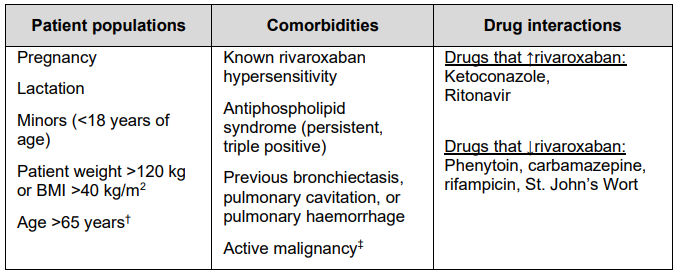
† Insufficient evidence in this patient population.
‡Exception: Patients receiving extended prophylaxis after gynaecological or colorectal malignancies.
VENOUS THROMBO-EMBOLISM – ACUTE TREATMENT
MEDICINE TREATMENT
LoE:Ibxxxiv
For proximal deep venous thrombosis and/or pulmonary embolism:
- Rivaroxaban, oral, 15 mg twice daily for 3 weeks, followed by 20 mg once daily for 3 months.
If i) rivaroxaban is contraindicated, or ii) patient is high risk and requires long term anticoagulation (> 6 months), e.g. recurrent VTE:
- Start unfractionated or low molecular weight heparin simultaneously with warfarin.
- After 5 days, heparin may be stopped if an INR within therapeutic range (INR between 2 and 3) has been reached and maintained for at least 24 hours.
Note:
Heparin and warfarin therapy should overlap for at least 5 days.
- Low molecular weight heparin, e.g.:
- Enoxaparin, SC, 1.5 mg/kg daily,
LoE:Ixxxv
OR
- Enoxaparin, SC, 1 mg/kg 12 hourly
LoE:Ixxxvi
CAUTION – Enoxaparin
In morbid obesity, dosing of LMWH should be individualised in discussion with a specialist.
LoE:IIIxxxvii
In renal failure (eGFR <30 mL/minute), the recommended treatment dose of enoxaparin is 1 mg/kg daily.
LoE:IIIxxxviii
CAUTION – Unfractionated heparin
Evidence indicates that PTT monitoring is not necessary with weight-based dosing of unfractionated heparin. However, in patients with morbid obesity and renal failure (eGFR <30 mL/minute), unfractionated heparin should be used with PTT monitoring to maintain the PTT at 1.5 to 2.5 times the control.
PTT should be taken 4 hours after SC dose.
LoE:IVb
Follow with:
Warfarin, oral, 5 mg daily.
- Measure INR after 48 hours, then every 1 to 2 days until the INR is within the therapeutic range of 2–3 (refer to initiation dosing tables in the Appendix II).
- Adjust dose to keep INR within therapeutic range (refer to maintenance dosing tables in Appendix II: Prescribing Information for Specific Medicines).
LoE:IVbxxxix
- Continue warfarin for 3 months with regular INR monitoring, provided that a precipitating cause that has resolved.
- In patients with a first-time, unprovoked DVT, discuss duration of therapy with a specialist.
- All women of reproductive age should be on appropriate contraception (see Primary Health Care STGs and EML: Family Planning). If a pregnancy is planned, do frequent pregnancy tests and change to enoxaparin once pregnancy is confirmed (see: VTE during pregnancy and the puerperium).
LoE:IIIbxl
- For all major elective surgery and other elective procedures with a significant bleeding risk, such as neuraxial anaesthesia and lumbar punctures, the INR should be <1.5 (see: Anticoagulants and spinal or epidural blocks).
- Educate patient on signs and symptoms of warfarin toxicity, and on risks associated with drastic dietary changes such as increased consumption of cruciferous vegetables.
Heparin induced thrombocytopenia (HIT)
A severe immune-mediated drug reaction occurring in 1-5% of patients receiving heparin therapy (more common with unfractionated heparin, but may also occur with low molecular weight heparin). It presents with thrombocytopenia and thrombosis. Diagnosis requires a high index of suspicion and should be considered if a patient has a 50% drop in platelet count within 5-10 days after initiating heparin therapy. A positive antibody test confirms the diagnosis.
Management of HIT:
Stop heparin and discuss all patients with a specialist.
REFERRAL/CONSULTATION
- All patients with heparin induced thrombocytopaenia.
Standard Treatment Guidelines And Essential Medicines List For South Africa, Adult Hospital level_Version 1_30 March 2026
Chapter 2: Blood and Blood Forming Organs; 2.8 Venous Thromboembolism; 2.8.1 Venous Thrombo-ebolism Prophylaxis; 2.8.2 Venous Thrombo-embolism Acute Treatment
Drugs mentioned
ICD-10 codes
- I26.0Pulmonary embolism with mention of acute cor pulmonale
- I26.9Pulmonary embolism without mention of acute cor pulmonale
- I80.0Phlebitis and thrombophlebitis of superficial vessels of lower extremities
- I80.1Phlebitis and thrombophlebitis of femoral vein
- I80.2Phlebitis and thrombophlebitis of other deep vessels of lower extremities
- I80.3Phlebitis and thrombophlebitis of lower extremities, unspecified
- I80.8Phlebitis and thrombophlebitis of other sites
- I80.9Phlebitis and thrombophlebitis of unspecified site
- I81Portal vein thrombosis
- I82.0Budd-Chiari syndrome
- I82.1Thrombophlebitis migrans
- I82.2Embolism and thrombosis of vena cava
- I82.3Embolism and thrombosis of renal vein