GuidelinesOther guideline
Venous Umbilical Catheterisation
Management guidelines for students, interns and registrars on a variety of routine and emergency situations in our neonatal service at Tygerberg Children’s Hospital. Published in 2014.
Indications
- Exchange transfusion
- Premature neonates <1000 gram.
- Babies with severe asphyxia neonatorum and shock, as well as any infant with a shocked status.
- Parental feeding when peripheral lines are unobtainable in infants <1500 gram.
- Infants of diabetic mothers (especially those requiring more than 10 - 12 mg/kg/min dextrose infusion).
Requirements
- Catheterisation pack
- Disposable umbilical catheters (Argyle FG 3.5 or 5)
- Heparinised solution; infusion pump; 3 way stopcock
- Infusion set
- Infusion set filter
- Clave® connection piece
- Infusion set
- Sterile gloves
Technique
- Wash hands thoroughly and wear sterile gloves
- Prepare the area (umbilicus cleanly cut with a sharp blade ± 1 cm from base) with iodine and alcohol solution.
- Wait 30-60 seconds.
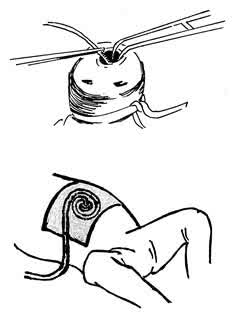
- Stabilise the stump with a forceps.
- Remove clots in the vein.
- Sound the vein CAREFULLY (if necessary) with the sound.
- Insert a fluid-filled catheter (IU Heparin/1ml 0.2% NaCl + 5% D/W) attached to a 3-way stopcock and syringe according to the specified length.
Length of catheter insertion (cm) = (baby’s weight in Kg x 1.5) + 5.5). - Aspirate blood after the catheter has been placed correctly.
- Connect the umbilical catheter to the infusion line and secure the catheter with Tegaderm® or Opsite® on the abdominal wall.
- Confirm the position of the catheter tip with an abdominal X-ray. The catheter tip should be visible at the level of the right diaphragm (i.e. in the inferior vena cava).
- If the catheter tip is too deep, pull it back to the correct position. If the catheter tip is too shallow, do not advance it. Repeat the procedure with a new sterile catheter.
Precautions
Air emboli can occur if the catheter has not been run through and filled with fluid or as a result of negative intrathoracic pressure in a catheter, which has been left open to the atmosphere.
Hyperosmolar solutions (> 300 mosmol/kg/H2O) such as NaHCO3 must be used with extreme caution (liver necrosis and thrombosis).
Complications
- Trauma to the blood vessels intima
- Thrombus formation at the catheter tip
- Portal vein thrombosis
- Calcification of the umbilical vein and intra-hepatic branches of the portal vein
- Infection
- Air embolism
Catheter insertion duration
- Keep the catheter in situ only as long as absolutely necessary, but not longer than 7 days.
- Buretrol and infusion sets for clear IV infusions should be changed every 24 - 48 hours.
- If an appropriate filter is used with the infusion set (distal), chance sets at 96 hours.