Ventilation Concepts: Overview
Ventilation Concepts
Mechanical ventilation aims
Mechanical ventilation
Ventilator parameters
Optimising gas exchange
Ventilator modes
New ventilator modes
Ventilation specifics
Ventilation troubleshooting
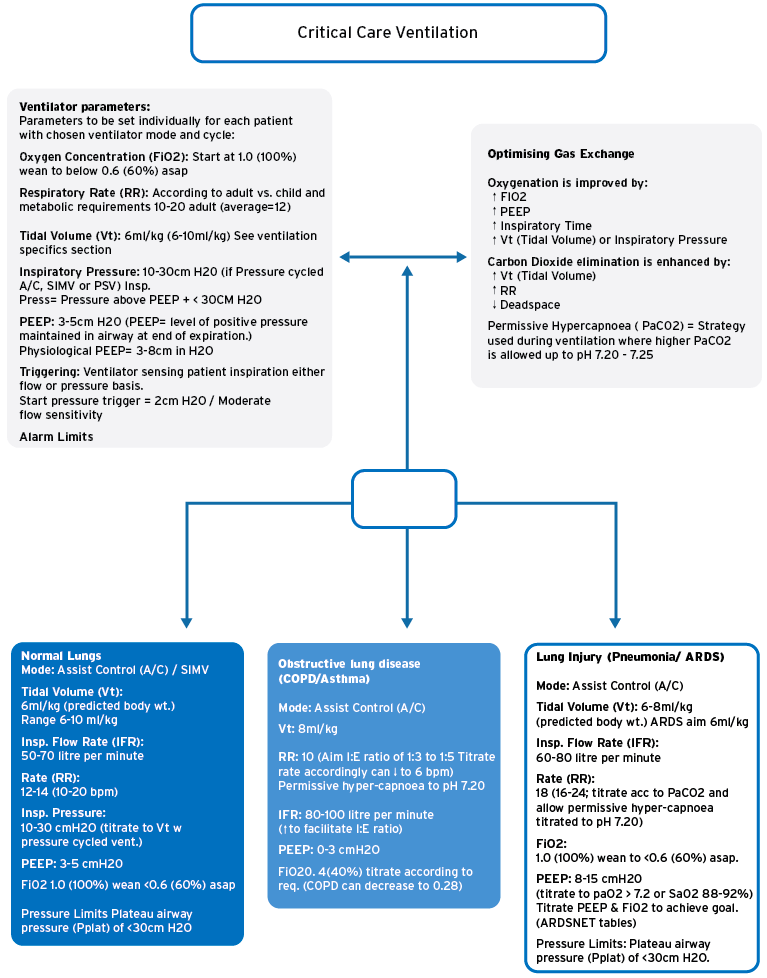
It is important to familiarise yourself with the specific ventilator/s and the modes / settings available in your EC before clinical use.
Mechanical ventilation in itself is not a cure but a temporising measure while underlying pathology is managed optimally.
Mechanical ventilation aims:
- Reversal of hypoxemia / oxygenation failure
- Adequate ventilation / Managing Respiratory distress
- Management / Reversal of acute respiratory acidosis
- Relieving ↑ work of breathing
- Patient comfort and synchronising well with ventilator
Mechanical ventilation:
Volume Cycled Ventilation
- Inhalation continues till set tidal volume (Vt) is delivered, followed by passive exhalation.
- Volume cycling deliver a constant minute ventilation and is frequently used as initial ventilation mode in the Emergency Centre (EC.)
- Gas is delivered with a constant inspiratory flow pattern → resulting peak pressures applied to airways is higher than required to distend the lung (plateau pressure).
- As delivered volume remains constant the pressure applied to the airway varies as pulmonary compliance and airway resistance change.
- Negative aspects are possible high airway pressures with possible barotrauma as result.
- Setting pressure limits on the ventilator and vigilant monitoring are required to minimise this.
Pressure Cycled Ventilation
- Inhalation continues till set pressure is reached regardless of tidal volume delivered.
- Gas is delivered with a decelerating inspiratory flow pattern where inspiratory flow tapers off as the lung inflates.
- Dynamic changes in pulmonary compliance / mechanics may result in varying tidal volumes and has to be observed closely with minute ventilation, these are negative aspects of this mode.
- Modern ventilators can provide volume-assured pressure-cycled ventilation, which ↑ peak pressures as required to guarantee a set minimum tidal volume (Vt).
Ventilator parameters:
Parameters to be set individually for each patient depending on chosen ventilator mode and cycle:
| Oxygen Concentration (FiO2): | Start at 1.0 (100%) wean to below 0.6 (60%) asap |
| Respiratory Rate (RR): | According to adult vs. child and metabolic requirements. 10 – 20 adult (average=12) |
| Tidal Volume (Vt) | 6 ml/kg (6-10ml/kg) See ventilation specifics section |
| Inspiratory flow rate | 50 - 70 l/min (depending on ventilator) |
| Inspiratory : expiratory ratio: | I:E = 1:2 or 3 (determines inspiratory time) |
| Inspiratory pressure | 10 - 30 cm H2O (if Pressure cycled A/C, SIMV or PSV) Insp. press is usually pressure above PEEP and aim < 30 cm H2O |
| PEEP | 3 - 5 cm H2O PEEP = level of positive pressure maintained in airway at end of expiration. Physiological PEEP = 3-8 cm H2O, equal PEEP should be set on the ventilator to prevent atelectasis. |
| Triggering | Ventilator sensing patient inspiration either flow or pressure basis. Start pressure trigger – 1 or 2 cm H2O or moderate flow sensitivity |
| Alarm limits |
Optimising Gas Exchange
Mechanical ventilation can improve oxygenation (measured by PaO2) and assist carbon dioxide elimination (PaCO2.) By optimising these parameters the oxygenation, acid-base balance and haemodynamic status of patient can be improved.
The aim of mechanical ventilation is not to normalise the arterial blood gas but to use clinical knowledge in applying ventilation strategies tailored to individual patient conditions.
Permissive Hypercapnoea (↑PaCO2) = strategy used during ventilation where a higher PaCO2 is allowed as far as the pH does not deteriorate to less than 7.20 - 7.25
Oxygenation is improved by:
- ↑ FiO2
- ↑ PEEP
- ↑ Inspiratory Time
- ↑ Vt (Tidal Volume) or Inspiratory Pressure
Carbon Dioxide elimination is enhanced by:
- ↑ Vt (Tidal Volume)
- ↑ RR
- ↓Dead-space
Ventilator Modes:
Continuous mandatory ventilation (CMV)
Delivers a set number of mechanical breaths, with set tidal volume (Vt), at set respiratory rate (RR.) All breaths controlled by ventilator and patient are not able to initiate or terminate a breath. Best for patient without respiratory effort e.g. apnoea, paralysed, well sedated / anaesthetised pt.
Assist-control ventilation (A/C)
Provide a high level of ventilatory assistance. Set breath volume or pressure and a minimum respiratory rate are either ventilator or patient inspiratory effort triggered. Ventilator initiated breaths triggered only if minimum set respiratory rate is not achieved by patient.
The characteristics of each breath delivered are similar regardless origin of initiation. Patient breaths additional to the set respiratory rate can increase the work of breathing.
Synchronised Intermittent Mandatory Ventilation (SIMV)
Ventilator delivers set mandatory breaths (volume or pressure cycled) synchronised with the respiratory effort of the patient.
Spontaneous breathing is allowed between breaths (if above set respiratory rate preferably pressure supported breaths) facilitating patient-ventilator synchrony.
Synchronisation of the delivered breath to the inspiratory effort of the patient serves to avoid the potential delivery of a mechanical breath to a patient in mid or end in/ex-halation.
Continuous Positive Airway Pressure (CPAP)
Continuous positive pressure is provided to spontaneous breaths supplementary to ambient pressure throughout the ventilator cycle thus decreasing effort with inspiration and providing pressure attention end expiration. The pressure delivered is set.
CPAP is used to assist weaning from mechanical ventilation.
Pressure support ventilation
Ventilator support of each individual patient triggered breath to the set inspiratory pressure. If no breath initiated (apnoea period can be set), the ventilator will switch to a different mode and deliver a breath. This mode assists with decreasing work of breathing in spontaneously breathing patients.
Non Invasive Ventilation (NIV)/ Non Invasive Positive Pressure Ventilation (NIPPV)
This mode provides ventilator support without invasive airway devices, delivered through nasal or face mask (with correct size and tight seal on face.) Evidence based indications for improved outcome with NIPPV are COPD exacerbations and cardiogenic pulmonary oedema. Patients have to be alert, cooperative and haemodynamically stable.
NIPPV can be applied as CPAP or BiPAP (biphasic positive airway pressure.) CPAP delivers pressure continuously and BiPAP delivers an inspiratory pressure (iPAP) combined with expiratory pressure (ePAP).
Suggested initial settings BiPAP: iPAP = 8-10 cmH20 & ePAP = 4-6 cm H2O.
New Ventilation Modes
Airway Pressure Release Ventilation (APRV)
APRV combines Continuous Positive Airway Pressure (PHigh), with intermittent time-cycled transient pressure release to a lower pressure (PLow). The pressure release periods assists in CO2 elimination and limiting airway pressures.
Pressure-Regulated Volume Control (PRVC)
Pressure controlled breaths delivered to assure a set minimum tidal volume.
Proportional assist ventilation (PAV)
PAV optimises the degree of ventilator pressure output to patient’s ventilatory drive.
With higher patient inspiratory drive (rate and volume of inspiratory flow) the ventilator generates more pressure with that particular breath. PAV provides variable support with each breath according to patient effort.
Neurally Adjusted Ventilatory Assist (NAVA)
NAVA delivers ventilation proportional and synchronous to the neural output of the patient’s central respiratory centre. This neural output is measured utilising the electromyographic (EMG) activity of the patient’s diaphragm (measured by specific adapted NG tube with EMG sensors around diaphragm) and adjusts the pressure, flow, volume and time of each ventilated breath accordingly.
References:
- Hamed HMF, Ibrahin HG, Khater YH, Aziz ES. Ventilation and ventilators in the ICU: What every intensivist must know. Current Anaesthesia & Critical Care 2006; 17: 77-83.
- Gomersall C, Joynt G, Cheng C, Yap F, Lam P, Lam K, et al. Basic Assessment & Support in Intensive Care. Hong Kong, The Chinese University of Hong Kong; 2011.
- The Acute Respiratory Distress Syndrome Network. Ventilation with lower tidal volumes as compared with traditional
- tidal volumes for acute lung injury and the acute respiratory distress syndrome. N Engl J Med 2000; 342(18):1301-1308.
- Engelbrecht A, Tintinger GR. Mechanical ventilation in the Emergency Department. CME 2007; 25(3): 118-22.
- Weingart S. Spinning Dials How to dominate the Ventilator. http://crashingpatient.com/wp-content/pdf/weingart%20vent%20handout.pdf.
- Sigillito RJ, DeBlieuw PM. Mechanical Ventilation in Emergency Medicine. http://crashingpatient.com/wp-content/pdf/Mechanical%20Ventilation%20in%20Emergency%20Medicine.pdf.
- Terzi N, Piquilloed L, Roze H, Mercat A, Lofaso F, Delisle S, et al. Clinical Review: Update on neutrally adjusted ventilator assist – report of a round table conference. Critical Care 2012; 16:225 - 238