Weight Management
Weight Management in type 2 Diabetes
Bariatric surgery for type 2 diabetes
(See Strength of Recommendations Taxonomy (SORT) for explanation of Grade A-C)
| SEMDSA 2017 Recommendations | |
|
The body mass index (BMI) and waist circumference of all patients with type 2 diabetes must be recorded at every visit
|
C |
|
Modest weight loss (5-10%) in overweight and obese individuals improves glycaemic control and cardiovascular risk factors
|
A |
|
For obese or overweight patients with type 2 diabetes who are willing, an intensive lifestyle intervention focusing on diet, physical activity, and behavioural therapy should be available to support >5% weight loss over 6 months. Successful programmes require high frequency contact (weekly for 6 months and at least monthly thereafter for those who achieve their goals). Behavioural therapy can/should be offered in groups
|
A |
|
The primary focus of the dietary intervention for weight loss should be on caloric restriction (aim for >500 to 750 kcal deficit/day) irrespective of macronutrient composition, which is less important
|
A |
|
Very low calorie diets must not be prescribed in the primary health care setting
|
C |
|
For achieving and maintaining weight loss goals, encourage individuals to engage in at least 4 hours of moderate intensity exercise (e.g. brisk walking, dancing, gardening) per week
|
|
|
Orlistat is the only weight-loss medication approved in South Africa and can be used as an adjunct to intensive lifestyle interventions in selected patients (BMI ≥ 27 kg/m2 with diabetes or BMI ≥ 30 kg/m2 with IGT)
|
A |
|
When choosing medications for the management of diabetes and co-morbid conditions, always consider the potential effects on weight in obese patients. If weight gain from other glucose therapies is problematic consider switching to drugs with a neutral or beneficial effect on weight (metformin, DPP-4 inhibitors, alpha-glucosidase inhibitors, GLP-1 agonists and SGLT2 inhibitors)
|
C |
|
Bariatric surgery is a treatment option for obesity and diabetes in patients whose BMI ≥ 35 kg/m2 and in selected patients with a BMI ≥ 30 kg/m2 when glucose levels are not controlled, despite the best efforts with medications and lifestyle modification
|
B |
Table I: WHO Classification of Weight by Body Mass Index (BMI) in adults§
| Classification | International BMI category (kg/m2) | BMI Category for Asians |
| Underweight | <18.5 | <18.5 |
| Normal weight | 18.5–24.9 | 18.5-22.9 |
| Overweight | 25.0–29.9 | 23.0-24.9 |
| Obese | ≥30.0 | ≥25.0 |
| Class I | 30.0–34.9 | 25.0-29.9 |
| Class II | 35.0–39.9 | ≥30 |
| Class III | ≥40.0 |
Formula to calculate BMI = weight in kilograms divided by the square of the height in meters (kg/m2)
§ WHO/IASO/IOTF, “The Asia-Pacific perspective: Redefining obesity and its treatment. Health communications,” 2000. [Online] Available: http://www.wpro.who.int/nutrition/documents/docs/Redefiningobesity.pdf. [Accessed on 20th Februrary 2017]
The literature review for this guideline involved a Pubmed and Cochrane database review search up to 1 August 2016, as well as a review of Diabetes Guidelines from the ADA, IDF, AHA, and a Joint Statement by International Diabetes Organisations.
INTRODUCTION
Obesity is a common association with type 2 diabetes, with a large proportion (80-90%) of patients being overweight or obese. Weight gain is a particularly strong risk factor for the development of diabetes,1,2 and a 5 – 10% weight loss has been consistently associated with diabetes prevention (Refer to: Prevention or Delay of type 2 Diabetes Mellitus). Current data from the SANHANES-13 report show that 1/3 of South African men and 2/3 of women are obese or overweight.4 The World Health Organisation (WHO) classification for weight is shown in Table I.
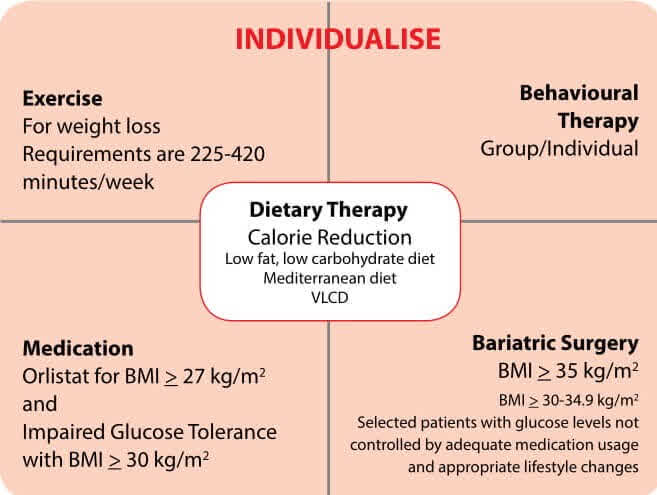
Management of obesity is typically multifaceted and involves dietary changes, exercise, behavioural therapy, pharmacotherapy, and surgical options.
WEIGHT LOSS GOALS
The aim in overweight patients with diabetes is to lose a minimum of 5-10% of body weight, as this has been shown to reduce cardiovascular risk factors.4,5.6 The optimal amount of weight loss is difficult to ascertain, but a minimum of 15% weight loss has been shown to have a marked impression upon glucose levels7 and even reversing diabetes.8 The durability of this approach to diabetes remission though has not been clearly demonstrated, apart from bariatric studies, but does look promising.
DIET
The role of dietary manipulation in diabetes is an evolving one, but when it comes to weight loss, quantity adjustments of the diet in terms of caloric restriction is the most important component, more so than quality adjustments.9,10,11,12,13,14 Optional diets include the low fat, low-carbohydrate (may need to adjust hypoglycaemic therapy), and the Mediterranean diet. Very low calorie diets (VLCD) (< 800 calories per day) should only be prescribed in very carefully selected patients7. Very low-calorie diets that achieve substantial weight loss have been associated with remission of diabetes , but the practicality and durability of this approach, as mentioned earlier, requires further research7,8,15 There is no one diet that is applicable to all patients, and therefore each patient’s diet needs to be individualised.
EXERCISE
Exercise16,17 is an important component in the management of diabetes, but currently still plays a secondary role to dietary caloric reduction when it comes to weight loss.
With regards to weight loss, physical activity of moderate intensity for longer than 225–420 minutes per week will result in about a 5-7.5 kg weight loss. There is a dose-response relationship between exercise and weight loss, with more exercise leading to greater weight loss. For weight maintenance, after weight loss has been achieved, 200-300 minutes of exercise per week is required.
For people with diabetes at a stable weight, moderate exercise for 150-250 minutes per week is required to prevent weight gain of > 3% in adults. Resistance training has not been shown to be particularly effective for weight loss, although there is limited evidence that it promotes the gain or maintenance of lean mass and loss of body fat during energy restriction. There is also some evidence that resistance training helps improves chronic disease risk factors.16,17
BEHAVIOURAL THERAPY
Behavioural therapy is an important component in supporting weight loss, and can be offered on an individual and/or group basis to help patients overcome problems and to help them to achieve their goals.15
PHARMACOTHERAPY
Currently, only orlistat is approved in South Africa as pharmacotherapy for weight loss, although other medications (phentermine-topamax, lorcaserin, natrexone-bupropion, and liraglutide 3.0mg) are licenced in other countries. Orlistat can be prescribed for patients with diabetes and a body mass index (BMI) ≥ 27 kg/m2, as well as for those with impaired glucose tolerance and a BMI ≥ 30 kg/m2. If weight loss is < 5% in 3 months, then the medication must be stopped.18,19
The SCALE study examined liraglutide 1.8 mg and 3.0 mg for weight loss in type 2 diabetes;20 mean placebo corrected weight loss was 2.7% and 4% for the 1.8 mg and 3.0 mg dose, and 20% and 35% of patients lost >5% weight respectively (placebo corrected).
The single exit price including VAT for these drugs as at March 2017 was as follows:
- Orlistat 120 mg TDS x 28 days: R945.67
- Liraglutide 1.8 mg/day (registered dose for diabetes) x 30 days: R2145.97
Drugs with a neutral or beneficial effect on weight, such as metformin, DPP-4 inhibitors, GLP-1 agonists, SGLT2 inhibitors and alpha-glucosidase inhibitors may be the preferred choice of treatment for overweight or obese patients, especially if weight gain is problematic with other therapies.
BARIATRIC SURGERY FOR TYPE 2 DIABETES
Bariatric surgery has been a major advancement in the treatment of obese people with diabetes in recent years. It should be considered for patients who have reached physical maturity and have type 2 diabetes with a BMI≥ 35 kg/m2.21,22,23,24,25,26,27,28,29,30,31 The surgery must be performed in an experienced multidisciplinary unit. The benefits of surgery extend beyond improving glycaemic control, as multiple other comorbidities are also positively affected. With regards to the complications of diabetes, particularly microvascular and macrovascular complications, cancer and mortality, there is currently only observational data on the influence of bariatric surgery.31
This data does, however, shows some promise with regard to the aforementioned endpoints. Bariatric surgery has been shown to reduce mortality.42 Bariatric surgery for patients whose BMI is under 35 kg/m2 can only be considered in those in whom glucose levels are not controlled by adequate medication usage and appropriate lifestyle changes.31,32,33,34,35,36,37,38,39,40,41
The BMI threshold in patients of Asian descent should be 2.5 kg/m2 lower than for Caucasians (ADA recommendation).
Bariatric surgery is not without its complications, and therefore regular structured follow-up is essential to pre-empt potential complications, with particular attention being paid to those complications relating to nutritional deficiencies.43
The choice of procedure (Roux-en Y gastric bypass, biliopancreatic diversion with duodenal switch, sleeve gastrectomy and gastric banding) is to be individualised by the Bariatric Centre.
SUMMARY
Weight loss for overweight/obesity in patients with diabetes must be considered as an integral part of management. The optimal means to lose weight involves multiple options, and must be individualised for each patient. Bariatric surgery is the most effective intervention for those who fail to achieve weight loss goals with lifestyle modification but is not without cost or complications.
Author: Wayne May
Editors: Aslam Amod and Fraser J. Pirie
Bibliography
- Colditz GA, Willett WC, Rotnitzky A, Manson JE. Weight gain as a risk factor for clinical diabetes mellitus in women. Ann Intern Med. 1995; 122(7):481-486.
- Chan JM, Rimm EB, Colditz GA, Stampfer MJ, Willett WC Obesity, fat distribution, and weight gain as risk factors for clinical diabetes in men. Diabetes Care. 1994; 17(9):961-969.
- Shisana O, Labadarios D, Rehle T, Simbayi L, Zuma K, Dhansay A, Reddy P, Parker W, Hoosain E, Naidoo P, Hongoro C, Mchiza Z, Steyn NP, Dwane N, Makoae M, Maluleke T, Ramlagan S, Zungu N, Evans MG, Jacobs L, Faber M, & the SANHANES-1 Team (2014) South African National Health and Nutrition Examination Survey (SANHANES-1): 2014 Edition. Cape Town: HSRC Press
- Wing RR , Lang W, Wadden TA., Safford M, Knowler WC, Bertoni AG et al. Benefits of modest weight loss in improving cardiovascular risk factors in overweight and obese individuals with type 2 diabetes. Diabetes Care. 2011; 34(7):1481-1486
- Eight-year weight losses with an intensive lifestyle intervention: the Look AHEAD study Look AHEAD Research Group. Obesity (Silver Spring) 2014; 22:5–13
- Wing RR, Bolin P, Brancati FL, et al.; Look AHEAD Research Group. Cardiovascular effects of intensive lifestyle intervention in type 2 diabetes. N Engl J Med 2013; 369:145–154
- Lean M. VLED and formula LED in the management of type 2 diabetes: defining the clinical need and research requirements. Clinical Obesity. (2011) 1, 41–49
- Lim EL, Hollingsworth KG, Aribisala BS, Chen MJ, Mathers JC, Taylor R. Reversal of type 2 diabetes: normalization of beta cell function in association with decreased pancreas and liver triacylglycerol. Diabetologia 2011; 54:2506–2514
- Foster GD, Wyatt HRHill JO, Makris AP, Rosenbaum DLet al Weight and Metabolic Outcomes after 2 Years on a Low-Carbohydrate Versus Low-Fat Diet. Ann Intern Med. 2010 August 3; 153(3): 147–157
- Sacks FM, Bray GA, Carey VJ., Smith SR, Ryan DH , Anton SD, et al. Comparison of weight-loss diets with different compositions of fat, protein, and carbohydrates. N Engl J Med 2009; 360:859–873
- Shai I, Shwarzfuchs D, Henkin Y, et al. Weight loss with low carb, low fat or mediterranean diet. New Engl J Med. 2008; 359:229-241.
- Esposito K, Maiorino MI, Ciotola M, Di Palo C, Scognamiglio P, Gicchino M, et al. Effects of a Mediterranean-style diet on the need for antihyperglycemic drug therapy in patients with newly diagnosed type 2 diabetes: a randomized trial. Ann Intern Med. 2009; 151:229-241.
- Davis NJ, Tomuta N, Schechter C, Isasi CR, Segal-Isaacson CJ, et al. Comparative Study of the Effects of a 1-Year Dietary Intervention of a Low-Carbohydrate Diet Versus a Low-Fat Diet on Weight and Glycemic Control in Type 2 Diabetes.Diabetes Care July 2009 vol. 32 no. 7 1147-1152
- Iqbal N, Vetter ML, Moore RH, Chittams JL, Dalton-Bakes CV, Dowd M, et al. Effects of a low-intensity intervention that prescribed a low-carbohydrate vs. a low-fat diet in obese, diabetic participants- 2 year Obesity 2010 Sep;18(9):1733-8
- Jackness C, Karmally W, Febres G, et al. Very low-calorie diet mimics the early beneficial effect of Roux-en-Y gastric bypass on insulin sensitivity and b-cell function in type 2 diabetic patients. Diabetes 2013; 62:3027–3032
- Donnelly JE, Blair SN, Jakicic JM, Manore MM, Rankin JW et al. Appropriate physical activity intervention strategies for weight loss and prevention of weight regain for adults. Medicine and Science in Sports and Exercise. 2009;41(2):459-471.
- Colberg SR, Albright AL, Blissmer BJ, Braun B, Chasan-Taber L, Fernhall B et al.Exercise and type 2 diabetes: joint position statement. Medicine and Science in Sports and Exercise. 2010;42(12):2282-2303
- Torgenson JS, Boldrin MN, Hauptman J, et al. XENical in the prevention of diabetes in obese subjects (XENDOS) study. Diabetes Care. 2004;27: 155-161.
- Li Z, Maglione M, Tu W, et al. Meta-analysis: pharmacologic treatment of obesity. Ann Intern Med. 2005; 142:532-546.
- Davies MJ, Bergenstal R, Bode B, et al. Efficacy of Liraglutide for Weight Loss Among Patients With Type 2 Diabetes. JAMA. 2015;314(7):687. doi:10.1001/jama.2015.9676.
- Dixon JB, O’Brien PE, Playfair J, et al. Adjustable gastric banding and conventional therapy for type 2 diabetes. JAMA. 2008; 299(3):316-323.
- Sjöström L, Lindroos LAK, Peltonen M, et al. Lifestyle, diabetes, and cardiovascular risk factors 10 years after bariatric surgery. N Engl J Med. 2004;351(26):2683W.
- Schauer PR, Bhatt DL, , Kirwan JP, Wolski K, Brethauer SA, Navaneethan S. et al for the STAMPEDE Investigators. Bariatric Surgery versus Intensive Medical Therapy for Diabetes — 3-Year Outcomes. N Engl J Med 2014; 370:2002-2013
- Mingrone G, Panunz S, De Gaetano A, Guidone C, Iaconelli A, Leccesi Let al . Bariatric Surgery versus Conventional Medical Therapy for Type 2 Diabetes. N Engl J Med 2012; 366:1577-1585
- Mingrone G, Panunzi S, De Gaetano A, et al. Bariatric-metabolic surgery versus conventional medical treatment in obese patients with type 2 diabetes: 5 year follow-up of an open-label, single-centre, randomised controlled trial. Lancet 2015; 386: 964–973
- Cummings DE, Arterburn DE, Westbrook EO, et al. Gastric bypass surgery vs intensive lifestyle and medical intervention for type 2 diabetes: the CROSSROADS randomised controlled trial. Diabetologia 2016; 59: 945–953
- Halperin F, Ding SA, Simonson DC, et al. Roux-en-Y gastric bypass surgery or lifestyle with intensive medical management in patients with type 2 diabetes: feasibility and 1-year results of a randomized clinical trial. JAMA Surg 2014; 149: 716–726
- American Diabetes Association. 6. Obesity management for the treatment of type 2 diabetes. Diabetes Care 39 (Suppl. 1), S47–S51 (2016).
- International Diabetes Federation. The International Diabetes Federation has released its Position Statement on Bariatric Surgery [homepage on the Internet]. c2011 [cited 2012 Mar 8]. Available from: http://www.idf.org/webdata/docs/IDF-Position-Statement-Bariatric-Surgery.pdf.
- Bariatric surgery and cardiovascular risk factors. A scientific statement from the American Heart Association. Circulation. 2011; 123: 1683-1701.
- Rubino F, Nathan DM, Eckel RH, et al. Metabolic surgery in the treatment algorithm for type 2 diabetes: a joint statement by international diabetes organizations. Diabetes Care. 2016; 39: 861-877
- Panunzi S, De Gaetano A, Carnicelli A, Mingrone G. Predictors of remission of diabetes mellitus in severely obese individuals undergoing bariatric surgery: do BMI or procedure choice matter? A meta-analysis. Ann Surg 2015; 261: 459–467
- Panunzi S, Carlsson L, De Gaetano A, Peltonen M, Rice T, Sjöström L Et al Determinants of Diabetes Remission and Glycemic Control After Bariatric Surgery. Diabetes Care 2016 Jan; 39(1):166-74
- Ikramuddin S, Korner J, Lee WJ, et al. Roux-en-Y gastric bypass vs intensive medical management for the control of type 2 diabetes, hypertension, and hyperlipidemia: the Diabetes Surgery Study randomized clinical trial. JAMA 2013; 309: 2240–2249
- Courcoulas AP, Goodpaster BH, Eagleton JK, et al. Surgical vs medical treatments for type 2 diabetes mellitus: a randomized clinical trial. JAMA Surg 2014; 149:707–715
- Liang Z, Wu Q, Chen B, Yu P, Zhao H, Ouyang X. Effect of laparoscopic Roux-en-Y gastric bypass surgery on type 2 diabetes mellitus with hypertension: a randomized controlled trial. Diabetes Res Clin Pract 2013; 101: 50–56
- Wentworth JM, Playfair J, Laurie C, et al. Multidisciplinary diabetes care with and without bariatric surgery in overweight people: a randomised controlled trial.Lancet Diabetes Endocrinol 2014; 2: 545–552
- Parikh M, Chung M, Sheth S, et al. Randomized pilot trial of bariatric surgery versus intensive medical weight management on diabetes remission in type 2 diabetic patients who do NOT meet NIH criteria for surgery and the role of soluble RAGE as a novel biomarker of success. Ann Surg 2014; 260: 617–622
- Cohen RV, Pinheiro JC, Schiavon CA, Salles JE, Wajchenberg BL Effects of Gastric Bypass Surgery in Patients With Type 2 Diabetes and Only Mild Obesity. Diabetes Care 2012; 35: 1420–1428
- ASMBS Clinical Issues Committee. Bariatric surgery in class I obesity (body mass index 30–35kg/m2). Surgery for Obesity and Related Diseases 9 (2013) e1–e10
- Harold E. Lebovitz. Metabolic Surgery for Type 2 Diabetes with BMI <35 kg/m2. Obes Surg (2013) 23: 800–808
- Sjöström L, Narbro K, Sjöström CD, Karason K, Larsson B, et al. Effects of Bariatric Surgery on Mortality in Swedish Obese Subjects N Engl J Med 2007;357:741-52
- Wolfe BM, Belle SH. Long-term risks and benefits of bariatric surgery: a research challenge. JAMA 2014; 312:1792–1793