WHO Recommendations for the Use of Analgesics
General principles and management of cancer pain in adults
The World Health Organisation (WHO) recommends a five point method for the use of analgesics that is inexpensive and effective for relieving pain in 70%-90% of patients with cancer:22
By mouth
As far as possible, analgesics should be administered by mouth. In patients where oral administration is unsuitable or not possible, alternative routes include rectal suppositories, continuous subcutaneous infusion and, in the hospital setting, intravenous administration.
By the clock
In order to achieve continuous pain control, analgesic medications must be administered regularly and at the appropriate fixed time interval (e.g., 4 hourly). The dose should be up-titrated until an adequate level of analgesia is achieved and the next dose should be given before the effect of the previous one has fully worn off. Rescue doses at 50% to 100% of the regular dose may be necessary for incident or breakthrough pain.
By the ladder
Analgesia should be appropriate for the type and severity of pain, stepping up for persisting or worsening pain and stepping down as pain improves, if it can be contained with lower doses or less potent analgesics.
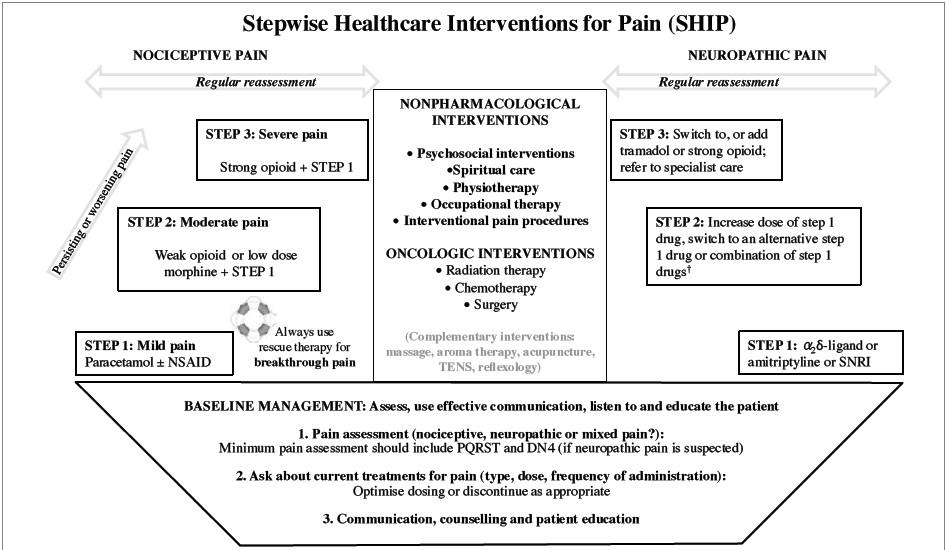
In patients with mild nociceptive pain, step 1 is a non-opioid analgesic (paracetamol) or a nonsteroidal anti-inflammatory drug (NSAID).
For moderate to severe nociceptive pain, steps 2 and 3 include the use of opioids, which may be co-prescribed with non-opioids (paracetamol and/or NSAID) as necessary. Because of its lower cost and predictable efficacy and tolerability, low dose morphine is a preferred option at step 2. This applies to adults and especially to pain management for children.11 Codeine should not be used in paediatric patients.
The combination of a weak opioid and a strong opioid is to be avoided. When a patient requires escalation of analgesia with a stronger opioid the weak opioid must be discontinued.
Unlike nociceptive pain, treatment for neuropathic pain is not escalated according to pain intensity, but according to response to step 1 agents, which may be an α2δ-ligand (pregabalin or gabapentin), amitriptyline or a serotonin noradrenaline reuptake inhibitor (SNRI; duloxetine or venlafaxine). Analgesic escalation may be achieved by increasing the dose of the step 1 treatment, switching to an alternative step 1 treatment, combining step 1 treatments and, at step 3, adding a strong opioid. Referral to specialist care should be considered in difficult cases, where, despite escalation of pain management, pain is not adequately controlled.
The Stepwise Healthcare Interventions for Pain (SHIP), is an inclusive progressive approach to pain management (Figure 1). As an initial work-up, all patients require a systematic assessment of their pain with open communication and education about their condition and available management options (see Communication). Special attention should be paid to previously tried and current analgesic use, the dose and how frequently it is being taken, adjusting or discontinuing as appropriate. Identifying the presence of nociceptive pain, neuropathic pain or mixed pain will determine the type of pain medication that is appropriate.
Stepwise management of pain does not need to begin at step 1. Depending on the experience and expertise of the attending physician, it may be appropriate to begin at step 2 or 3 in a patient with moderate to severe pain and to step down as pain control is achieved and maintained. Breakthrough pain should always be treated.
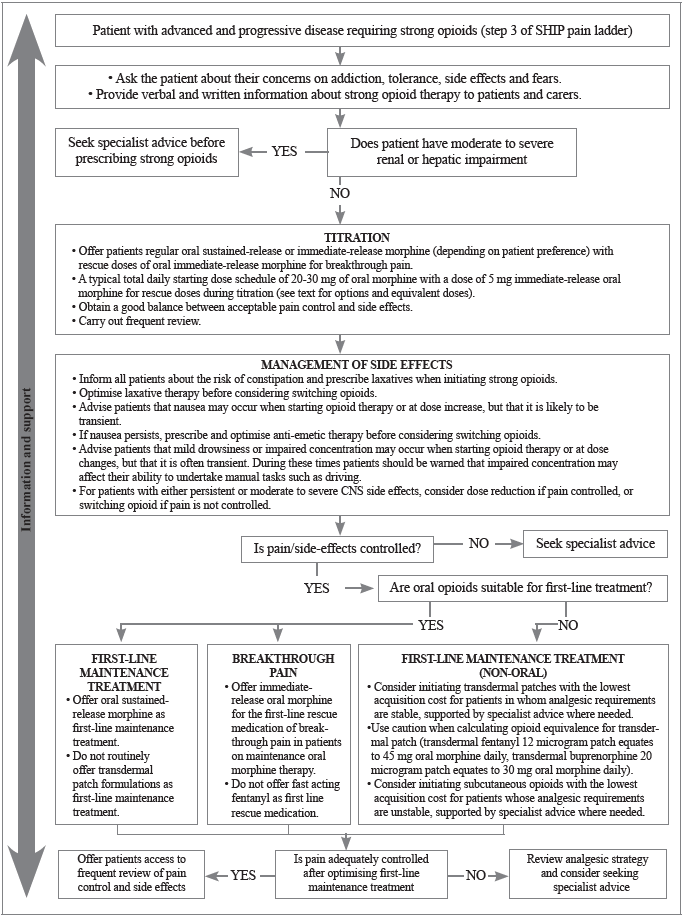
A stepwise algorithm for the use of opioids in patients with cancer pain is illustrated in Figure 2.
Communication, counselling and patient education should be continued throughout the duration of management. Nonpharmacological approaches to pain management and specific interventions for the cancer should be initiated at any step when they are indicated or where they will improve the patient’s quality of life. Psychosocial and complementary interventions (e.g., social interaction, spiritual counselling, recreational activities, relaxation therapy, imagery) should also be considered.
Click on image to enlarge
Figure 1: The Stepwise Healthcare Interventions for Pain (SHIP) model for pain management, including an analgesic ladder for nociceptive pain (left) and a stepwise pharmacotherapeutic approach to neuropathic pain (right). Mixed pain may require a combination of treatments from both sides of the diagram. Communication, counselling and patient education should be initiated at the first consultation and continued throughout the duration of management. Other psychosocial interventions (social interaction, spiritual counselling, recreational activities, relaxation therapy, imagery), nonpharmacological approaches to pain management and specific interventions for the cancer should be initiated at any step when they are indicated or where they will improve the patient’s quality of life. See text for details.
†Rational combinations for neuropathic pain are amitriptyline + α2δ-ligands, or SNRI + α2δ-ligands . NSAID: nonsteroidal anti-inflammatory drug; α2δ-ligand: gabapentin or pregabalin; SNRI: serotonin noradrenalin reuptake inhibitor (duloxetine or venlafaxine); TENS: transcutaneous electrical nerve stimulation.
©2015 South African Cancer Pain Working Group.
Click on image to enlarge
Figure 2: Algorithm for the prescription of opioids in patients with cancer pain
Reproduced from National Institute for Health and Clinical Excellence (NICE) clinical guideline 140; 2012.12
For the individual
All pain management strategies must be individualised. Doses of analgesics and frequency of administration will vary depending on the individual patient and their current level of pain.
Attention to detail
Pain medication must be administered regularly. In patients with normal renal and hepatic function oral morphine is administered every 4 hours. The first and last doses of the day should be linked to the patient’s waking and bedtime. A double dose at bedtime may be permissible so that the patient can skip the dose scheduled for the early hours of the morning. For example, if dosing is at 6 am, 10 am, 2 pm, 6 pm, 10 pm and 2 am, taking a double dose at 10 pm means that the patient does not have to wake for the 2 am dose.
Dosing instructions for the patient or their family should be written out in full, including the drug name, reason for use, dose (number of tablets if appropriate) and number of times a day that the medication should be taken. Patients should be warned about possible side effects and cautioned about using other medications that have not been prescribed for them. Combination analgesic preparations (two or more pharmacologically active ingredients combined in a single tablet, capsule or liquid preparation) may pose a risk of overdose or adverse effects when used in conjunction with prescribed or over-the-counter medications containing the same or similarly acting ingredients, and should be avoided.
Thus, in summary, the steps to be considered in the management of cancer pain are as follows:16
- Appropriate assessment to identify cause and severity of symptoms
- Explanation to patient and family at all stages
- Correct reversible factors
- Consider disease-specific palliative therapy
- Institute non-pharmacological interventions
- Prescribe appropriate first-line treatment
- Consider adjuvant/ second-line treatment
- Review assessment and management
At all stages of management consider: - Involvement of interdisciplinary team
- Referral to appropriate service/more experienced clinician