Acute Coronary Syndromes
Standard Treatment Guidelines and Essential Medicines List for South Africa, Hospital Level, Adults 2019 Edition
ST elevation myocardial infarction (STEMI)
Non-ST elevation myocardial infarction (NSTEMI) and unstable angina (UA)
Chronic management of STEMI/ NSTEMI/ UA
Atherosclerotic peripheral arterial disease
These conditions should be managed in a high care setting with continuous ECG and frequent BP monitoring.
Reference guide for ECG analysis: “ECG APPtitude” smartphone app can be downloaded from the relevant app stores - available for iOS and Android.
ST ELEVATION MYOCARDIAL INFARCTION (STEMI)
I21.0-I21.3/I21.9/I22.0-1/I22.8-9
DESCRIPTION
Ischaemic chest pain that is prolonged, ongoing or associated with nausea, sweating and syncope or associated with persistent ST elevation or new / presumed new left bundle branch block (LBBB). Repeat ECG at 20 to 30-minute intervals if the initial ECG is not diagnostic. Treatment should not be delayed while awaiting for troponin results.
MEDICINE TREATMENT
Note:
The following guidance is not for primary percutaneous coronary intervention (PCI).
- Oxygen if saturation <94%.
LoE:IIbix
- Clopidogrel, oral, 75 mg daily for one month.
LoE:IIax
AND
- Aspirin, oral, 150 mg immediately as a single dose (chewed or dissolved).
- Followed with 150 mg daily (continued indefinitely in absence of contraindications).
LoE:IIaxi, LoE:IIaxii
AND
Thrombolytic therapy:
- Streptokinase, IV 1.5 million units diluted in 100 mL sodium chloride 0.9%, infused over 30–60 minutes. Do not use heparin if streptokinase is given.
- Hypotension may occur. If it does, reduce the rate of infusion but strive to complete it in < 60 minutes.
- Streptokinase is antigenic and should not be re-administered in the period of 5 days to 12 months after 1st administration.
- Severe allergic reactions are uncommon but antibodies which may render it ineffective may persist for years.
LoE:IIIbxiii
| Considerations for initiating thrombolytics | Contra-indications |
| For acute myocardial infarction with ST elevation or left bundle branch block: - Maximal chest pain is <6 hours - Beyond 6 hours and chest pain, consult a specialist - >6 hours and no chest pain, manage with anticoagulants (See NSTEMI) - If on-going ischaemic pain LoE:Iaxiv |
Absolute: - Streptokinase used within the last year, - previous allergy, - Confirmed CVA within the last 3 months - history of recent major trauma, - bleeding within the last month, -aneurysms, - brain or spinal surgery or head injury within the preceding month, or recent (<3 weeks) major surgery, - active bleeding or known bleeding disorder, - aortic dissection. Relative (consult specialist): - Refractory hypertension, - warfarin therapy, - recent retinal laser treatment, - subclavian central venous catheter, -pregnancy, -TIA in the preceding 6 months, -Traumatic resuscitation. |
Table 2: Indications and contraindications for streptokinase
OR
If streptokinase is unavailable:
- Thrombolytic e.g.:
- Alteplase, IV infusion:
- Do not exceed 100 mg.
- If history of onset is less than 6 hours (beyond 6 hours consult a specialist or treat as NSTEMI (see below):
- Alteplase, IV infusion:
LoE:Iaxv
|
Weight
|
Bolus
|
Next 30 minutes
|
Next 60 minutes
|
|
>65 kg
|
15 mg
|
50 mg
|
35 mg
|
|
≤65 kg
|
15 mg
|
0.75 mg/kg
|
0.5 mg/kg
|
Indications and contraindications are similar to those for streptokinase as above (except that prior use of streptokinase is not a contraindication).
LoE:IVbxvi
Monitor the following, continuously and also during transfer:
- pulse
- BP
- respiration depth and rate (count for a full minute)
- ECG
Note:
Defibrillator should be readily available at all times including during transport.
Adjunctive treatment
- Enoxaparin (after alteplase; do not use heparins after streptokinase).
- Loading dose: IV, 30 mg as a bolus, followed by SC, 1 mg/kg as a single dose (total cumulative dose not to exceed 100 mg).
- Maintenance dose: SC, 1.5 mg/kg daily or 1 mg/kg 12 hourly.
- Continue enoxaparin therapy until coronary angiography, or for the duration of hospitalisation up to a maximum of 8 days.
- In the elderly (>75 years of age), omit the IV loading dose and reduce the SC dose:
- Loading dose: SC, 0.75 mg/kg as a single dose.
- Maintenance dose: SC, 1.5 mg/kg daily or 1 mg/kg 12 hourly.
LoE:IIbxvi, LoE:Iaxviii
Pain not responsive to thrombolytics may suggest ongoing unresolved ischaemia.
- Discuss with specialist and consider the following treatments:
- Nitrates, e.g.:
- Isosorbide dinitrate, SL, 5 mg immediately as a single dose.
- May be repeated at 5-minute intervals for 3 or 4 doses.
- Isosorbide dinitrate, SL, 5 mg immediately as a single dose.
- Nitrates, e.g.:
LoE:IIIbxix
For ongoing chest pain, to control hypertension or pulmonary oedema:
- Glyceryl trinitrate, IV, 5–200 mcg/minute, titrated to response.
- Guidance on preparation and administration included below.
CAUTION
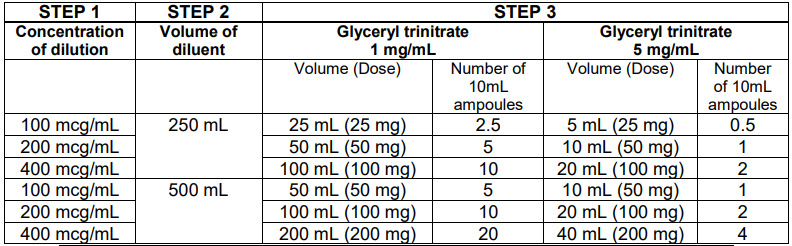
Glyceryl trinitrate IV formulation must be diluted before infusion
STEP 1: Select the concentration as required for the individual patient
- For patients who are fluid congested or require higher doses for a clinical response, consider using a more concentrated solution e.g. 200 or 400 mcg/mL.
STEP 2: Select the volume of the diluent
- Patients who are likely to require treatment for a longer duration e.g. unstable angina prepare a larger volume e.g. 500mL.
- Compatible diluents include sodium chloride 0.9% or dextrose 5%.
STEP 3: Confirm the formulation of glyceryl trinitrate available and mix with diluent
- Confirm the strength of the GTN solution i.e. whether a 1mg/mL or 5mg/mL formulation is available.
- Depending on the formulation available, select the number of ampoules to be used based on the concentration and volume of the diluent as decided in Step 1 and 2 above.
- Ensure that the equivalent volume of diluent is removed from the bag before adding the total GTN volume e.g. if 100mLs of GTN is to be added, first remove 100mL of diluent from the bag before adding the GTN.
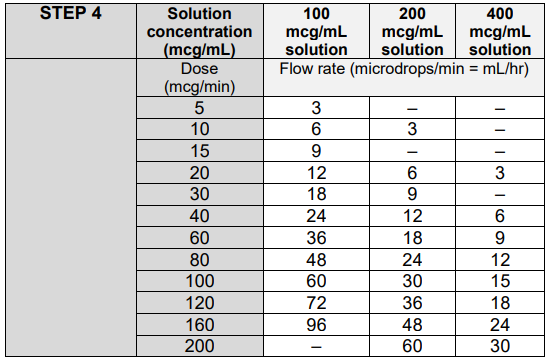
STEP 4: Set the flow rate for infusion
- Flush the PVC tube before administering to the patient.
- Start with the lowest flow rate possible based on the concentration of the solution prepared.
- Increase by 5 mcg/minute every 5 minutes until a response is achieved or until the rate is 20 mcg/minute.
- If no response after 20 mcg/minute, increase by 20 mcg/minute until a response.
- Monitor blood pressure carefully.
E.g. To prepare a 200 mcg/mL solution for a patient likely to require several hours of the GTN infusion:
Use 10 ampoules (100 mL) of the 1 mg/mL GTN formulation mixed with 400 mL of diluent (100 mL to be removed from a 500 mL bag). Initiate the infusion at a flow rate of 3 mL/hr and titrate the infusion rate based on the patient's response.
Click on image to enlarge.
Click on image to enlarge.
Table 3: Dilution of glyceryl trinitrate
For severe pain unresponsive to nitrates:
Discuss with a specialist for possible transfer for rescue PCI, and then consider morphine:
- Morphine, IV, to a total maximum dose of 10 mg (See Appendix II: Prescribing Information for Specific Medicines, for individual dosing and monitoring for response and toxicity).
- Ongoing severe pain despite all appropriate treatment above is an indication for urgent referral.
When clinically stable without signs of heart failure, hypotension, bradydysrhythmias or history of asthma:
- Cardio-selective ß-blocker, e.g.:
- Atenolol, oral, 50 mg daily.
- HMGCoA reductase inhibitors (statins), e.g.:
- Rosuvastatin, oral, 10 mg at night.
LoE:Iaxx
Patients on protease inhibitor:
- Atorvastatin, oral, 10 mg at night.
LoE:Iaxxi
Patients on amlodipine (and not on a protease inhibitor):
- Simvastatin, oral, 10–20 mg at night.
LoE:IIIbxxii
If patient complains of muscle pain:
Reduce dose:
- HMGCoA reductase inhibitors (statins), e.g.:
- Simvastatin, oral, 10-20 mg at night.
OR
Consult specialist for further management.
LoE:IIIbxxiii
For left ventricular (LV) dysfunction following myocardial infarction, heart failure or ejection fraction <40%:
- ACE-inhibitor, e.g.:
- Enalapril, oral, target dose, 10 mg 12 hourly.
If ACE-inhibitor intolerant, i.e. intractable cough or angio-oedema:
- Angiotensin receptor blocker (ARB), e.g.:
- Losartan, oral, 50–100 mg daily. Specialist initiated.
|
- Angioedema is a potentially serious complication of ACE-inhibitor/ angiotensin receptor blocker treatment and if it occurs stop the medication and do not re-challenge.
- Concomitant use of fluoroquinolones with ACE-inhibitor/ angiotensin receptor blocker is contraindicated in moderate to severe renal impairment (CrCl ≤30 mL/minute) and in the elderly. Assess renal function before initiating treatment and monitor during treatment. LoE:IIIbxxiv |
Institute other therapy for heart failure and LV dysfunction as described in Congestive cardiac failure.
REFERRAL
- Refractory cardiogenic shock.
- Refractory pulmonary oedema.
- Haemodynamically compromising ventricular dysrhythmia.
- Patients with the combination of new right bundle and posterior fascicular block post MI should be referred for permanent pacemaker consideration as they at high risk for progression to complete heart block.
- Myocardial infarction-related mitral regurgitation or ventricular septal defect (VSD).
- Contraindication to thrombolytic therapy provided PCI facility available (confirm with cardiologist).
- Ongoing ischaemic chest pain.
- Failed reperfusion (<50% reduction in ST elevation at 90 minutes after initiation of streptokinase and 60 minutes after initiation of thrombolytics (e.g., alteplase) in leads showing greatest ST elevation, especially in anterior infarct or inferior infarct with right ventricular involvement).
NON-ST ELEVATION MYOCARDIAL INFARCTION (NSTEMI) AND UNSTABLE ANGINA (UA)
I21.4/I21.9/I20.0
DESCRIPTION
Non-ST elevation MI: Chest pain that is increasing in frequency and/or severity or occurring at rest. The chest pain is associated with elevated cardiac biomarkers and ST segment depression or T wave inversion on ECG, or a normal ECG. Biomarker elevation in the absence of diagnostic ECG changes or symptoms compatible with myocardial ischemia should prompt consideration of alternative diagnoses (e.g. heart failure, pulmonary embolism, chronic kidney disease, sepsis, myopericarditis).
LoE:IVbxxv
Unstable angina pectoris: Chest pain that is increasing in frequency and or severity, or occurring at rest. It also encompasses post-infarct angina. The chest pain may be associated with ST segment depression or T wave inversion on ECG. There is no rise in cardiac biomarkers.
MEDICINE TREATMENT
Note:
The following guidance is not for primary percutaneous coronary intervention
- Oxygen, if saturation <94%.
LoE:IIbxxvi
- Clopidogrel, oral, 300 mg.
- Followed by 75 mg daily for 3 months.
LoE:Iaxxvii
AND
- Aspirin, oral, 150 mg immediately as a single dose (chewed or dissolved).
- Followed with 150 mg daily (continued indefinitely in absence of contraindications).
LoE:Iaxxviii
AND
Anticoagulation:
For NSTEMI and UA (also for STEMI not given thrombolytic therapy):
- Enoxaparin, SC, 1 mg/kg 12 hourly for minimum of 2 days.
OR
- Unfractionated heparin, IV bolus, 5 000 units.
- Follow with 1 000–1 200 units hourly monitored by aPTT.
- Continue infusion for minimum of 2 days.
LoE:Iaxxix
To relieve possible coronary spasm and pain and to reduce preload:
- Nitrates, e.g.:
- Isosorbide dinitrate SL, 5 mg immediately as a single dose.
- May be repeated at 5-minute intervals for 3 or 4 doses.
- Isosorbide dinitrate SL, 5 mg immediately as a single dose.
For persistent pain and if oral therapy is insufficient:
- Glyceryl trinitrate, IV, 5–200 mcg/minute, titrated to response.
- Start with 5 mcg/minute and increase by 5 mcg/minute every 5 minutes until response or until the rate is 20 mcg/minute.
- If no response after 20 mcg/minute, increase by 20 mcg/minute every 5 minutes until pain response or medicine no longer tolerated.
- Flush the PVC tube before administering the medicine to patient.
- Monitor BP carefully.
For dilution of glyceryl trinitrate refer to ST elevation myocardial infarction (STEMI).
For severe pain unresponsibe to nitrates:
Discuss with a specialist for possible transfer for rescue PCI, and then consider morphine:
- Morphine, IV, to a total maximum dose of 10 mg (See Appendix II Prescribing Information for Specific Medicines, for individual dosing and monitoring for response and toxicity).
- Ongoing severe pain despite all appropriate treatment above is an indication for urgent referral
When clinically stable without signs of heart failure, hypotension, bradydysrhythmias or asthma:
- Cardio-selective ß-blocker, e.g.:
- Atenolol, oral, 50 mg daily.
- HMGCoA reductase inhibitors (statins), e.g.:
- Rosuvastatin, oral, 10 mg at night.
LoE:Iaxxx
Patients on protease inhibitor:
- Atorvastatin, oral, 10 mg at night.
LoE:Iaxxxi
Patients on amlodipine (and not on a protease inhibitor):
- Simvastatin, oral, 10-20 mg at night.
LoE:Iaxxxii
If patient complains of muscle pain:
Reduce dose:
- HMGCoA reductase inhibitors (statins), e.g.:
- Simvastatin, oral, 10 mg at night.
OR
Consult specialist for further management.
- Simvastatin, oral, 10 mg at night.
LoE:IIIbxxxiii
If there is cardiac failure or LV dysfunction: (See Congestive cardiac failure):
(I50.0)
- ACE-inhibitor, e.g.:
- Enalapril, oral, target dose 10 mg 12 hourly.
LoE:IVbxxxiv
If ACE-inhibitor intolerant, i.e. intractable cough or angio-oedema:
- Angiotensin receptor blocker (ARB), e.g.:
- Losartan, oral, 50-100 mg daily. Specialist initiated.
Institute other therapy for heart failure and LV dysfunction as described in Congestive cardiac failure.
REFERRAL
- Patients with a diagnosis of acute coronary syndrome should be risk stratified at presentation to estimate their likelihood of developing a major adverse cardiac event (acute MI, heart failure, death or readmission for UA) over the subsequent 4-6 weeks. High risk patients (including those with positive troponins) should be discussed with a cardiology service for consideration for angiography and revascularization therapy. Two widely used and well validated risk stratification scores are TIMI (http://www.mdcalc.com/timi-risk-score-for-uanstemi/) and Grace Risk Scores (http://www.mdcalc.com/grace-acs-risk-and-mortality-calculator). The patient’s co-morbidities and willingness to undergo revascularization, which may involve coronary surgery, should be taken into account when advising such referral.
- Other important indications for referral include:
- ongoing chest pain (non-responsive to nitrates, provided PCI facility is available – confirm with cardiologist at referral centre),
- post-infarct angina,
- sustained dysrhythmias,
- refractory heart failure,
- refractory cardiogenic shock.
LoE:IVbxxxv
CHRONIC MANAGEMENT OF STEMI/ NSTEMI/ UA
I25.2/I20.0
GENERAL MEASURES
- Lifestyle modification. See Ischaemic heart disease and atherosclerosis, prevention.
MEDICINE TREATMENT
- Continue oral therapy see ST elevation myocardial infarction (STEMI) and Non-ST elevation myocardial infarction (NSTEMI) and Unstable angina (UA) above.
- If heart failure develops, replace atenolol with carvedilol. See Congestive cardiac failure.
ANGINA PECTORIS, STABLE
I20.0-1/I20.8-9
DESCRIPTION
Characteristic chest pain due to myocardial ischaemia usually occurring on exercise and relieved by rest. Discomfort may occasionally be experienced in a site of referral (shoulder, jaw) but the characteristic provocation by exercise and relief by rest is a valuable clue.
GENERAL MEASURES
Lifestyle modification. See Ischaemic heart disease and atherosclerosis, prevention.
MEDICINE TREATMENT
Long-term prophylaxis for thrombosis:
- Aspirin, oral, 150 mg immediately as a single dose (chewed or dissolved).
- Followed with 150 mg daily (continued indefinitely in absence of contraindications).
LoE:Iaxxxvi
AND
Relief of angina:
- Nitrates, short acting e.g.:
- Isosorbide dinitrate, SL, 5 mg.
- May be repeated if required at 5-minute intervals for 3 or 4 doses.
- Instruct patients to keep the tablets in the airtight and lightproof container in which they are supplied.
- Instruct patients that nitrates are not addictive.
- Instruct patients to use prophylactically, before activities which may provoke angina.
- Isosorbide dinitrate, SL, 5 mg.
AND
Step 1
- Cardio-selective ß-blocker, e.g.:
- Atenolol, oral, 50–100 mg daily.
- Titrate to resting heart rate of approximately 60 bpm.
- Atenolol, oral, 50–100 mg daily.
If beta-blocker cannot be tolerated or is contraindicated, use long acting calcium channel blocker.
Step 2
ADD
- Long-acting calcium channel blocker, e.g.:
- Amlodipine, oral, 5 mg daily.
- Increase to 10 mg daily if required.
- Amlodipine, oral, 5 mg daily.
Step 3
ADD
- Organic nitrates, e.g.:
- Isosorbide mononitrate: 10-20 mg twice daily.
OR
Isosorbide dinitrate: 20-30 mg twice daily
- Taken at 8:00 and 14:00 as this provides a nitrate-free period to prevent tolerance
- Modify for night shift workers
- Isosorbide mononitrate: 10-20 mg twice daily.
LoE:IIIbxxxvii
Long-term secondary prophylaxis for coronary artery disease
- HMGCoA reductase inhibitors (statins), e.g.:
- Rosuvastatin, oral, 10 mg at night.
LoE:Iaxxxviii
Patients on protease inhibitor:
- Atorvastatin, oral, 10 mg at night.
LoE:Iaxxxix
Patients on amlodipine (and not on a protease inhibitor):
- Simvastatin, oral, 10-20 mg at night
LoE:IIIbxl
If patient complains of muscle pain:
Reduce dose:
- HMGCoA reductase inhibitors (statins), e.g.:
- Simvastatin oral, 10 mg at night.
OR
Consult specialist for further management.
- Simvastatin oral, 10 mg at night.
LoE:IIIbxli
REFERRAL
- When diagnosis is in doubt, despite exercise stress testing.
- Failed medical therapy. A common reason for “failed” therapy is that the patient has an alternative diagnosis. Therefore this conclusion should be reached after reasonable effort for non-invasive diagnosis including exercise stress test.
ATHEROSCLEROTIC PERIPHERAL ARTERIAL DISEASE
I70.2, I70.20, I70.21
DESCRIPTION
History and palpation of pulses confirms diagnosis.
GENERAL MEASURES
Smoking cessation is essential and is the single most important intervention to prevent progression.
Exercise within exercise tolerance and other lifestyle modifications.
See Ischaemic heart disease and atherosclerosis, prevention.
MEDICINE TREATMENT
Long-term prophylaxis for thrombosis:
- Aspirin, oral, 150 mg daily.
HMGCoA reductase inhibitors (statins), e.g.:
- Rosuvastatin, oral, 10 mg at night.
LoE:Iaxlii
Patients on protease inhibitor:
- Atorvastatin, oral, 10 mg at night.
LoE:Iaxliii
Patients on amlodipine (and not on a protease inhibitor):
- Simvastatin, oral, 10-20 mg at night.
LoE:IIIbxliv
If patient complains of muscle pain:
Reduce dose:
- HMGCoA reductase inhibitors (statins), e.g.:
- Simvastatin oral, 10 mg at night.
OR
Consult specialist for further management.
- Simvastatin oral, 10 mg at night.
LoE:IIIbxlv
Therapy should be initiated together with appropriate lifestyle modification. See Ischaemic heart disease and atherosclerosis, prevention.
REFERRAL
Ongoing vascular insufficiency, which may be surgically reversible.
Standard Treatment Guidelines and Essential Medicines List for South Africa, Adult Hospital Level, 2020-2024_Version 1.0_01 November 2024
Chapter 3: Cardiovascular System_3.2 Acute Coronary Syndromes
Drugs mentioned
ICD-10 codes
- I20.0Unstable angina
- I20.1Angina pectoris with documented spasm
- I20.8Other forms of angina pectoris
- I20.9Angina pectoris, unspecified
- I21.0Acute transmural myocardial infarction of anterior wall
- I21.1Acute transmural myocardial infarction of inferior wall
- I21.2Acute transmural myocardial infarction of other sites
- I21.3Acute transmural myocardial infarction of unspecified site
- I21.4Acute subendocardial myocardial infarction
- I21.9Acute myocardial infarction, unspecified
- I22.0Subsequent myocardial infarction of anterior wall
- I22.1Subsequent myocardial infarction of inferior wall
- I22.8Subsequent myocardial infarction of other sites
- I22.9Subsequent myocardial infarction of unspecified site
- I25.2Old myocardial infarction
- I50.0Congestive heart failure
- I70.20Atherosclerosis of arteries of extremities without gangrene
- I70.21Atherosclerosis of arteries of extremities with gangrene