Aggressive Disruptive Behaviour in Adults
Description General Measures Medicine Treatment Description ICD-10 code: R45.1/45.4-8 + code(s) for underlying/comorbid condition(s) Agitation may escalate to overt aggression and often manifests with restlessness, pacing, and loud or demanding speech. Aggressive behaviour includes verbally abusive language, specific verbal threats, intimidating physical behaviour, and/or actual physical vi
Description
ICD-10 code: R45.1/45.4-8 + code(s) for underlying/comorbid condition(s)
Agitation may escalate to overt aggression and often manifests with restlessness, pacing, and loud or demanding speech. Aggressive behaviour includes verbally abusive language, specific verbal threats, intimidating physical behaviour, and/or actual physical violence to self, others, or property. All agitation and aggression must be considered an emergency, and violence should be prevented wherever possible.
Causes for aggressive, disruptive behaviour include:
- Physical: acute medical illness, delirium and its causes (See Delirium with perceptual disturbances), epilepsy (pre-, intra-, and post-ictal), intracerebral lesions, traumatic brain injury.
- Psychiatric: psychosis, mania, agitated depression, neurocognitive disorders (e.g. dementias, old traumatic brain injury), developmental disorders (e.g. intellectual disability and autistic spectrum disorder), severe anxiety.
- Substance misuse: alcohol; cannabis; methaqualone (mandrax) intoxication or withdrawal; stimulant (cocaine, methamphetamine [tik], methcathinone [cat]) intoxication; benzodiazepine withdrawal.
- Psychological factors: high levels of impulsivity and antagonism, hypersensitivity to rejection or insult, poor frustration tolerance, and maladaptive coping skills may all contribute to aggression.
- In pregnant women: labour, obstetric complications, sepsis, organ failure as well as substances and mental disorders (See Primary Health Care [PHC] Standard Treatment Guidelines [STGs] and Essential Medicines List [EML], Maternal mental health).
CAUTION
- Do not assume that the aggression is due to mental illness or psychological factors.
- Patients known with psychiatric conditions and/or intellectual disability often have co-morbid medical conditions, trauma, and substance misuse.
General Measures
- Prepare, anticipate and prevent:
Be aware of high risk patients e.g. those with previous violence, substance misuse, and State Patients on leave of absence. Have:- A step-wise protocol to ensure safety of all patients and staff.
- Clear roles for all staff members.
- A triage plan for early signs of aggression.
- Available backup – hospital security and SAPS and EMS.
- A designated calming area – suitable for regular monitoring.
- De-escalate and contain:
- Be calm, confident, kind, and reassuring.
- Listen to the person.
- Maintain a submissive posture with open hands.
- Do NOT turn your back on the patient; avoid direct eye contact.
- Do NOT attempt to reason with the patient.
- Do NOT argue, confront delusions, or touch the patient.
- Set clear limits regarding behaviour.
- Take patient to quiet, calm area – do NOT leave unobserved.
- Examine for delirium, medical and other causes while calming the patient and after sedation.
- Manual restraint:
- May be necessary to administer medication.
- Manual restraint refers to interventions done with hands or bodies without the use of any device, to limit a user's movement of body or limb. It is sometimes called “holding”. Manual restraint must be respectful, controlled and kept to a minimum. It should preferably be applied by personnel of the same sex as the patient.
- Report any injuries or death associated with the restraint to the Mental Health Review Board as well as the health facility quality assurance department.
- Mechanical restraint:
- An emergency intervention in which an instrument or appliance is used to restrict movement of the body. See national policy guidelines on the use of mechanical restraint: https://www.knowledgehub.org.za/elibrary/policyguidelines-seclusion-and-restraint-mental-health-care-users-2012
- Only use if absolutely necessary to protect the patient and others for as short a time as possible, and as prescribed by a doctor.
- Document the type, sites, and duration of any restraints used.
- 15-minute monitoring: vital signs, mental state, restraint sites, and reasons for use.
- For people managed under the MHCA, complete a MHCA Form 48 (restraint register) and submit to the Mental Health Review Board, together with a report of any injuries or death associated with the restraint as well as to the health facility quality assurance department.
- Pregnant women:
- Never leave unattended.
- Avoid excessive force; gently nurse mother in a supported semi-seated position (not supine or prone), in an armchair or large beanbag if available.
- Use restraint sparingly and with care.
- Counsel the family/friend/patient escort regarding:
- Possible causes for the behaviour.
- Reasons for restraints if used.
- Importance of their continued support of the patient post-discharge.
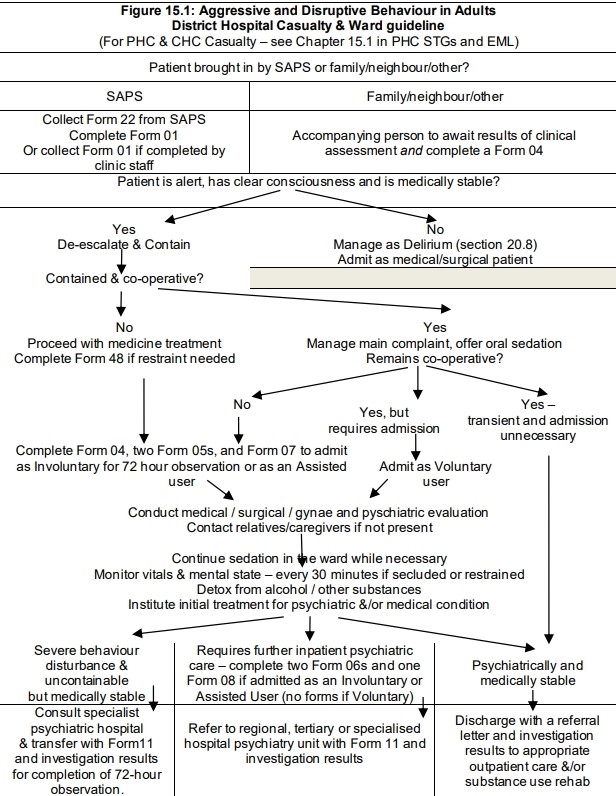
Click on the image to enlarge
Medicine Treatment
The goal of rapid tranquilisation is to calm the patient so that risk to self or others is minimised and manage the underlying condition.
CAUTION
- Rapid tranquillisation may cause cardiovascular collapse, respiratory depression, acute dystonic reactions, and neuroleptic malignant syndrome.
-Pregnant women, elderly, intellectually disabled, and those with comorbid medical conditions and/or substance use are at highest risk of serious adverse drug reactions.
- Late pregnancy: neonatal sedation or extra-pyramidal side effects may occur.
- Write out single prescriptions and review between each prescription.
- Allow at least 30 – 60 minutes between prescriptions.
- An emergency trolley, airway, bag, oxygen, and intravenous line must be available for use if needed.
- Monitor vital signs closely during and after medicine administration.
- Use the safest route of administration possible: The safest route of administration of benzodiazepines is oral followed by IM. IV route has the highest risk of respiratory depression and arrest.
- Do not use depot antipsychotic injections (e.g., flupenthixol decanoate or zuclopenthixol decanoate injections) for rapid tranquillisation.
Offer oral treatment:
If aggression is clearly caused by psychosis, or if pregnant, elderly/frail, or has significant risk for respiratory depression:
- Olanzapine, orodispersible tablet or IM, immediately:
- Aggression clearly due to psychosis or if pregnant: 5–10 mg.
- Elderly/frail, respiratory depression risk / medically unwell: 2.5–5 mg.
- Repeat after 30–60 minutes if needed.
If cause of aggression unclear, non-pregnant, non-elderly/frail, and without significant risk for respiratory depression:
- Benzodiazepines, e.g.:
- Lorazepam, oral, 0.5–2 mg immediately.
OR
- Clonazepam, oral, 0.5–2 mg immediately.
OR
- Diazepam, oral, 5–10 mg immediately.
OR
- Midazolam, oral or buccal, 7.5–15 mg immediately.
If there is an inadequate response to oral benzodiazepine (after 30–60 minutes), or where oral treatment is refused:
- Olanzapine, orodispersible tablet/IM, 5–10 mg immediately
- Repeat after 30–60 minutes if needed.
Note:
Repeated doses may result in excessive sedation
If there is an inadequate response to oral benzodiazepine with a history of intolerability to olanzapine (e.g. previous neuroleptic malignant syndrome):
- Lorazepam, IM, 0.5–2 mg immediately.
OR
- Midazolam, IM, 7.5–15 mg immediately.
OR
- Clonazepam, IM, 0.5–2 mg immediately.
Note:
- To avoid inappropriate repeat dosing, allow at least 30 minutes for the oral/IM medication to take effect.
LoE:IIIbxiv
- Repeated IM doses of benzodiazepines may result in toxicity owing to accumulation.
- Lorazepam IM has slower onset of sedation than midazolam IM (32 vs 18 minutes) and longer duration of sedation (217 vs 82 minutes).
- Clonazepam oral or IM may be used if longer duration of sedation is required. Onset of action may be 30-60 minutes, with predicted maximum effect after 1- 4 hours. There is an increased risk of accumulation due to its long half-life (18- 50 hours). Allow at least 12 hours between repeat doses.
To continue tranquilisation under specialist supervision in psychiatric wards:
- Zuclopenthixol acetate, IM, 50–150 mg every 2–3 days (specialist/specialist consultation).
- Start with 50mg in neuroleptic-naïve patients.
- Maximum dose: 400 mg over a two-week period.
If alcohol use is suspected:
ADD
- Thiamine, oral, 300 mg immediately and daily for 14 days.
Monitor the patient:
- Nurse in recovery position – prevent aspiration. Nurse pregnant women in supported semi-seated position if possible or left lateral position, and not supine.
- Monitor pulse, respiratory rate, blood pressure, temperature every 5–10 minutes for the first hour, and then every 30 minutes until the patient is ambulatory. Use pulse oximeter if available.
- Pregnant women: monitor fetal heart rate as well as mother’s vital signs.
- Continue monitoring once ambulatory, assessing for risk of falls and further injury (especially elderly and frail), re-emergence of aggression, and abscondment.
- If patient absconds – request assistance from SAPS with a MHCA Form 25.
Manage acute complications:
- Respiratory depression: if respiratory rate drops to <12 breaths/minute, or oxygen saturation <90% - give oxygen; be prepared to ventilate.
- Circulatory collapse: See Cardiac arrest in adults.
- Acute dystonia: See PHC STGs and EML, Extra-pyramidal side effects.
- Neuroleptic Malignant Syndrome: See PHC STGs and EML, Neuroleptic malignant syndrome.
Standard Treatment Guidelines and Essential Medicines List for South Africa, Hospital Level, Adults_Chapter 15: Mental Health Conditions and Substance Misuse_NEMLC Recommendations for Medicine Amendments 2020-2023