Analgesic Poisoning
Paracetamol poisoning Salicylate poisoning Opioid poisoning PARACETAMOL POISONING T39.1 + (X40.99/X60.99/Y10.99) DESCRIPTION Liver damage, due to the depletion of glutathione and accumulation of toxic metabolites, can occur in any individual with paracetamol overdose. Patients with predisposing risk factors for hepatotoxicity (“high risk” patients, see below) may experience toxicity at lower inge
PARACETAMOL POISONING
T39.1 + (X40.99/X60.99/Y10.99)
DESCRIPTION
Liver damage, due to the depletion of glutathione and accumulation of toxic metabolites, can occur in any individual with paracetamol overdose. Patients with predisposing risk factors for hepatotoxicity (“high risk” patients, see below) may experience toxicity at lower ingested doses.
Clinical features
Gastrointestinal symptoms (anorexia, nausea, vomiting, malaise) predominate in the first 24 hours. Patients with normal or only slightly raised serum paracetamol levels usually continue to full recovery. In patients with significantly raised paracetamol levels, hepatic toxicity (right upper quadrant abdominal pain and tenderness, elevated bilirubin, raised liver enzymes, coagulation defects, hypoglycaemia, encephalopathy, and metabolic acidosis) may manifest from 20-24 hours, peaking in severity at about 72-96 hours. Patients may make a full recovery in 5-7 days, or demise from hepatic failure, or less commonly, renal failure.
“High risk” patients include those with:
- Chronic alcoholism
- Chronic liver disease
- Use of enzyme-inducing medicines (e.g. carbamazepine, phenytoin, efavirenz, phenobarbitone, rifampicin etc.)
- Depletion of glutathione resources (e.g. malnutrition, starvation, AIDS, chronic illness, eating disorders etc.)
- Recent illness, dehydration
GENERAL MEASURES
The treatment of paracetamol overdose depends on the dose ingested and the time of presentation since ingestion. A serum paracetamol level is plotted on the nomogram to assess the risk for hepatotoxicity. Values which appear above the treatment line require the antidote N-acetylcysteine (NAC).
Acute single ingestion <8 hours post-ingestion:
- Toxic dose is defined as a paracetamol ingestion >200 mg/kg or 10 g (whichever is less).
- Give activated charcoal if the patient presents within 1-2 hours of ingestion.
- Perform a serum paracetamol level and ALT no earlier than 4 hours postingestion.
- If serum paracetamol level results will not be available before 8 hours post-ingestion, AND the patient has taken a toxic dose, do not delay initiation of NAC. It can always be stopped if the serum level plotted on the nomogram does not indicate its continued use.
Acute single ingestion >8 hours post-ingestion:
- Toxic dose defined as >200 mg/kg or 10 g (whichever is less).
- Start NAC infusion if a toxic dose has been ingested or the patient shows clinical signs of toxicity.
- Perform serum paracetamol level, ALT, and INR.
- Indications for continuing NAC infusion:
- Serum paracetamol level above the treatment line on the nomogram.
- Serum paracetamol level under the treatment line but abnormal ALT.
- Measurable paracetamol level and/or abnormal ALT more than 24 hours post-ingestion.
Acute single ingestion with unknown time of ingestion:
Manage as for >8 hours post-ingestion, however, the nomogram is not applicable to this group.
LoE:IIIaxxiii
Repeated supratherapeutic ingestion (RSTI):
This may occur in patients using repeated high doses of the same product or concurrent use of multiple paracetamol-containing products such as during an acute febrile illness or in patients with chronic pain. RSTI toxic doses are defined as:
- >200 mg/kg or 10 g (whichever is less) over a single 24-hour period.
- >300 mg/kg or 12 g (whichever is less) over a single 48-hour period.
- >60 mg/kg/day for more than 48 hours and patients have symptoms suggestive of liver injury.
LoE:IIIaxxiv
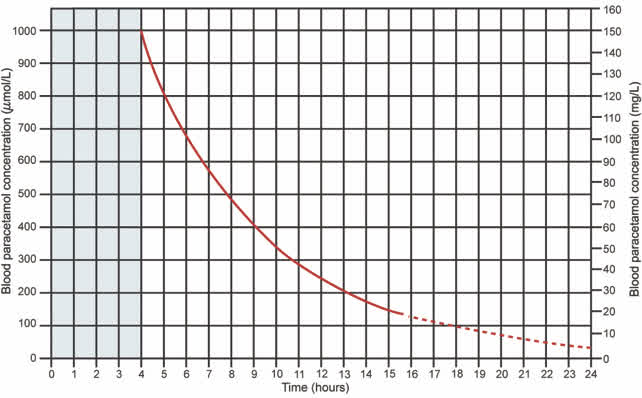
Source: Daly FF, Fountain JS, Murray L, Graudins A, Buckley NA; Panel of Australian and New Zealand clinical toxicologists. Guidelines for the management of paracetamol poisoning in Australia and New Zealand-explanation and elaboration. A consensus statement from clinical toxicologists consulting to the Australasian poisons information centres. Med J Aust. 2008 Mar 3;188(5):296-301.
Figure 19.1: Paracetamol treatment nomogram. (Access the paracetamol nomogram tool on the EML Clinical Guide cellphone application).
MEDICINE TREATMENT
N-acetylcysteine is the antidote of choice and should be given intravenously. Although it is more effective when given within 8 hours of ingestion of paracetamol, there may be benefit even if liver failure has developed. Histamine may be released, which mimics an allergic reaction. If this occurs and the patient is stable, infusion may continue at a slower rate under antihistamine cover. Stop the infusion if bronchospasm occurs.
- N-acetylcysteine, IV:
- Initial infusion: 200 mg/kg in 500 mL dextrose, 5% over 4 hours.
- Second infusion: 100 mg/kg in 1000 mL dextrose, 5% over 16 hours.
- Any further N-acetylcysteine is given according to the second infusion regimen.
LoE:IIIaxxv
If N-acetylcysteine IV formulation is unavailable:
- N‐acetylcysteine, oral, 140 mg/kg immediately.
- Followed by 70 mg/kg 4 hourly, for up to seventeen doses.
LoE:IIIaxxvi
Note:
- As anaphylactoid reactions to N-acetylcysteine do occur, the loading dose should preferably be administered in a monitored area.
LoE:IVbxxvii
- Avoid giving oral N-acetylcysteine together with activated charcoal as systemic absorption and effect of N-acetylcysteine is reduced.
LoE:IIIaxxviii
Further investigations and referral
Blood tests such as renal function, clotting profile, serum glucose and acid/base status should only be done where clinically indicated. Patients who develop liver failure must be referred for further management and/or possible transplant.
SALICYLATE POISONING
T39.0 + (X40.99/X60.99/Y10.99)
DESCRIPTION
Salicylate poisoning may result from oral and/or topical exposure. Salicylate products vary widely in concentration, e.g. oil of wintergreen is almost 100% methyl salicylate.
Diagnosis:
Mild to moderate toxicity:
- Nausea, vomiting, tinnitus, fever, tachypnoea, and respiratory alkalosis
Severe toxicity:
- Metabolic acidosis, altered mental status, seizures, coma, noncardiogenic pulmonary oedema.
- Monitor salicylate levels if possible (do not always correlate with clinical severity):
| Severity of toxicity | Peak plasma salicylate concentrations | |
| mmol/L | mg/dL | |
| Asymptomatic | <2.2 mmol/L | <30 mg/dL |
| Mild toxicity | 2.2-4.3 mmol/L | 30-60 mg/dL |
| Moderate toxicity | 4.3-5.8 mmol/L | 60-80 mg/dL |
| Severe toxicity | >5.8 mmol/L | >80 mg/dL |
Table 19.3: Severity of toxicity by peak plasma salicylate concentrations.
- Serial monitoring until declining levels are documented.
- Monitor and treat hypoglycaemia; patients with normoglycaemia may still be neuroglycopaenic.
GENERAL MEASURES
- Assess severity with history, clinical examination, and salicylate levels if possible.
- Correct hydration using dextrose-containing fluids.
- Ensure hypokalaemia treated early
- Consider ICU admission for pulmonary and/or cerebral oedema.
MEDICINE TREATMENT
- Salicylates delay gastric emptying, therefore activated charcoal may be effective for a longer period than usual.
- Whole bowel irrigation maybe useful for enteric-coated or modifiedrelease preparations.
LoE:IIIbxxix
For mild toxicity:
- Rehydrate and correct hypovolaemia with dextrose-containing fluids.
- Add dextrose 50%, 100mL to every litre of balanced crystalloid solution (e.g. ringers lactate) or sodium chloride 0.9%, and administer by IV infusion.
- During preparation of the infusion fluid, ensure the equivalent volume of rehydration fluid (e.g. 100mL) is removed from the bag before adding the total dextrose 50% volume (e.g. 100mL).
- The rate and duration of IV fluids should be guided by clinical assessment of fluid balance.
LoE:IIIbxxx ,LoE:IVb
In patients with moderate to severe toxicity and/or acidosis:
- Sodium bicarbonate 8.4%, IV, 1–2 mL/kg over 30 minutes to manage acidosis.
- Simultaneously fluid resuscitate with sodium bicarbonate 8.4%, 150mL added to dextrose 5%, 1L and administer by IV infusion to correct hypovolaemia.
- During preparation of the infusion fluid, ensure the equivalent volume of dextrose 5% (i.e. 150 mL) is removed from the bag before adding the total sodium bicarbonate 8.4% volume of 150 mL.
- Continue a maintenance infusion at 150 to 200 mL/hour, targeting a urine output of 2mL/kg/hour.
- Titrate the sodium bicarbonate maintenance infusion to a urinary pH of 7.5 to 8.5 and blood pH of 7.45 to 7.5.
- Monitor for and correct hypokalaemia.
LoE:IIIbxxxi, LoE:IVb
REFERRAL
- Discuss with specialist and consider ICU admission
- Where acidosis does not respond to sodium bicarbonate, refer for haemodialysis.
LoE:IIIaxxxii
OPIOID POISONING
T40.0/T40.1/T40.2/T40.3 + (X42.99/X62.99/Y12.99)
DESCRIPTION
Patients present with the triad of CNS depression, respiratory depression, and constricted pupils. Non-cardiogenic pulmonary oedema can occur.
GENERAL MEASURES
Supportive management aimed at maintaining cardiorespiratory function.
Body packers/stuffers:
- Patients may ingest packages of illicit opioids and are at increased risk of life-threatening toxicity in the event of rupture.
- Abdominal X-rays or CT scan may show packages.
- Conservative management is recommended, as any attempt at removal risks package rupture.
- Activated charcoal and whole bowel irrigation may aid in expelling packets.
- Surgery is reserved for those who develop obstruction or perforation.
MEDICINE TREATMENT
- Naloxone, IV, 0.4 mg immediately, in patients with significant respiratory depression.
- Effectiveness is limited by a half-life (± 1 hour) that is shorter than most opioids.
- Repeated incremental doses (e.g.: 0.4 mg, 0.8 mg, 2 mg, 4 mg etc.) may be required at 2 to 3 minute intervals, up to a maximum of 10 mg. If a response is noted, a maintenance infusion of 0.4 mg/hour should be initiated.
- If there is no response after a maximum total dose of 10 mg of naloxone is administered, the diagnosis of opioid-induced or partial opioid-induced toxicity should be re-assessed.
- Consider intramuscular or subcutaneous administration if the intravenous route is not available.
Note:
- Clinical response is measured by reversal of respiratory depression rather than complete reversal of sedation.
- Continuous monitoring is required for all patients who receive naloxone.
- Naloxone in an opioid-dependent person may precipitate a withdrawal syndrome with agitation, hypertension, tachycardia, emesis, and potential aspiration. These patients usually require lower doses when initiating naloxone (0.04 - 0.1mg IV).
LoE:IVbxxxiii
Standard Treatment Guidelines and Essential Medicines List for South Africa, Adult Hospital Level, 2020-2024_Version 2.0_27 March 2025
Chapter 19 Poisoning_19.5 Analgesic Poisoning
Drugs mentioned
ICD-10 codes
- T39.0Poisoning, salicylates
- T39.1Poisoning, 4-aminophenol derivatives
- T40.0Poisoning, opium
- T40.1Poisoning, heroin
- T40.2Poisoning, other opioids
- T40.3Poisoning, methadone
- X40.99Accidental poisoning by and exposure to nonopioid analgesics, antipyretics and antirheumatics, unspecified place, during unspecified activity
- X42.99Accidental poisoning by and exposure to narcotics and psychodysleptics [hallucinogens], not elsewhere classified, unspecified place, during unspecified activity
- X60.99Intentional self-poisoning by and exposure to nonopioid analgesics, antipyretics and antirheumatics, unspecified place, during unspecified activity
- X62.99Intentional self-poisoning by and exposure to narcotics and psychodysleptics [hallucinogens], not elsewhere classified, unspecified place, during unspecified activity
- Y10.99Poisoning by and exposure to nonopioid analgesics, antipyretics and antirheumatics, undetermined intent, unspecified place, during unspecified activity
- Y12.99Poisoning by and exposure to narcotics and psychodysleptics [hallucinogens], not elsewhere classified, undetermined intent, unspecified place, during unspecified activity