Anaphylaxis
Description General Measures Emergency Treatment Medicine Treatment Referral ICD-10 code: T78.2/Y57.9 DESCRIPTION A very severe allergic reaction that usually occurs within seconds or minutes after exposure to an allergen, but may be delayed for up to 1 hour. The reaction can be short-lived, protracted or biphasic, i.e. acute with recurrence several hours later. Immediate reactions a
ICD-10 code: T78.2/Y57.9
DESCRIPTION
A very severe allergic reaction that usually occurs within seconds or minutes after exposure to an allergen, but may be delayed for up to 1 hour. The reaction can be short-lived, protracted or biphasic, i.e. acute with recurrence several hours later. Immediate reactions are usually the most severe and/or life-threatening
Clinical features include:
- Acute onset of signs and symptoms.
- Urticaria (hives) or angioedema.
- Bronchospasm, wheezing, dyspnoea, chest tightness.
- Laryngeal oedema with upper airway obstruction or stridor.
- Gastrointestinal symptoms such as nausea, vomiting, diarrhoea.
- Hypotension and/or shock.
- Dizziness, paraesthesia, syncope, sweating, flushing, dysrhythmias.
GENERAL MEASURES
Anaphylaxis associated with vaccinations:
- Always keep a fully equipped emergency tray at the vaccination point.
- It is advisable to observe clients for 15 minutes after a vaccination. If a client is known with severe allergies, an observation period of 30 minutes is advised.
- Clients who develop symptoms should be assessed for possible vaccination associated anaphylaxis by considering the following:
- If signs and symptoms are generalised involving more than 2 body systems, manage as anaphylaxis.
- If signs and symptoms are serious or life-threatening, even if only one body system is involved (including hypotension, respiratory distress, significant swelling of lips or tongue), treat as anaphylaxis.
- If isolated rash in an otherwise well client, monitor for 30 minutes.
- Collapse following vaccination might be due to anaphylaxis or other causes such as a vasovagal episode:
- Call for help and put patient on his/her back and raise legs.
- Check if responsive – if unresponsive, commence CPR (See: Cardiac arrest)
- A vasovagal episode is usually associated with a transient loss of consciousness (< 1 minute), relieved by raising the legs when supine, transient low BP and low HR.
- Collapsing after vaccination usually occurs 5-10 minutes post-vaccination, but can occur up to an hour afterwards.
- Treat as anaphylaxis if loss of consciousness is not brief and not relieved by raising the legs, or if any of the signs or symptoms of anaphylaxis occur.
Table 21.5: Differences between anaphylaxis, general acute stress response and vasovagal reaction with syncope
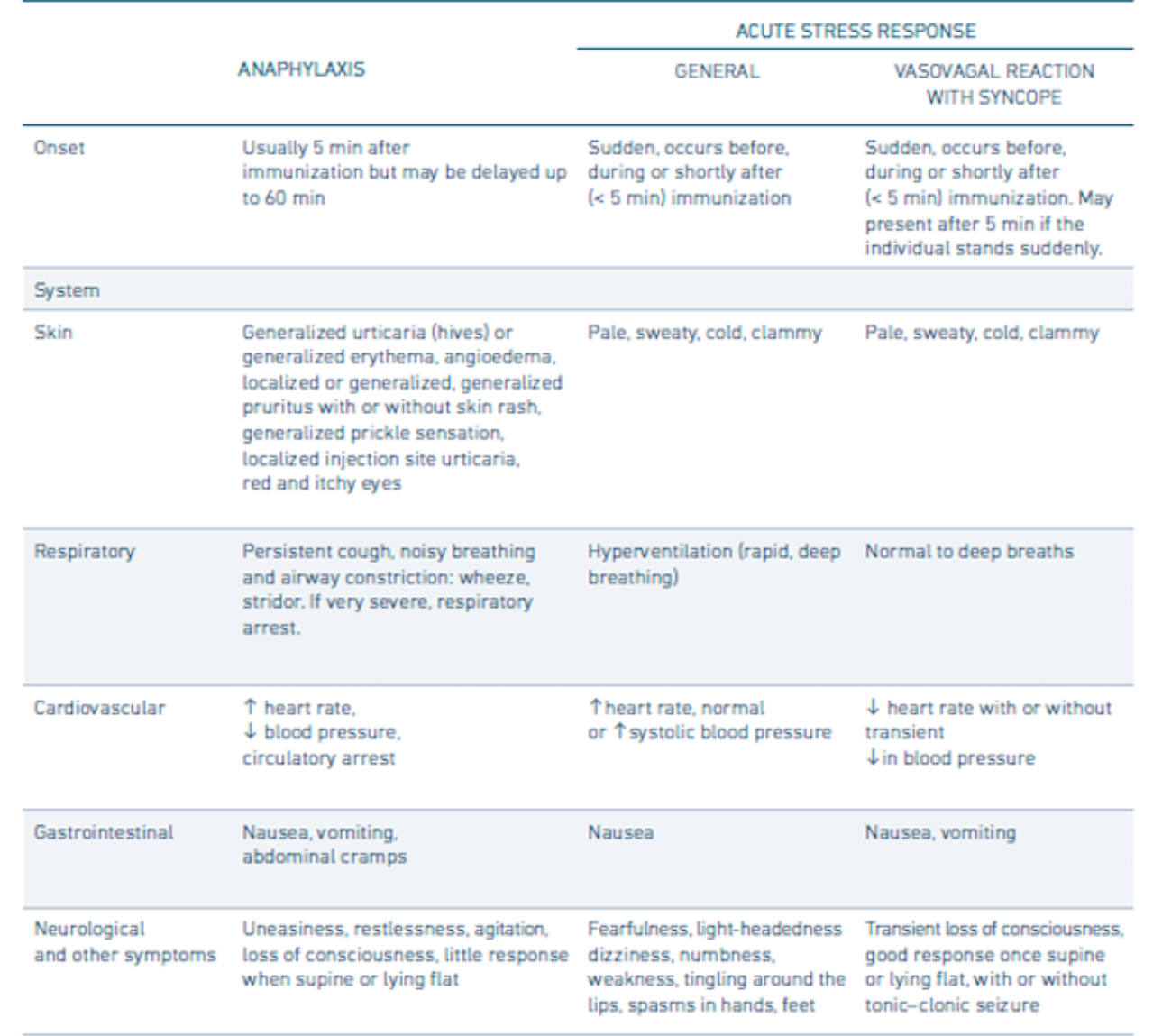
Source: Immunization stress-related response. A manual for program managers and health professionals to prevent, identify and respond to stress related responses following immunization. Geneva: World Health Organization; 2019. https://apps.who.int/iris/handle/10665/330277
Click on the image to enlarge.
EMERGENCY TREATMENT
- Resuscitate (CAB) immediately (See: Cardiac arrest).
- Place hypotensive or shocked patient in horizontal position. Do NOT sit the patient up.
- Severe anaphylaxis: administer oxygen by facemask at high flow rate of 15 L/min.
- Remove the trigger if possible.
MEDICINE TREATMENT
First line priority:
Adrenaline (epinephrine) is the mainstay of treatment and should be given immediately.
- Adrenaline (epinephrine), 1:1000, IM, 0.01 mL/kg as a single dose.
- Children: 1:1000, IM, 0.01 mL/kg as a single dose. See: Dosing table.
- Adults: 1:1000, IM, 0.5 mg (0.5 mL) as a single dose, into the lateral thigh.
- Repeat in 5 minutes if no improvement.
Second line priority:
- Oxygen, 8-10 L/ minute via facemask or up to 100% oxygen, as needed.
AND
If hypotension not responding promptly to adrenaline (epinephrine), also give:
- Sodium chloride 0.9%, IV:
- Children: 20 mL/kg, over 5 to 10 minutes. Repeat as needed.
- Adults: 1–2 L, at the most rapid flow possible in the first minutes of treatment. Repeat as needed.
CAUTION
Monitor continuously for clinical response and fluid overload.
AND
If wheeze:
- Salbutamol 0.5%, solution, nebulised, with high flow oxygen.
- Children: 0.5–1 mL (2.5–5 mg) salbutamol 0.5% solution,
- Adults: 1 mL (5 mg) salbutamol 0.5% solution,
AND
- Ipratropium bromide, solution, added to salbutamol solution.
- Children: Ipratropium bromide 0.25mg/2ml; nebuliser solution: 2mL (0.25 mg) nebulised with salbutamol and made up to a total volume of 4mL with sodium chloride 0.9%.
- Adults: Ipratropium bromide 0.5mg/2ml; nebuliser solution, 2 mL (0.5 mg) nebulised with salbutamol and made up to a total volume of 4mL with sodium chloride 0.9%.
AND
- Hydrocortisone IM/ slow IV, immediately.
- Children: 5 mg/kg immediately. See: Dosing table.
- Adults: 200 mg immediately.
AND
- Promethazine IM/ slow IV.
- Children > 2 years: 0.25 mg/kg. See: Dosing table.
- Adults: 25–50 mg.
REFERRAL
All patients.
Note:
Adrenaline (epinephrine) administration may have to be repeated due to its short duration of action. Observe closely during transport.
Click here for the NEMLC Recommendations for medicine amendments (2020-4 review cycle).
Standard Treatment Guidelines and Essential Medicines List for South Africa, Primary Healthcare, 2020-4_Version 1.1_October 2024
Chapter 21: Emergencies and Injuries