Anaphylaxis/ Anaphylactic Shock
Description General measures Medicine treatment ICD-10 code: T78.2 + Y57.9 DESCRIPTION An acute, potentially life-threatening hypersensitivity reaction. The reaction usually starts within seconds to minutes after administration of, or exposure to a substance to which the individual has been sensitised. Clinical manifestations range from mild urticaria and angioedema to upper airway obstruction, b
ICD-10 code: T78.2 + Y57.9
DESCRIPTION
An acute, potentially life-threatening hypersensitivity reaction.
The reaction usually starts within seconds to minutes after administration of, or exposure to a substance to which the individual has been sensitised.
Clinical manifestations range from mild urticaria and angioedema to upper airway obstruction, bronchospasm, hypotension, shock and death.
The reaction can be short-lived, protracted or biphasic, i.e. acute with recurrence several hours later.
Immediate reactions are usually the most severe and/or life threatening.
GENERAL MEASURES
Remove the inciting cause (e.g., stop infusion of medicine that caused anaphylaxis).
Administer adrenaline (epinephrine) immediately (see below)
Cardiopulmonary resuscitation, if required.
Maintain an open airway. Intubate, if necessary.
Monitor all vital parameters (including pulse and blood pressure) closely.
Reassure and comfort the patient.
Counsel patient to prevent recurrence.
Patient should wear an alert bracelet at all times.
Anaphylaxis associated with vaccinations:
- Always keep a fully equipped emergency tray at the vaccination point.
- It is advisable to observe clients for 15 minutes after a vaccination. If a client is known with severe allergies, an observation period of 30 minutes is advised.
- Clients who develop symptoms should be assessed for possible vaccination associated anaphylaxis by considering the following:
- If signs and symptoms are generalised - involving more than 2 body systems, manage as anaphylaxis.
- If signs and symptoms are serious or life-threatening (including hypotension, respiratory distress significant swelling of lips or tongue), even if only one body system is involved, treat as anaphylaxis.
- If isolated rash in an otherwise well client, monitor for 30 minutes.
- Clients who collapse following vaccination:
- Call for help and put patient on his/her back and raise legs.
- Check if responsive if unresponsive, commence CPR (See Cardiac Arrest - Cardiopulmonary Resuscitation)
- A vasovagal episode is usually associated with a transient loss of consciousness (< 1 minute), relieved by raising the legs when supine, transient low BP and low HR.
- Collapsing after vaccination usually occurs 5-10 minutes post-vaccination, but can occur up to an hour afterwards.
- Treat as anaphylaxis if loss of consciousness is not brief and not relieved by raising the legs, or when any of the warning signs for anaphylaxis occur.
Table 20.1.: Differences between anaphylaxis, general acute stress response and vasovagal reaction with syncope
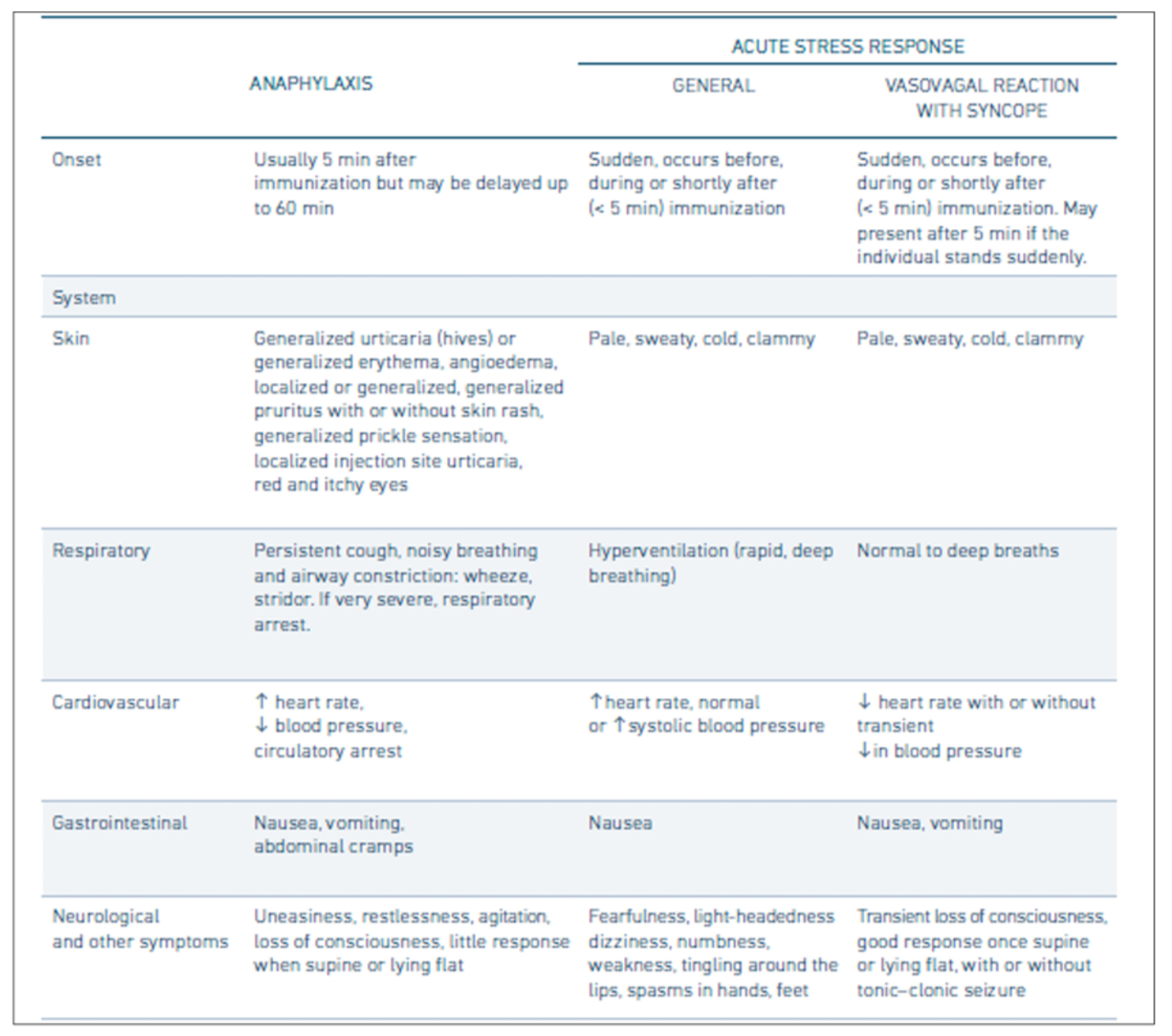
Source: Immunization stress-related response. A manual for program managers and health professionals to prevent, identify and respond to stress related responses following immunization. Geneva: World Health Organization; 2019. https://apps.who.int/iris/handle/10665/330277
Click on the image to enlarge.
MEDICINE TREATMENT
- Adrenaline (epinephrine) 1:1000, 0.5 mL, IM, immediately into anterolateral thigh.
- Repeat dose every 5 minutes, as required.
In cases of persistent hypotension or where multiple repeat doses are required:
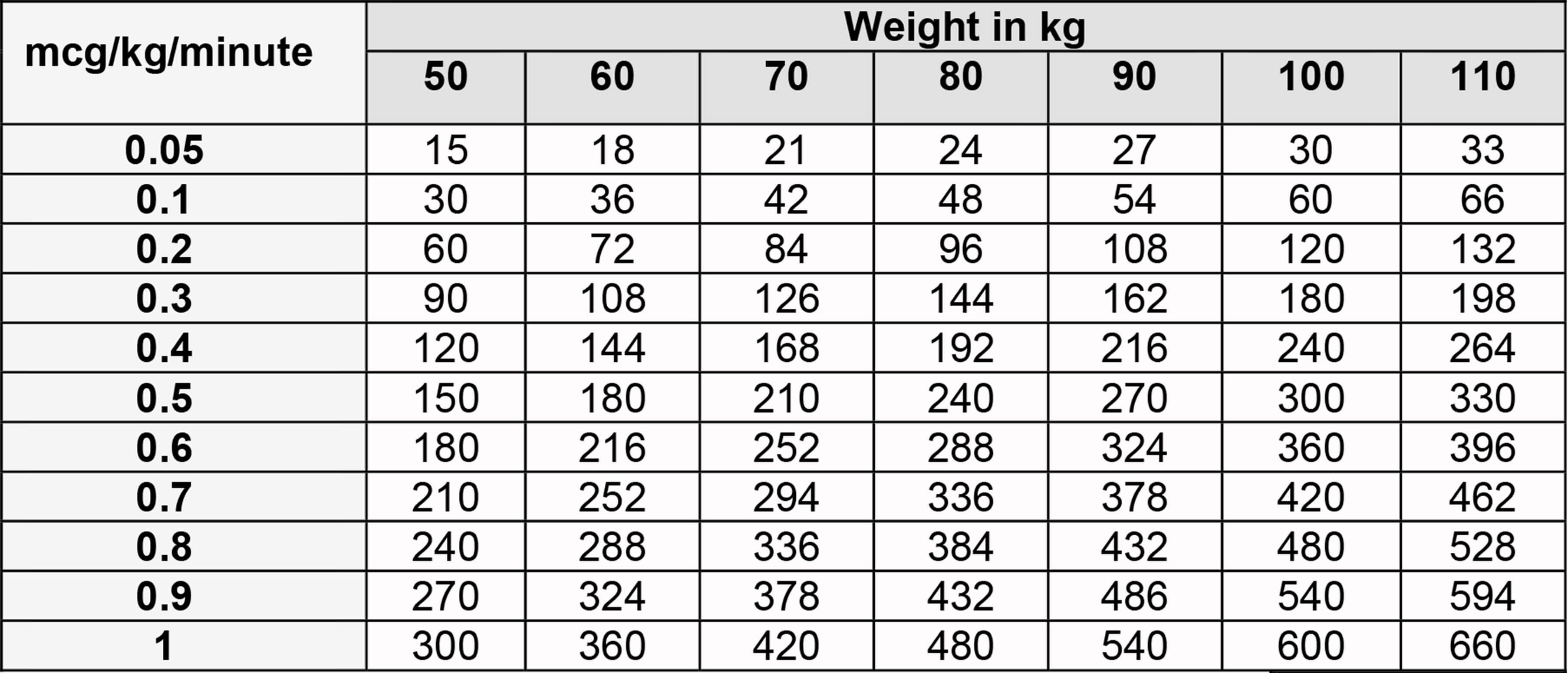
- Adrenaline (epinephrine), IV infusion, start at 0.05 mcg/kg/minute titrated according to the response.
- Dilute 10 mg i.e. 10 ampoules of adrenaline 1:1 000 in 1 L sodium chloride 0.9%.
- Infuse according to weight and clinical response.
- Infusion rate: mL/hour:
Click on the image to enlarge.
AND
- Hydrocortisone, IV/IM, 200 mg, immediately as a single dose.
AND
Intravenous fluids
Establish an intravenous line:
- Sodium chloride 0.9%, IV.
If bronchospasm:
- Oxygen if saturation <94%.
AND
- Salbutamol, nebulisation, 5 mg.
- Nebulise continuously (refill the nebuliser reservoir every 20 minutes) at a flow rate of 6–8 L/minute.
AND
- Ipratropium bromide, nebulisation 0.5 mg, added to salbutamol solution.
If urticaria and/or itch present:
- Antihistamine, e.g.:
- Promethazine, IV 25-50mg as a single dose.
OR
- Cetirizine, oral, 10 mg as a single dose.
Click here for the Supporting NEMLC report and reviews_(2020-4 review cycle).
Standard Treatment Guidelines And Essential Medicines List For South Africa, Adult Hospital level, 2020-4_Version 1_June 2024
Chapter 20: Emergencies and Injuries