Animal Bites
Description Medicine Treatment Prevention Referral ICD-10 code: S01.0-9/S11.0-2/S11.7-9/S21.0-2/S21.7-9/S31.0-5/S31.7-8/S41.0-1/S41.7-8/S51.0/S51.7-9/S61.0-1/S61.7-9/S71.0-1/S71.7- 8/S81.0/S81.7-9/S91.0-3/S91.7/T01.0-3/T01.6/T01.8-9/T09.1/T11.1/T13.1/T14.0-1/A82.0-1/A82.9/Z24.2/Z20.3 + External Cause Code (W,X,Y,Z) Note: Rabies and tetanus are notifiable medical conditions. DESCRIPTION Anim
ICD-10 code: S01.0-9/S11.0-2/S11.7-9/S21.0-2/S21.7-9/S31.0-5/S31.7-8/S41.0-1/S41.7-8/S51.0/S51.7-9/S61.0-1/S61.7-9/S71.0-1/S71.7- 8/S81.0/S81.7-9/S91.0-3/S91.7/T01.0-3/T01.6/T01.8-9/T09.1/T11.1/T13.1/T14.0-1/A82.0-1/A82.9/Z24.2/Z20.3 + External Cause Code (W,X,Y,Z)
Note:
Rabies and tetanus are notifiable medical conditions.
DESCRIPTION
Animal bites may be caused by:
- Domestic animals e.g. horses, cows, dogs, cats.
- Wild animals e.g. jackals, mongooses (meerkats), bats.
Animal bites may result in:
- Wound infection, often due to mixed aerobic and anaerobic infection.
- Puncture wounds.
- Tissue necrosis.
- Transmission of diseases, e.g. tetanus, rabies.
NICD hotline for rabies advice: 0828839920
Suspected rabid bite
Any mammal bite can transmit rabies. Rabies incubation period is at least 9–90 days, but could be much longer. In suspected rabies exposure of a person by a domestic animal, attempt to trace the source animal to determine likelihood of rabies. Observe the suspected rabid animal for abnormal behaviour for 10 days. If the animal remains healthy for 10 days, rabies is unlikely.
Note:
If the animal has to be put down, care should be taken to preserve the brain, as the brain is required by the state veterinarian for confirmation of diagnosis. The animal must not be killed by shooting it in the head, as this will damage the brain.
| PATIENT WITH ANIMAL EXPOSURE | |||
| Severity of exposure | No direct contact with animal (for example, being in the presence of a rabid animal or petting an animal) | Direct contact with animal but no breach of skin, no bleeding (for example bruising or superficial scratch) | Direct contact with animal with breach of skin, any amount of bleeding, contact with mucosal membranes (for example lick on/in eyes or nose), contact with broken skin (for example licks on existing scratches), any contact with a bat. |
| Management based on severity of the exposure | Washing of exposed skin surfaces | Wound management AND Full course of rabies vaccine (Rabies immunoglobulin, only if severely immunocompromised) |
Wound management AND Rabies immunoglobulin AND Full course of rabies vaccine |
| Table 21.6: Algorithm for rabies post exposure prophylaxis (PEP) | |||
MEDICINE TREATMENT
Wound management:
Wash wound thoroughly with soap under running water for 15 minutes.
- Chlorhexidine 0.05%, aqueous solution.
Apply disinfectant if available:
- Povidone-iodine 10%, solution.
CAUTION
Primary suturing of wounds should be avoided unless for urgent haemostasis. Clean wound thoroughly, dress (avoid compressive dressings), and review after 48 hours for secondary closure at that time.
The following treatment may be commenced in facilities designated by Provincial/Regional Pharmaceutical Therapeutics Committees. If access to rabies vaccine and/or immunoglobulin is not immediately available refer urgently.
Immunocompromised individuals:
Individuals with documented immunodeficiency, such as symptomatic HIV infection, patients with cancer on chemotherapy/radiotherapy, and patients on long-term corticosteroids dosed at 20 mg/day for ≥2 weeks, should be evaluated on a case-by-case basis and receive a complete course of PEP including RIG and 4 doses of rabies vaccine in all exposures with direct animal contact.
Note:
HIV-infected individuals receiving ART who are clinically monitored and well managed are not considered immunocompromised. Such patients have been shown to respond normally to rabies vaccines.
Rabies immunoglobulin (RIG) – doctor prescribed:
- Only indicated for:
- Direct animal contact with breach of skin/ bleeding/ mucosal contact, immunocompetent patients
- Any direct animal contact, immunocompromised patients
- All bat exposures
- Patients who have received PEP or PrEP do not require RIG. Only wound treatment is required.
- Available from the nearest district hospital.
- If not immediately available, source and give as soon as possible.
- When 7 days have lapsed since the initial rabies vaccination, RIG is no longer indicated as the vaccine induced immune response will be effective at that time.
- Infiltrate as much as possible in and around the wound.
- It is no longer recommended to inject the remainder of the calculated RIG dose at a site distant to the wound.
- In the case of smaller wounds/areas where it is not possible to infiltrate the entire calculated dose, infiltrate as much as is anatomically feasible in and around the wound site/s without causing compartment syndrome.
- In case of large and multiple wounds, RIG can be diluted with sodium chloride 0.9% solution if necessary to ensure infiltration of all wounds.
- Follow with a complete course of vaccine.
- Human-derived rabies immunoglobulin (HRIG), IM 20 IU/kg (doctor prescribed). Infiltrate as much as possible in and around the wound.
OR
- Equine-derived rabies Immunoglobulin (ERIG), IM 40 IU/kg (doctor prescribed). Infiltrate as much as possible in and around the wound.
- Administer ERIG only in facilities where anaphylaxis or adverse reactions can be managed. (Refer to Anaphylaxis).
Table 21.7: Summary of regimen for HRIG and ERIG
| (HRIG) Rabigam® | (HRIG) KamRAB® | (ERIG) Equirab® | |
| Max. dose | 20 IU/kg | 20 IU/kg | 40 IU/kg |
| Description | 150 IU/mL (Supplied in 2 mL vial) | 150 IU/mL (Supplied in 2,5 and 10 mL vials). | 200 IU/mL (Supplied in 5 mL vial). |
| Site of administration | Infiltrate up to the maximum calculated dose in and around the wound site/s. For smaller wounds where it is not possible to infiltrate all of the calculated dose, infiltrate as much as is anatomically feasible in and around the wound site/s. |
||
| Schedule | On day 0 (when patient presents for first time)/as soon as possible after exposure to be effective to neutralise virus. When RIG is not available it should be sourced as a matter of urgency. When 7 days have lapsed since initial rabies vaccination, RIG is no longer indicated. |
||
Source: NICD updated human rabies prophylaxis guideline. www.nicd.ac.za
Rabies vaccination – doctor initiated:
- Only indicated for direct animal contact.
- Patients who have previously been fully immunised or who received PEP more than 3 months ago need only two doses: on Day 0 and Day 3.
- Patients who have received previous PEP or PrEP within the previous 3 months do not require vaccination against rabies. Only wound treatment is required.
- Available from the nearest district hospital.
Children
| Rabies vaccine, 1 amp, IM anterolateral thigh (doctor initiated). | |
|
Day 0
|
Single dose
|
|
Day 3
|
Single dose
|
|
Day 7
|
Single dose
|
|
Between day 14-28
|
Single dose
|
Adults
| Rabies vaccine, 1 amp, IM deltoid (doctor initiated). | |
| Day 0 | Single dose |
| Day 3 | Single dose |
| Day 7 | Single dose |
| Between day 14-28 | Single dose |
CAUTION
Do not administer rabies vaccine into buttocks (gluteus maximus).
Tetanus prophylaxis if not previously immunised within the last 5 years:
ICD-10 code: Z23.5
- Tetanus toxoid vaccine (TT), IM, 0.5 mL.
Note:
In a fully immunised person, tetanus toxoid vaccine or tetanus immunoglobulin may produce an unpleasant reaction, e.g. redness, itching, swelling or fever, but in the case of a severe injury the administration is justified.
Antibiotic treatment (only for direct animal contact with broken skin, hand wounds):
Adults and Children > 35 kg
- Amoxicillin/clavulanic acid, oral, 875/125 mg 12 hourly for 5 days.
Children ≤ 35 kg
- Amoxicillin/clavulanic acid, oral, 15–25 mg/kg/dose of amoxicillin component, 8 hourly for 5 days.
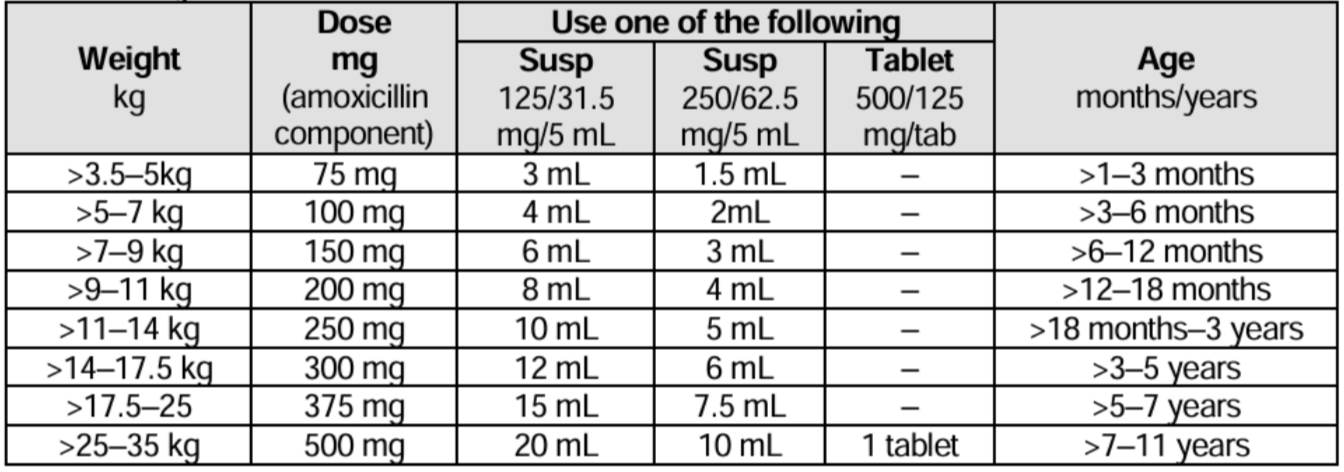
Click on the image to enlarge.
Severe penicillin allergy:
ICD-10 code: Z88.0
Adults and Children > 35 kg
- Macrolide, e.g.:
- Azithromycin, oral, 500 mg daily for 3 days.
Children
- Macrolide, e.g.:
- Azithromycin, oral, 10 mg/kg daily for 3 days. See dosing table.
AND
Adults
- Metronidazole, oral, 400 mg, 8 hourly for 5 days.
Children
- Metronidazole, oral, 7.5 mg/kg/dose 8 hourly for 5 days. See dosing table.
PREVENTION
- Regular vaccination of domestic cats and dogs.
- Pre-exposure vaccine may be given to those at risk, e.g. occupation, endemic areas, laboratories.
REFERRAL
- Deep and large wounds requiring suturing.
- Shock and bleeding.
- Possible rabies exposure (for immunoglobulin and vaccination).
- Severe infected wounds or infected wounds not responding to oral antibiotics.
- Hand bites.
Click here for the NEMLC Recommendations for medicine amendments (2020-4 review cycle).
Standard Treatment Guidelines and Essential Medicines List for South Africa, Primary Healthcare, 2020-4_Version 1.1_October 2024
Chapter 21: Emergencies and Injuries
Drugs mentioned
ICD-10 codes
- A82.0Sylvatic rabies
- A82.1Urban rabies
- A82.9Rabies, unspecified
- S01.0Open wound of scalp
- S01.1Open wound of eyelid and periocular area
- S01.2Open wound of nose
- S01.3Open wound of ear
- S01.4Open wound of cheek and temporomandibular area
- S01.5Open wound of lip and oral cavity
- S01.7Multiple open wounds of head
- S01.8Open wound of other parts of head
- S01.9Open wound of head, part unspecified
- S11.0Open wound involving larynx and trachea
- S11.1Open wound involving thyroid gland
- S11.2Open wound involving pharynx and cervical oesophagus
- S11.7Multiple open wounds of neck
- S11.8Open wound of other parts of neck
- S11.9Open wound of neck, part unspecified
- S21.0Open wound of breast
- S21.1Open wound of front wall of thorax
- S21.2Open wound of back wall of thorax
- S21.7Multiple open wounds of thoracic wall
- S21.8Open wound of other parts of thorax
- S21.9Open wound of thorax, part unspecified
- S31.0Open wound of lower back and pelvis
- S31.1Open wound of abdominal wall
- S31.2Open wound of penis
- S31.3Open wound of scrotum and testes
- S31.4Open wound of vagina and vulva
- S31.5Open wound of other and unspecified external genital organs
- S31.7Multiple open wounds of abdomen, lower back and pelvis
- S31.8Open wound of other and unspecified parts of abdomen
- S41.0Open wound of shoulder
- S41.1Open wound of upper arm
- S41.7Multiple open wounds of shoulder and upper arm
- S41.8Open wound of other and unspecified parts of shoulder girdle
- S51.0Open wound of elbow
- S51.7Multiple open wounds of forearm
- S51.8Open wound of other parts of forearm
- S51.9Open wound of forearm, part unspecified
- S61.0Open wound of finger(s) without damage to nail
- S61.1Open wound of finger(s) with damage to nail
- S61.7Multiple open wounds of wrist and hand
- S61.8Open wound of other parts of wrist and hand
- S61.9Open wound of wrist and hand part, part unspecified
- S71.0Open wound of hip
- S71.1Open wound of thigh
- S71.7Multiple open wounds of hip and thigh
- S81.0Open wound of knee
- S81.7Multiple open wounds of lower leg
- S81.8Open wound of other parts of lower leg
- S81.9Open wound of lower leg, part unspecified
- S91.0Open wound of ankle
- S91.1Open wound of toe(s) without damage to nail
- S91.2Open wound of toe(s) with damage to nail
- S91.3Open wound of other parts of foot
- S91.7Multiple open wounds of ankle and foot
- T01.0Open wounds involving head with neck
- T01.1Open wounds involving thorax with abdomen, lower back and pelvis
- T01.2Open wounds involving multiple regions of upper limb(s)
- T01.3Open wounds involving multiple regions of lower limb(s)
- T01.6Open wounds involving multiple regions of upper limb(s) with lower limb(s)
- T01.8Open wounds involving other combinations of body regions
- T01.9Multiple open wounds, unspecified
- T09.1Open wound of trunk, level unspecified
- T11.1Open wound of upper limb, level unspecified
- T13.1Open wound of lower limb, level unspecified
- T14.0Superficial injury of unspecified body region
- T14.1Open wound of unspecified body region
- Z20.3Contact with and exposure to rabies
- Z23.5Need for immunization against tetanus alone
- Z24.2Need for immunization against rabies
- Z88.0Personal history of allergy to penicillin