Burns
Description Emergency Treatment Medicine Treatment Referral ICD-10 code: T30.0-3/T31.0-9 + (Y34.99) DESCRIPTION Burns lead to skin and soft tissue injury and may be caused by: heat, e.g. open flame, hot liquids, hot steam chemical compounds physical agents, (e.g. electrical/lightning) or radiation. The extent and depth may vary from superficial (epidermis) to full-thickness burns of the skin and
ICD-10 code: T30.0-3/T31.0-9 + (Y34.99)
DESCRIPTION
Burns lead to skin and soft tissue injury and may be caused by:
- heat, e.g. open flame, hot liquids, hot steam
- chemical compounds
- physical agents, (e.g. electrical/lightning) or
- radiation.
The extent and depth may vary from superficial (epidermis) to full-thickness burns of the skin and underlying tissues.
Initially, burns are usually sterile.
Table 21.8: Assessment of burns
|
Depth of burn wound
|
Surface/ colour
|
Pain sensation/ healing
|
|
Superficial or epidermal
|
Dry, minor blisters, erythema
|
- Painful
- Heals within 7 days |
|
Partial thickness superficial or superficial dermal
|
Blisters, moist
|
- Painful
- Heals within 10–14 days |
|
Partial thickness deep or deep dermal
|
Moist white or yellow slough, red mottled
|
- Less painful
- Heals within a month or more - Generally needs surgical debridement and skin graft
|
|
Full thickness (complete loss of skin)
|
Dry, charred whitish, brown or black
|
- Painless, firm to touch
- Healing by contraction of the margins - Generally needs surgical debridement and skin graft |
EMERGENCY TREATMENT
Follow the 7C’s:
- Clothing: remove non-sticking clothing especially if hot or smouldering or constrictive (e.g. rings).
- Cool: with tap water for 30 minutes.
- Clean: with chlorhexidine.
- Cover: with a non-adherent dressing.
- Comfort: provide pain relief.
- Carbon dioxide poisoning: consider if enclosed fire, decreased LOC, disorientation.
- Consider inhalation injury if: carbonaceous (black-coloured) sputum, shortness of breath, perioral burns, hoarse voice, stridor. Discuss with referral centre as early intubation may be needed.
Table 21.9: Estimated body surface area (BSA) percentages
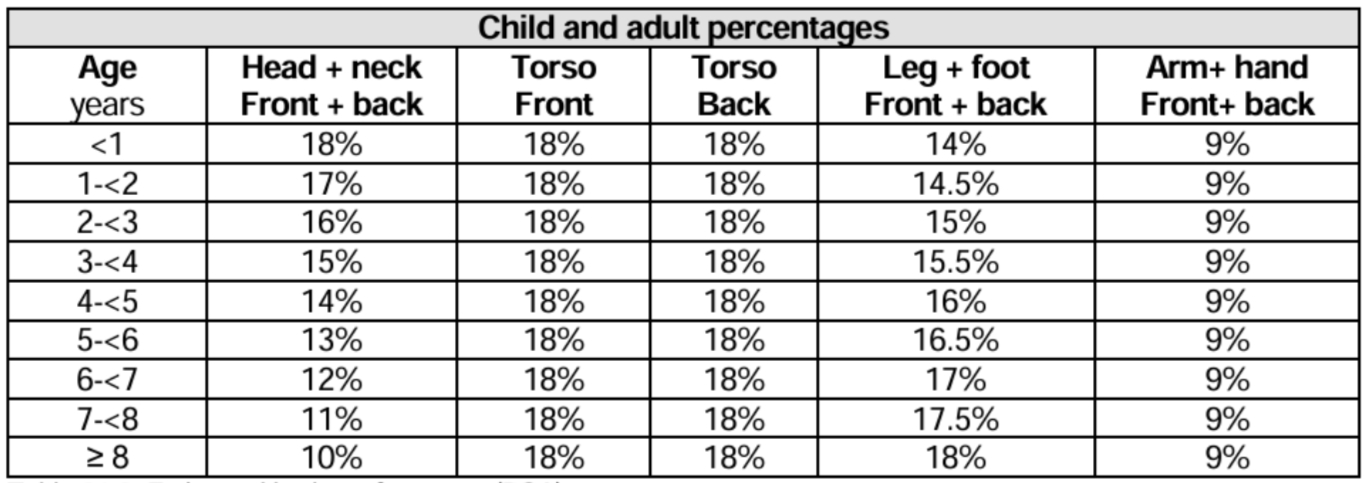
Click on the image to enlarge.
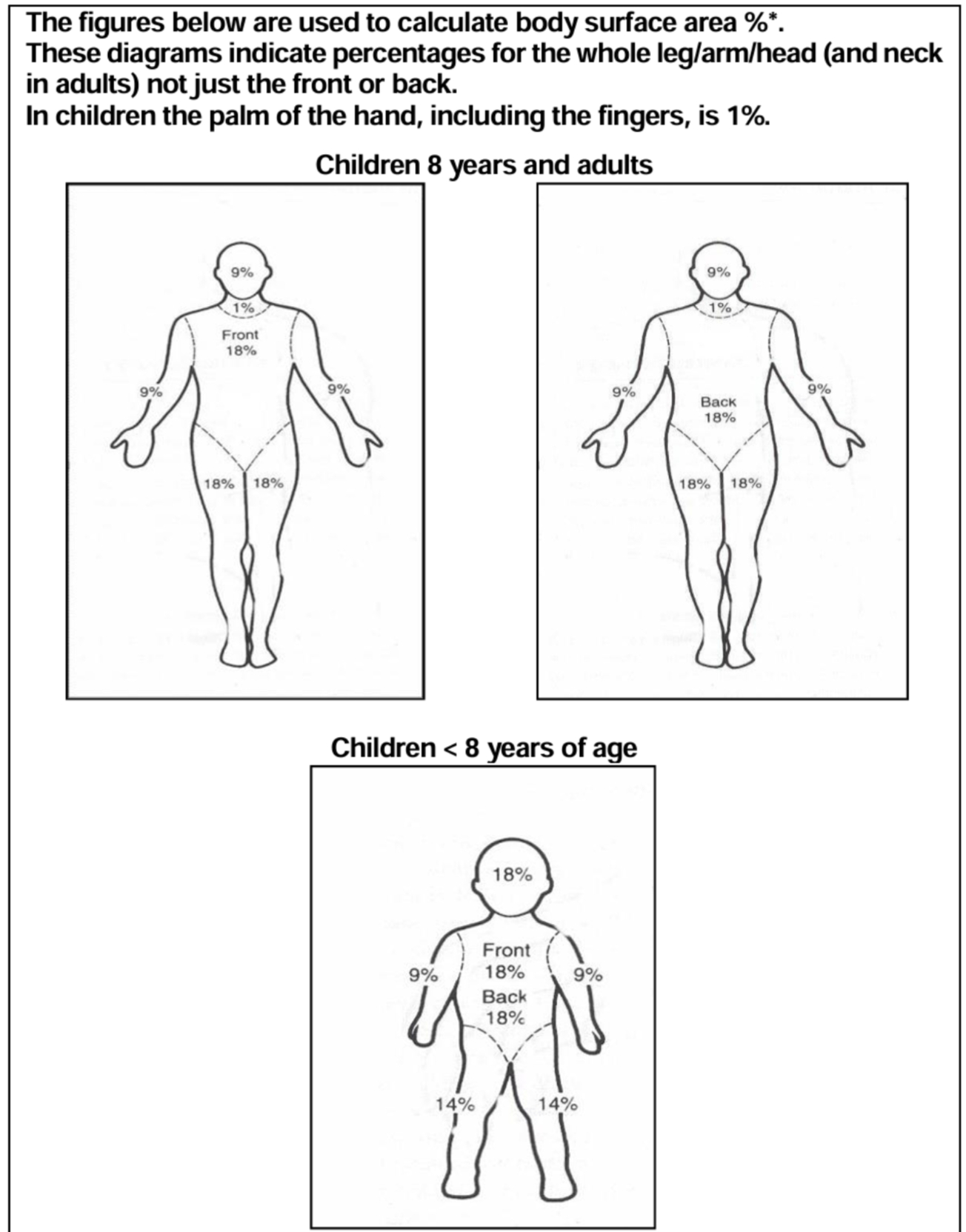
Figure 21.6: Calculating body surface area for management of burns
* Source: Karpelowsky JS, Wallis L, Madaree A, Rode H; South African Burn Society. South African Burn Society burn stabilisation protocol. S Afr Med J. 2007. Aug;97(8):574-7. https://www.ncbi.nlm.nih.gov/pubmed/17966146
Click on the image to enlarge.
MEDICINE TREATMENT
Fluid replacement
Burns ≤ 10% Total Body Surface Area (TBSA):
Oral fluids.
Burns > 10% of TBSA:
- IV fluid for resuscitation, replacement, and maintenance.
Note:
IV fluid replacement is very important in large burns. However, if unable to obtain IV access, give fluids orally or via NGT and transfer urgently.
Calculation of fluid replacement
Fluids in adults:
If shocked, see: Shock.
First 24 hours:
- Sodium chloride 0.9%, IV.
- Calculate total fluid requirement in 24 hours: Total % burn x weight (kg) x 4 mL.
- Give half this volume in the first 8 hours.
- Administer remaining fluid volume in next 16 hours.
Note:
If urine output is not adequate, increase fluids for the next hour by 50%. Continue at a higher rate until urine output is adequate, then resume normal calculated rate.
Fluids in children:
Note:
Avoid circumferential taping when securing infusion lines, as oedema under the eschar may decrease the venous return.
Table 21.10: Replacement fluids for burns >10% BSA in children
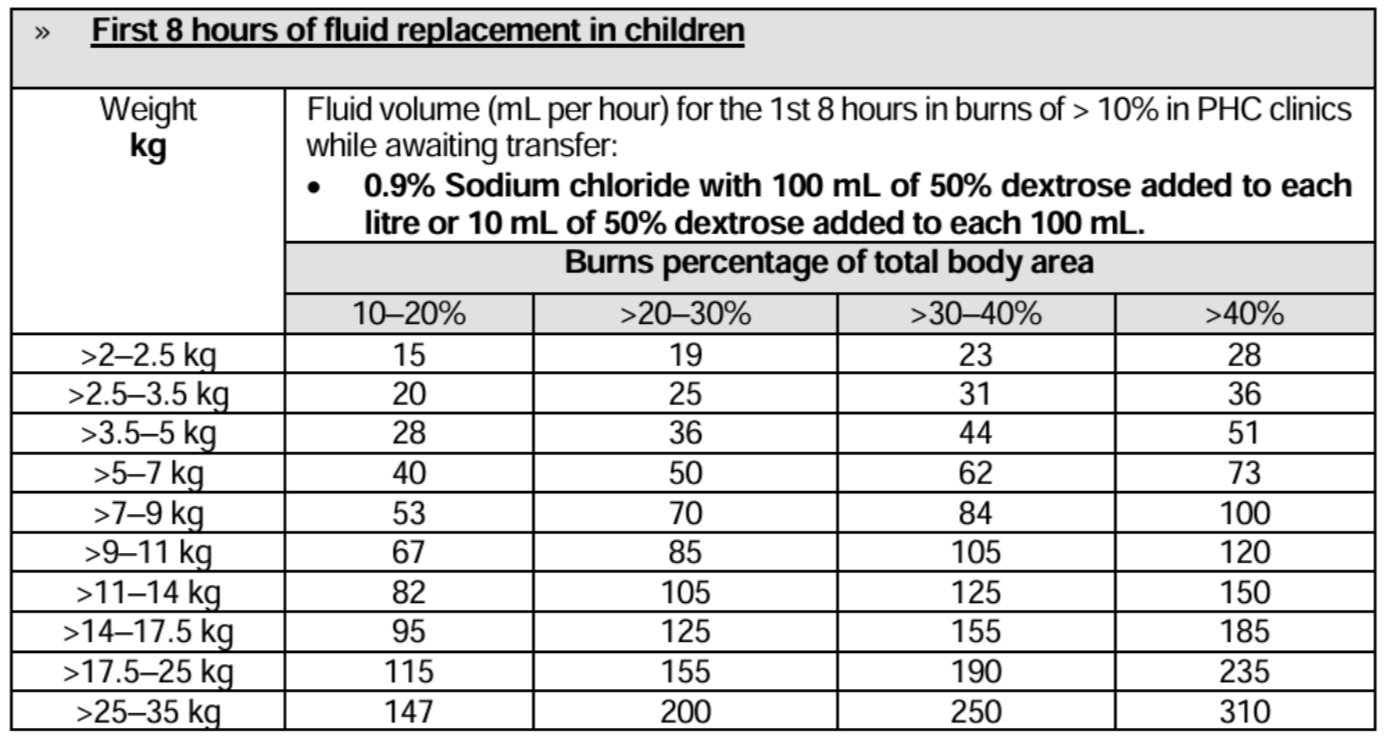
Click on the image to enlarge.
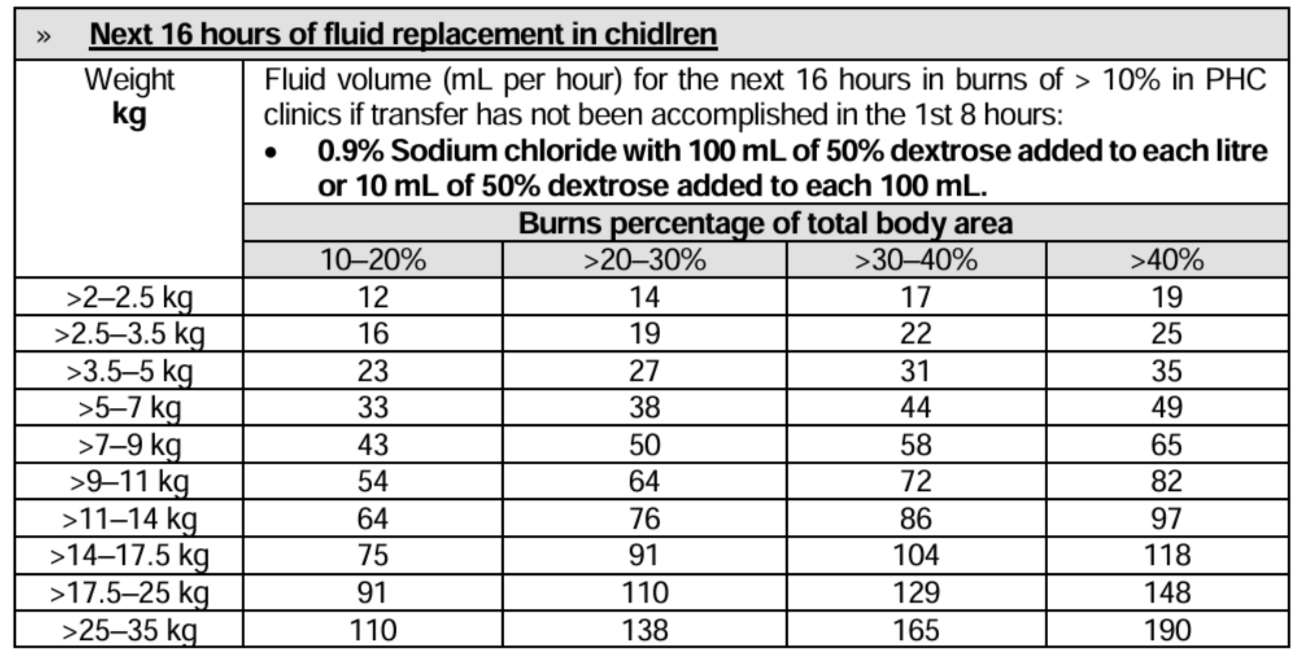
Click on the image to enlarge.
Pain:
Children
- Paracetamol, oral, 10–15 mg/kg/dose 6 hourly when required. See dosing table.
Adults
- Paracetamol, oral, 500mg -1 g 4–6 hourly when required (to a maximum of 4 g in 24 hours)
- Maximum dose: 15 mg/kg/dose.
Severe pain:
See: Chronic non-cancer pain.
Wound cleansing:
Clean the burn wound gently.
Sodium chloride 0.9% or clean water.
Burn dressing:
Keep the wound clean and dress with sterile dressings.
For patients requiring referral
- If within 12 hours, transfer patient wrapped in clean dry sheet and blankets.
- If delayed by >12 hours, paraffin gauze dressing and dry gauze on top.
- For full thickness and extensive burns cover with a paraffin gauze occlusive dressing. Cover the dressing with plastic wrap (e.g. cling film).
For patients not requiring transfer (burns that can be treated at home)
- Paraffin gauze dressing.
If infected burn
- Povidone-iodine 5%, cream, applied daily.
Tetanus prophylaxis:
ICD-10 code: Z23.5
If not vaccinated within the last 5 years
- Tetanus toxoid (TT), IM, 0.5 mL.
See: Animal bites or Human bites, for detailed indications and management principles.
REFERRAL
- All children <1 year of age.
- All children >5% in children 1–2 years of age.
- Full thickness burns of any size in any age group.
- Partial thickness burns >10% TBSA.
- Burns of special areas – face, hands, feet, genitalia, perineum and major joints.
- Electrical burns, including lightning injury.
- Severe chemical burns.
- Inhalation injury – fire or scald injury.
- Circumferential burns of the limbs or chest.
- Burn injury in a patient with pre-existing medical disorders which could complicate management, prolong recovery or affect mortality.
- Any patient with burns and concomitant trauma.
- Suspected child abuse.
- Burns exceeding the capabilities of the referring centre.
- Septic burn wounds.
- Consider rehabilitation services for reducing the risk of contractures and disfigurement.
Click here for the Burn Dressings Scoping Review PHC/Adults October.
Click here for the NEMLC Recommendations for medicine amendments (2020-4 review cycle).
Standard Treatment Guidelines and Essential Medicines List for South Africa, Primary Healthcare, 2020-4_Version 1.1_October 2024
Chapter 21: Emergencies and Injuries
Drugs mentioned
ICD-10 codes
- T30.0Burn of unspecified body region, unspecified degree
- T30.1Burn of first degree, body region unspecified
- T30.2Burn of second degree, body region unspecified
- T30.3Burn of third degree, body region unspecified
- T31.0Burns involving less than 10% of body surface
- T31.1Burns involving 10-19% of body surface
- T31.2Burns involving 20-29% of body surface
- T31.3Burns involving 30-39% of body surface
- T31.4Burns involving 40-49% of body surface
- T31.5Burns involving 50-59% of body surface
- T31.6Burns involving 60-69% of body surface
- T31.7Burns involving 70-79% of body surface
- T31.8Burns involving 80-89% of body surface
- T31.9Burns involving 90% or more of body surface
- Y34.99Unspecified event, undetermined intent, unspecified place, during unspecified activity
- Z23.5Need for immunization against tetanus alone