Burns
Description Assessment of burns General measures Medicine treatment ICD-10 code: T30.0-3 + T31.0-9 DESCRIPTION Skin and tissue damage caused by: exposure to extremes of temperature, contact with an electrical current, exposure to a chemical agent, and radiation. ASSESSMENT OF BURNS DEPTH OF BURN WOUND SURFACE/ COLOUR PAIN SENSATION/ HEALING Superficial or epidermal Dry, minor blisters, erythema -
ICD-10 code: T30.0-3 + T31.0-9
DESCRIPTION
Skin and tissue damage caused by:
- exposure to extremes of temperature,
- contact with an electrical current,
- exposure to a chemical agent, and
- radiation.
ASSESSMENT OF BURNS
| DEPTH OF BURN WOUND | SURFACE/ COLOUR | PAIN SENSATION/ HEALING |
| Superficial or epidermal | Dry, minor blisters, erythema | - Painful - Heals within 7 days |
| Partial thickness superficial or superficial dermal | Blisters, moist | - Painful - Heals within 10-14 days |
| Partial thickness deep or deep dermal | Moist white or yellow slough, red mottled | - Less painful - Heals within a month or more Generally needs surgical debridement and skin graft |
| Full thickness (complete loss of skin) | Dry, charred whitish, brown or black | - Painless, firm to touch - Healing by contraction of the margins Generally needs surgical debridement and skin graft |
The figures below are used to calculate body surface area %.
These diagrams indicate percentages for the whole leg/arm/head (and neck in adults) not just the front or back.
Children ≥8 years and adults
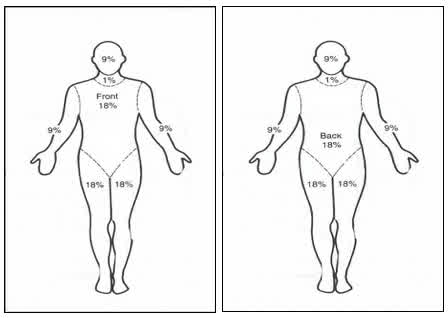
Source: Karpelowsky JS, Wallis L, Madaree A, Rode H; South African Burn Society. South African Burn Society burn stabilisation protocol. S Afr Med J. 2007 Aug;97(8):574-7. https://www.ncbi.nlm.nih.gov/pubmed/17966146
Click on above image to enlarge
GENERAL MEASURES
- Assess airway, breathing
- Look for signs of inhalational burn- history of hot gas, smoke, steam.
- INTUBATE if significant airway obstruction present or WORSENING symptoms.
- Intubation is necessary in the case of unconscious patients, hypoxic patients with severe smoke inhalation, or patients with flame or flash burns involving the face and neck if there is evidence of compromised airway patency.
- Intubate early if burns are inhalational, or in the presence of pharyngeal burns with soft tissue swelling, as these patients frequently tend to develop respiratory failure.
- Close monitoring is essential during the first 24-48 hours
- If breathing is compromised because of tight circumferential trunk burns, consult with burn centre surgeons immediately. Urgent escharotomies may be required to facilitate chest expansion
- Assess circulation
- Establish large-bore intravenous (IV) lines and provide resuscitation bolus fluid.
- Reminder: IV lines may be placed through the burned area if necessary (suture to secure).
- Assess neurological state of the patient
- Assess for associated trauma related injuries
- Secure the C–spine with an inline stabilising collar, when the mechanism of injury could indicate additional trauma.
- Identify potential sources of internal bleeding.
- Stop any external bleeding.
- Remove any sources of heat or chemicals. Removal constrictive clothing/accessories.
- Estimate percentage of total body surface area involved.
- Support vital organ function.
- Look for aggravating comorbidities, e.g. seizures, hyperkalaemia, renal failure.
- Assess need for decompression incisions: escharotomies
- Local wound care: Clean superficial burns can be managed by occlusive dressings. Deeper wounds may have to be excised and grafted.
- Rehabilitation involving physiotherapy and occupational therapy.
Local wound care
- Melted plastic and tar can be removed with the topical application of liquid paraffin solution.
- Wash burn wounds with soap and water or 1% chlorhexidine.
- Cool burns less than 3 hours old with cold tap water for at least 30 minutes and then dry the patient.
- Keep the wound clean and dress with sterile dressings.
- If infected burn:
- Povidone-iodine 5%, cream, applied daily.
For chemical burns
- Remove all clothing.
- Brush powdered chemicals off the wound.
- Flush chemical burns for a minimum of 30 minutes using copious volumes of running water.
- Reminder: Never neutralise an acid with a base or vice versa.
- Determine what chemical (and what concentration) caused the injury.
- Ocular burns: T26.4
- Sodium chloride 0.9% gentle eye washes or irrigations as soon as possible. Follow with an ophthalmology consultation.
For electrical burns
- Differentiate between low-voltage (1 000 v) injuries.
- Attach a cardiac monitor; treat life-threatening dysrhythmias as needed.
- Suspect compartment syndrome, consider escharotomies.
Nutrition
Burn injuries put patients into a hypermetabolic state which requires early and adequate nutritional support. Seek early guidance from local burns centre. See: Nutritional support.
MEDICINE TREATMENT
Fluid replacement
Burns ≤ 10% Total Body Surface Area (TBSA):
- Oral rehydration solution.
Burns >10% of TBSA:
- Sodium chloride 0.9%, IV fluid for resuscitation, replacement and maintenance.
Calculation of fluid replacement
Replacement fluids for burns
First 24 hours:
- Sodium chloride 0.9%, IV.
- Calculate total fluid requirement in 24 hours:
Total % burn x weight (kg) x 4 mL. - Give half this volume in the 1st 8 hours.
- Administer remaining fluid volume in next 16 hours.
- Calculate total fluid requirement in 24 hours:
Note:
If urine output is not adequate, increase fluids for the next hour by 50%. Continue at a higher rate until urine output is adequate, then resume normal calculated rate. Aim for urine output 0.5 mL/kg/hr.
Analgesia
Ensure adequate analgesia particularly at change of dressing, i.e.:
- Morphine, IV, to a total maximum dose of 10 mg (See Appendix II, for individual dosing and monitoring for response and toxicity).
AND
- Paracetamol, oral, 500mg - 1 g 4–6 hourly when required (to a maximum of 4 g in 24 hours).
- Maximum dose: 15 mg/kg/dose.
Tetanus prophylaxis Z23.5
- Tetanus toxoid vaccine, IM, 0.5 mL immediately, if not previously immunised within the last 5 years.
Stress ulcer prophylaxis
- Feeding patients provides protection against gastric ulcers developing and prophylaxis is not necessary in patients who are tolerating feeds.
- Stress ulceration, a complication of critical illness, needs to be prevented.
- Oral or enteral feeding should be initiated as soon as possible.
- Pantoprazole, 40mg, IV daily.
- Stop stress ulcer prophylaxis once the patient is tolerating enteral feeds.
Note:
Pharmacokinetic parameters are altered in patients with severe burns, notably an increased volume of distribution. An appropriate loading dose should be given of certain medicines, e.g. aminoglycosides. Therapeutic drug monitoring (TDM) may inform dosing and should be requested, if available.
Discuss the following cases with a burns specialist:
- Burns >15% body surface area (BSA) or >10% BSA >50 years of age.
- Burns of face, hands, feet, genitalia, perineum or involving joints.
- Electrical burns, including lightning burns.
- Chemical burns.
- Inhalation injury or burns.
- Burns associated with major trauma.
- Circumferential burns.
Click here for the Supporting NEMLC report and reviews_(2020-4 review cycle).
Standard Treatment Guidelines And Essential Medicines List For South Africa, Adult Hospital level, 2020-4_Version 1_June 2024
Chapter 20: Emergencies and Injuries
Drugs mentioned
ICD-10 codes
- T26.4Burn of eye and adnexa, part unspecified
- T30.0Burn of unspecified body region, unspecified degree
- T30.1Burn of first degree, body region unspecified
- T30.2Burn of second degree, body region unspecified
- T30.3Burn of third degree, body region unspecified
- T31.0Burns involving less than 10% of body surface
- T31.1Burns involving 10-19% of body surface
- T31.2Burns involving 20-29% of body surface
- T31.3Burns involving 30-39% of body surface
- T31.4Burns involving 40-49% of body surface
- T31.5Burns involving 50-59% of body surface
- T31.6Burns involving 60-69% of body surface
- T31.7Burns involving 70-79% of body surface
- T31.8Burns involving 80-89% of body surface
- T31.9Burns involving 90% or more of body surface
- Z23.5Need for immunization against tetanus alone