Cardiac Arrest, Adults
Description Covid-19 considerations General Measures Emergency Treatment Immediate Emergency Medicine Treatment Additional Guidance Referral ICD-10 code: I46.0/I46.9 Figure 21.1: Advanced cardiac arrest algorithm ( adapted with permission from the Resuscitation Council of South Africa ) Click on the image to enlarge. Figure 21.2: Advanced cardiac arrest algorithm - suspected respiratory communica
Immediate Emergency Medicine Treatment
ICD-10 code: I46.0/I46.9
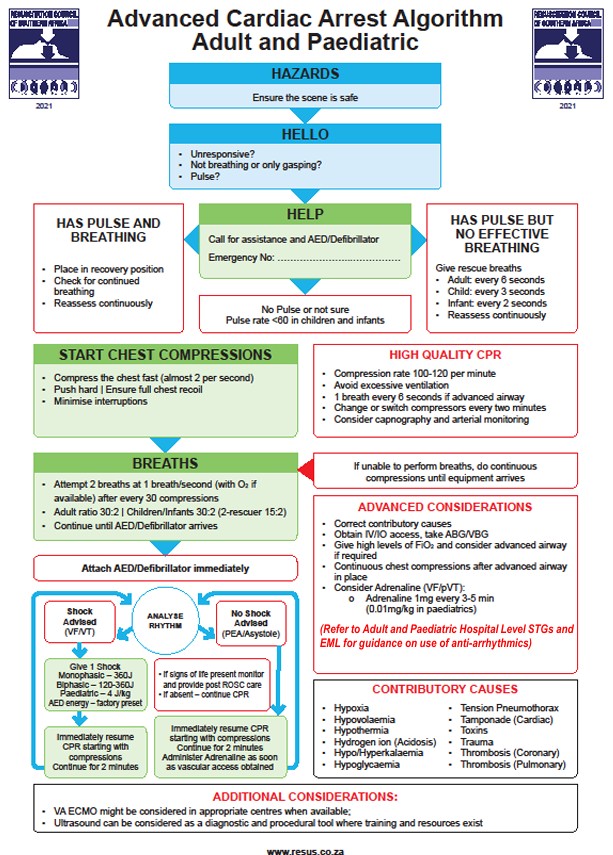
Figure 21.1: Advanced cardiac arrest algorithm (adapted with permission from the Resuscitation Council of South Africa)
Click on the image to enlarge.
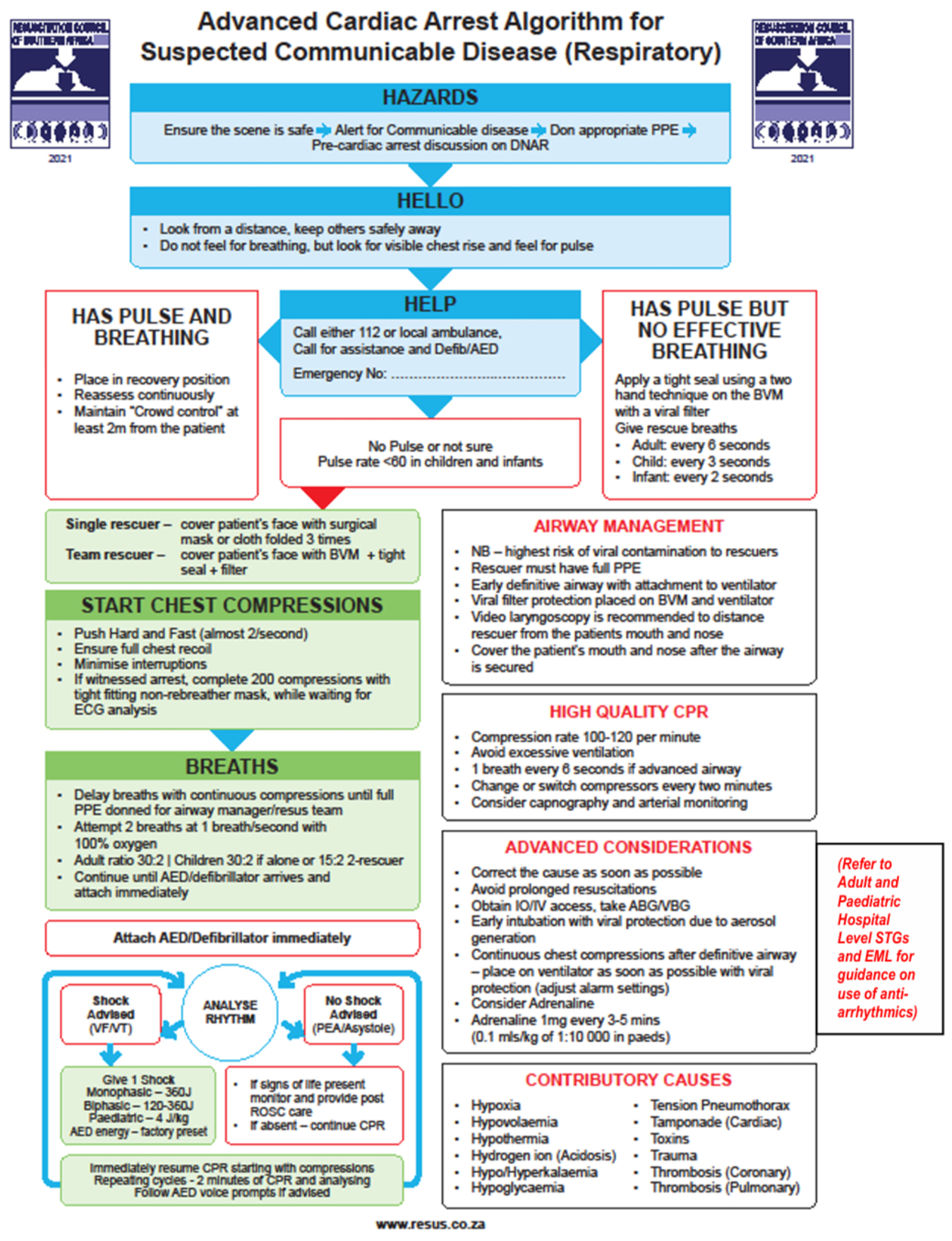
Figure 21.2: Advanced cardiac arrest algorithm - suspected respiratory communicable disease (adapted with permission from the Resuscitation Council of South Africa)
Click on the image to enlarge.
DESCRIPTION
Defined as the loss of a heart beat and loss of a palpable pulse, irrespective of the electrical activity captured on ECG tracing. Irreversible brain damage can occur within 2-4 minutes.
Clinical features include:
- sudden loss of consciousness;
- absent carotid pulse; and
- loss of spontaneous respiration.
COVID-19 CONSIDERATIONS
- The infection risk that CPR poses to providers due to aerosolization of coronavirus particles is not negligible.
- This potential risk should be weighed against the probability of achieving spontaneous return of circulation to inform the decision to initiate or stop CPR.
- For in hospital cardiac arrest in patients with suspected COVID-19, CPR has been shown to not be beneficial unless an immediate reversible cause is suspected, e.g., dislodgement of ET tube, etc. and is therefore not recommended.
- For out of hospital cardiac arrest in patients with suspected COVID-19, it is recommended to not start conventional CPR in unwitnessed cardiac arrest as it will likely not be beneficial.
- Appropriate PPE should be worn by all staff before initiating CPR: FFP3 mask, visor, gloves and gown.
GENERAL MEASURES
- Diagnose cardiac arrest rapidly.
- Make a note of the time of starting resuscitation.
- Document medication given and progress after the resuscitation.
- Follow instructions as per the appropriate algorithm (Fig 21.1 or 21.2) and below.
EMERGENCY TREATMENT
Hazards, Hello, Help
- Assess for any hazards and remove. Make use of personal protective equipment i.e. gloves, masks.
- Speak to the patient. If they respond, turn into recovery position and continue management as directed by findings.
- If no response, check for carotid pulse and breathing. Take no longer than 10 seconds.
- Call for skilled help and an automated external defibrillator (AED) or defibrillator.
Cardiopulmonary resuscitation (CPR)
- Place the patient on a firm flat surface and commence resuscitation immediately.
- Initiate CAB (Circulation Airway Breathing) sequence of CPR.
- Check the rhythm as soon as defibrillator or AED is available and defibrillate if a shockable rhythm is identified.
Circulation
- If there is no pulse or you are not sure, start with 30 chest compressions at a rate of 100-120 compressions per minute, and a depth of +/-5 cm.
- Allow full chest recoil between compressions.
- Minimise interruptions during compressions.
Airway and Breathing
- To open the airway, lift the chin forward with the fingers of the one hand and tilt the head backwards with other hand on the forehead. Do not do this where a neck injury is suspected (see below).
- If there is no normal breathing, give 2 breaths with bag-valve-mask resuscitator and face mask.
- The administered breaths must cause visible chest rise.
- If not able to perform breaths, continue compressions (reposition head and insert correctly sized oropharyngeal airway and try again after 30 compressions).
- If advanced airway is placed, administer 1 breath every 6 seconds without interrupting chest compressions. Avoid excessive ventilation.
- Oxygenate with 100% oxygen.
- Repeat the cycle of 30 compressions followed by 2 breaths (30:2) until the AED or defibrillator arrives.
Where neck injury is suspected:
- Do not perform a chin lift or head tilt manoeuvre if a neck injury is suspected.
- To open the airway, use a jaw thrust:
- place your fingers behind the jaw on each side
- lift the jaw upwards while opening the mouth with your thumbs “Jaw thrust”
- Ideally use a 3rd person to provide in-line manual stabilisation of the neck
Initiate fluids, IV/IO access
- Sodium chloride 0.9%, IV, 1000 mL
AED/Defibrillator
Attach leads and analyse rhythm as soon as the defibrillator arrives:
If pulseless with shockable rhythm (ventricular fibrillation/tachycardia)
- Defibrillate, as indicated per algorithm (1 shock).
- Immediately resume CPR. Starting with chest compressions.
- Continue CPR cycles of 30:2 for 2 minutes, then reassess for a pulse.
- Administer adrenaline (epinephrine) as per algorithm and medicine treatment below.
- Seek reversible cause of arrest.
- Continue CPR until spontaneous breathing and/or pulse returns.
If pulseless and no respirations with non-shockable rhythm
- Immediately resume CPR. Starting with chest compressions.
- Continue CPR cycles of 30:2 for 2 minutes then reassess for a pulse.
- Administer adrenaline as per algorithm.
- Seek reversible cause of arrest.
- Continue CPR until spontaneous breathing and/or pulse returns.
IMMEDIATE EMERGENCY MEDICINE TREATMENT
Adrenaline (epinephrine) is the mainstay of treatment. Give immediately, IV, IO, or endotracheal, when there is no response to initial resuscitation or defibrillation.
- Adrenaline (epinephrine 1 mg), 1:1 000, 1 mL , IV immediately as a single dose.
- Flush with 5–10 mL of sterile water or sodium chloride 0.9%.
- Repeat every 3–5 minutes during resuscitation.
OR
- Adrenaline (epinephrine 1 mg), intra-osseous (IO), 1:1 000, 1 mL, via IO line.
ADDITIONAL GUIDANCE
Connect bag-valve-mask resuscitator to 100% oxygen at 10-15L/min flow.
Check glucose and treat hypoglycaemia.
Continue CPR until spontaneous breathing and/or heart beat returns.
Assess continuously (every 2 minutes) until the patient shows signs of recovery.
Termination of resuscitation:
- The decision to stop CPR attempts depends on the specifics of the individual patient and should be based on clinical judgement.
- Consider stopping resuscitation attempts and pronouncing death if there is incurable underlying disease, or if asystole > 20 minutes or in the absence of the factors for prolonging resuscitation as listed below.
Consider carrying on for longer especially with:
- hypothermia and drowning
- poisoning or medicine overdose
- neurotoxic envenomation (e.g. black and green mamba or Cape cobra snakebite) – see: Snakebites
This decision should take into consideration the potential risk that CPR poses to the rescuer e.g. infectious diseases.
REFERRAL
All patients: transfer with supportive care and accompanying skilled worker until care is taken over by doctor at receiving institution.
Click here for the NEMLC Recommendations for medicine amendments (2020-4 review cycle).
Standard Treatment Guidelines and Essential Medicines List for South Africa, Primary Healthcare, 2020-4_Version 1.1_October 2024
Chapter 21: Emergencies and Injuries