Cardiorespiratory Arrest
Description General and supportive measures Medicine treatment Referral ICD-10 code: I46.9 Click on the image to enlarge DESCRIPTION Cardiorespiratory arrest in children usually follows a period of circulatory or respiratory insufficiency and less commonly is precipitated by a sudden cardiac event. It is, therefore, important to pre-empt cardiorespiratory arrest in
General and supportive measures
ICD-10 code: I46.9
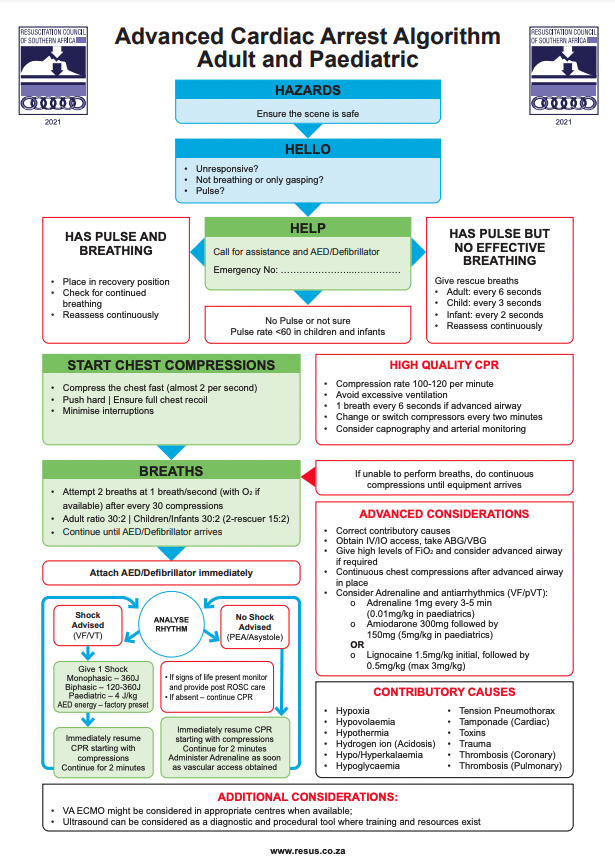
Click on the image to enlarge
DESCRIPTION
Cardiorespiratory arrest in children usually follows a period of circulatory or respiratory insufficiency and less commonly is precipitated by a sudden cardiac event. It is, therefore, important to pre-empt cardiorespiratory arrest in children by recognising and urgently treating respiratory or circulatory compromise.
Cardiorespiratory arrest is diagnosed clinically in the unresponsive child who has no respiratory effort and/or in whom there is no palpable pulse and no signs of life, i.e. cough or spontaneous movement.
GENERAL AND SUPPORTIVE MEASURES
Always call for help immediately.
Ensure an open airway (position head in a neutral position for toddlers or sniffing position for older children with head-tilt, chin-lift manoeuvre or jaw-thrust in trauma cases).
If there is still no respiration, then commence with artificial breathing using a self-inflating bag, with a reservoir and an appropriate mask. Connect the bag to a high flow oxygen source (15 L/minute). Squeeze the bag with enough air to cause the chest to rise, do not overinflate the child’s lungs with too much tidal volume.
If there is inadequate chest movement with bag-valve-mask ventilation, re-assess airway patency and adjust, re-positioning the airway with a naso or oropharyngeal tube/airway. If necessary, place an appropriately sized endotracheal tube. In the event of an unexpected arrest or an arrest where there are no witnesses, consider foreign body obstruction. See: Inhalation, foreign body.
Checklist:
- Reassess head position to keep airway open.
- Reassess for an adequate seal when performing bag-mask ventilation.
- Ensure an adequate size bag is used according to the size of the patient.
- Ensure no leaks in bag.
- Exclude a pneumothorax.
Once effective breathing has been established, provide chest compressions at a rate of 100–120/minute for all children excluding neonates. Provide artificial breaths at a ratio of 30 compressions to 2 breaths (30:2) if alone and 15 compressions to 2 breaths (15:2) if two rescuers are present.
Attach a cardiac monitor to the child and secure vascular access. If unable to insert an IV line, obtain intra-osseous access. See: Intra-osseous infusion in emergencies.
MEDICINE TREATMENT
Asystole or pulseless electrical activity (i.e. no palpable pulse even if normal electrical pattern (PEA)
- Adrenaline (epinephrine) 1:10 000 (diluted), IV/intra-osseous, 0.1 mL/kg. (Follow each dose with a small bolus of sodium chloride 0.9%)
- 0.1 mL of 1:10 000 solution = 10 µg.
- Dilute a 1 mL ampoule of adrenaline (epinephrine) 1:1000 in 9 mL of sodium chloride 0.9% or sterile water to make a 1:10 000 solution.
ETT adrenaline is no longer recommended as absorption is unpredictable.
It is faster to get an IO line than intubating the child – rather go for IO adrenaline.
Repeat the dose of adrenaline (epinephrine) every 4 minutes if asystole/PEA persists while CPR continues.
When an ECG sinus rhythm trace is present, continue CPR until an effective pulse and circulation is present.
If the arrest was preceded by circulatory shock:
- Sodium chloride 0.9% OR Modified Ringers Lactate, IV, 20 mL/kg as a bolus.
During the resuscitation consider if any of the following correctable conditions are present (and if present correct them):
- Hypoxia
- Hypovolaemia
- Hyperkalaemia, hypokalaemia, hypocalcaemia.
- Hypothermia
- Tension pneumothorax.
- Tamponade (cardiac).
- Toxins (e.g. tricyclic antidepressants).
- Thrombo-embolic event.
Note:
There is no evidence to support the routine use of any of the following in cardiac arrest:
- sodium bicarbonate,
- calcium,
- high dose IV adrenaline (epinephrine) (100 µg/kg/dose).
Ventricular fibrillation or pulseless ventricular tachycardia
Consider the following and if present, correct:
- Hypoxia
- Hypovolaemia
- Hyperkalaemia, hypokalaemia, hypocalcaemia.
- Hypothermia
- Tension pneumothorax.
- Tamponade (cardiac).
- Toxins (e.g. tricyclic antidepressants).
- Thrombo-embolic event.
Proceed to immediate defibrillation, but during this process cardiorespiratory resuscitation (compressions and ventilation) must continue, except during the actual administration of each shock. Continue until adequate circulation can be demonstrated.
For pulseless ventricular tachycardia and ventricular fibrillation, the defibrillator should be set to asynchronous mode and 4 J/kg shocks administered.
Do not increase voltage; give 4 J/kg repeatedly, if needed.
After each shock continue CPR immediately for 2 minutes and only re-assess the ECG rhythm thereafter.
If ventricular tachycardia/fibrillation has reverted to sinus rhythm, stop shock cycle, but continue CPR until good stable circulation and adequate spontaneous breathing is evident.
If fibrillation/ventricular tachycardia is still present, give further shocks for 3 x 2-minute cycles of shocks every 4 minutes.
Thereafter, if necessary, the 2-minute shock cycles should continue but, in addition, give the following after the 3rd shock:
- Adrenaline (epinephrine) 1:10 000 (diluted), IV, 0.1 mL/kg and then repeat after every 2nd shock, i.e. every 4 minutes. (Follow each dose with a small bolus of sodium chloride 0.9%.)
- 0.1 mL of 1:10 000 solution = 10 µg.
- Dilute a 1 mL ampoule of adrenaline (epinephrine) 1:1000 in 9 mL of sodium chloride 0.9% or sterile water to make a 1:10 000 solution.
Allow one minute of cardiopulmonary resuscitation between the administration of any medicine and a repeat cycle of shocks.
REFERRAL
To an intensive care unit after recovery from an arrest.
Standard Treatment Guidelines And Essential Medicines List For South Africa, Hospital Level, Paediatrics, 2023 Edition
Chapter 1: Emergencies and Trauma, 1.1 Paediatric Emergencies, Cardiorespiratory Arrest