Chronic Kidney Disease (CKD)
Structural or functional kidney damage
N18.1-5/N18.9
|
CAUTION
Check all medicines for possible dose adjustment based on eGFR
|
The doses of many medicines need to be adjusted when there is impairment of kidney function. Close attention for dose adjustments should be made once the estimated glomerular filtration rate (eGFR) falls <60 ml/min/1.73m2, and especially when eGFR<15 ml/min/1.73m2 or when the patient is on dialysis.
Recommendations for medicines that require dose adjustment in renal impairment can be found in the South African Medicines formulary (SAMF), package insert, and from many online resources e.g.: https://globalrph.com/renal/
DESCRIPTION
Structural or functional kidney damage present for > 3 months, with or without a decreased glomerular filtration rate (eGFR).
Markers of kidney damage include:
- Abnormalities in urine e.g. proteinuria or haematuria
- Abnormalities in blood e.g. serum creatinine or low eGFR
- Abnormalities in imaging tests e.g. small kidneys or cysts on ultrasound
- Abnormalities on pathological specimens e.g. glomerular disease on kidney biopsy.
Common causes of chronic kidney disease (CKD) include:
- Hypertension
- Polycystic kidney disease
- Diabetes mellitus
- HIV/AIDS
- Glomerular diseases
|
Chronic kidney disease can be entirely asymptomatic, BUT early detection and management can improve the outcome of this condition. |
Treatment and prevention strategies according to prognostic category
Estimation of the degree of kidney damage is important to guide management to prevent adverse outcomes of CKD.
Use eGFR and albumin:creatinine ratio to put patient into prognostic category - see table below.
The calculation eGFR using the CKD-EPI equation is currently the formula of choice for calculation of the eGFR.
LoE:IVb1
Note
- Adults with mild to moderate decline in eGFR (G3a) and no albuminuria can be managed at primary care level once the cause and plan for care has been established.
- All children should be referred for investigation and initial management.
Table: Prognosis of CKD by GFR and albuminuria categories: KDIGO 2024
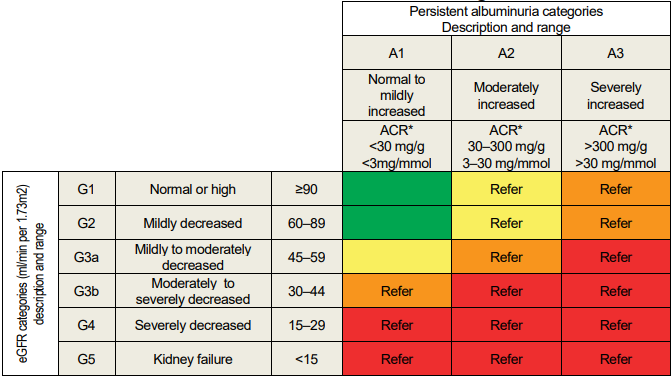
*ACR: albumin to creatinine ratio in urine specimen.
Green: low risk (if no other markers of kidney disease, no CKD); yellow: moderately increased risk; orange: high risk; red: very high risk; A1, A2, A3 = categories of albuminuria; G1, G2, G3a, G3b, G4, G5 = categories of eGFR
LoE:IVb2
Send blood annually for measurement of creatinine in all patients at increased risk (eGFR will be calculated by the laboratory, based on the serum creatinine).
GENERAL MEASURES
- Limit total daily salt intake (including salt in food) to < 5000 mg per day of sodium chloride (a level teaspoon). Consult with dietician as required.
- Reduce cardiovascular disease risk factors. See: Prevention of ischaemic heart disease and atherosclerosis.
- Avoid nephrotoxic drugs, e.g. NSAIDs, tenofovir and aminoglycosides.
- Screen for proteinuria.
- If urine dipstick 1+ or greater, repeat on a properly collected midstream urine specimen on another occasion. If proteinuria persists, quantify protein with a spot urine protein-creatinine ratio. Significant proteinuria = spot urine protein-creatinine ratio (PCR) of > 0.15 g/mmol. This is equivalent to 1 g per 24 hours.
LoE: IVb3
Note:
Proteinuria is screened for differently in diabetics. See: Diabetic nephropathy
MEDICINE TREATMENT
- Treat underlying conditions.
Proteinuria
- Measure serum potassium at baseline.
Adults
ACE-inhibitor, e.g.:
- Enalapril, oral, start with 5 mg 12 hourly.
- Titrate up to 10 mg 12 hourly, if tolerated.
- Start with low dosage of ACE-inhibitor and titrate up to the maximum dose or until the proteinuria disappears – whichever comes first. Ensure BP remains in normal range and no side effects are present.
ACE-inhibitors can be used in renal impairment (eGFR < 30 mL/min/1.73m2 ) if potassium can be monitored safely.
- Monitor creatinine and potassium:
- 1–2 weeks after treatment initiation, if eGFR < 60 mL/min and after 4 weeks, if eGFR > 60 mL/min.
- If creatinine increases by > 20% from the baseline, stop ACE-inhibitor and refer.
- If stable, monitor thereafter at regular clinic visits.
LoE:IVb
- ACE-inhibitors are contraindicated in, amongst others:
- Hyperkalaemia
- Known hypersensitivity to an ACE-inhibitor or an ARB
- Bilateral renal artery stenosis
- Pregnancy
Hyperlipidaemia
- If hyperlipidaemia is a co-existent risk factor, manage according to Prevention of ischaemic heart disease and atherosclerosis.
Diabetes mellitus
- In diabetics, optimise control according to Diabetes mellitus type 2, in adults.
- Replace oral sulphonylureas with insulin when eGFR < 60 mL/min, because of an increased risk of hypoglycaemia.
- Replace metformin with insulin when eGFR < 30 ml/min, because of the potential risk of lactic acidosis.
- Insulin is preferred to control blood glucose in patients with eGFR < 30 mL/min.
Hypertension
- Treat if present. See: Hypertension
- Target BP: Systolic < 140 mmHg and diastolic < 90 mmHg (See: Hypertension: Type 1 diabetes mellitus, in adults; and Diabetes mellitus type 2, in adults).
Fluid overload
- Treat fluid overload if present and refer
Adults
- Furosemide, oral or IV, 20 mg to 80 mg daily, as a single or in divided doses, initiating at the lowest effective dose and titrating upwards.
- Dose may be increased to 160mg IV or oral daily, in divided doses.
- First establish an effective dose and ascertain if urination occurs within 1-2 hours of intake. If urination does not occur within 1-2 hours, the dose should be increased further until urination ensues.
- Do not give IV fluids – use heparin lock or similar IV access.
Children
- Furosemide, IV, 1 mg/kg, over 5 minutes. See: dosing table.
Use the smallest volume possible to administer medication. Do not administer any resuscitation or maintenance fluids intravenously.
Note:
Exclude heart failure in patients with persistent pedal oedema
REFERRAL
- All cases of suspected chronic kidney disease stages 3–5 for assessment and planning.
- In addition, patients with chronic kidney disease stages 3–5 may also require rehabilitation support for optimisation of function outcomes e.g., improved muscle strength and cardiovascular fitness, reduced blood pressure, weight management.
- All children.
- All cases of CKD with:
- haematuria.
- significant proteinuria with urine protein-creatinine ratio > 0.1 g/mmol.
- eGFR < 60 mL/min for initial assessment and planning
- eGFR < 30 mL/min
- Uncontrolled hypertension/fluid overload.
- CKD associated with hyperlipidaemia.
- No reduction of proteinuria despite ACE-inhibitor therapy.
- If ACE-inhibitors are contraindicated or are not tolerated.
LoE:IIIb4
|
Patients who might qualify for dialysis and transplantation or who have complications should be referred early to ensure improved outcome and survival on dialysis, i.e. as soon as eGFR drops < 30mL/min, or as soon as diagnosis is made/suspected. |
Standard Treatment Guidelines and Essential Medicines List for South Africa, Primary Healthcare, 2020-2024_Version 1.0_17 October 2024
Chapter 8: Kidney and Urological Disorders_8.1 Chronic Kidney Disease (CKD)