Distributive Shock
Neurogenic shock Septic shock This happens when the blood vessels are abnormally dilated and presents with a low blood pressure, tachycardia and warm peripheries. There are 3 causes of this type of shock: neurogenic shock, septic shock, and anaphylactic shock (see Anaphylaxis/anaphylactic shock ). NEUROGENIC SHOCK ICD-10 code: T09.3 + R57.8 DESCRIPTION Occurs in spinal cord trauma when there is a
This happens when the blood vessels are abnormally dilated and presents with a low blood pressure, tachycardia and warm peripheries. There are 3 causes of this type of shock:
- neurogenic shock,
- septic shock, and
- anaphylactic shock (see Anaphylaxis/anaphylactic shock).
NEUROGENIC SHOCK
ICD-10 code: T09.3 + R57.8
DESCRIPTION
Occurs in spinal cord trauma when there is an interruption of the sympathetic chain causing vasodilatation.
GENERAL MEASURES
Check circulation, airway and breathing.
Spinal cord immobilisation.
Exclude other injuries that could cause low blood pressure.
MEDICINE TREATMENT
- Oxygen if saturation <94%.
- Sodium chloride 0.9%, IV.
- Administer crystalloid in titrated boluses up to 1 litre.
- Adrenaline (epinephrine), IV infusion, start at 0.05 mcg/kg/minute titrated according to the response.
- Dilute 10 mg (10 ampoules) of adrenaline 1:1 000 in 1 L sodium chloride 0.9%.
- Infuse according to weight and clinical response.
- Infusion rate: mL/hour:
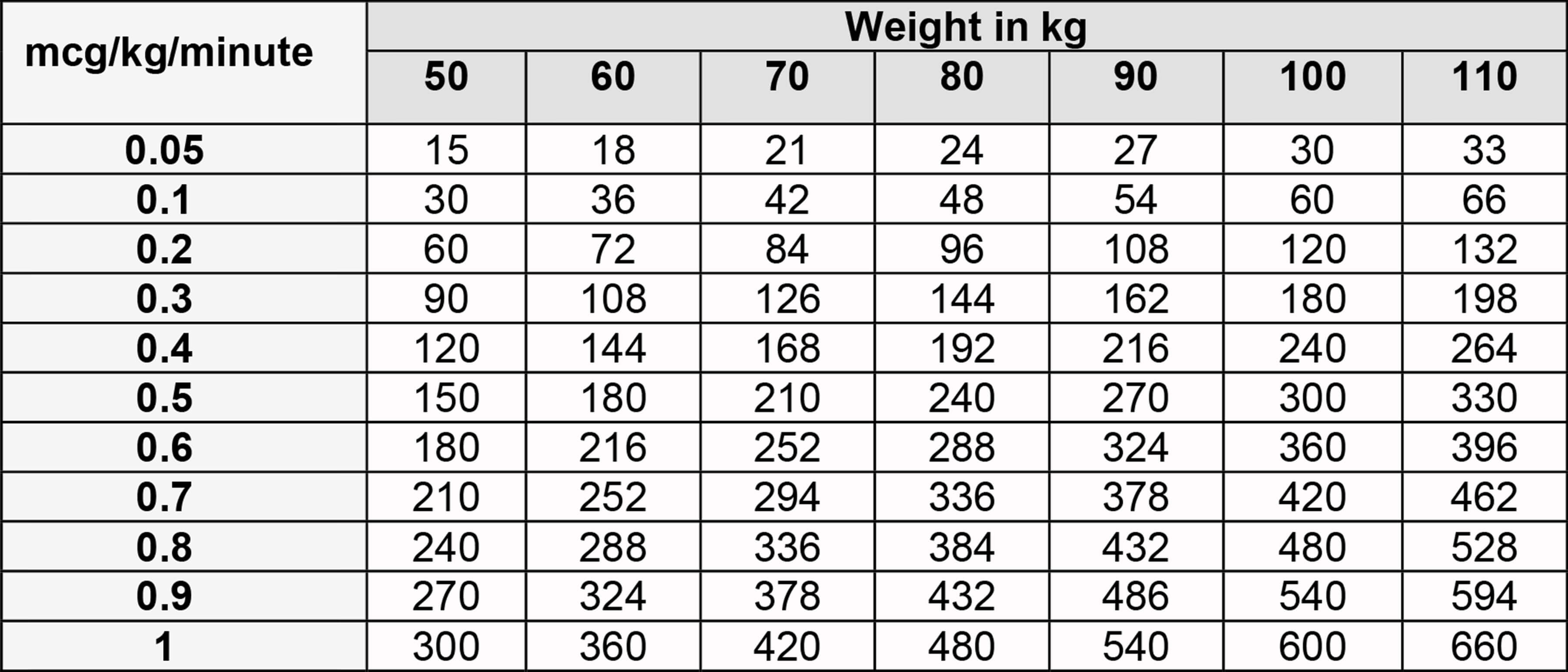
Click on above image to enlarge
SEPTIC SHOCK
ICD-10 code: R57.2
DESCRIPTION
Shock caused by a confirmed or suspected infection, with vasodilatation, increased capillary permeability, and decreased contractility of the heart.
GENERAL MEASURES
Check airway, breathing and circulation.
MEDICINE TREATMENT
- Oxygen of saturation <94%
Take blood culture (or any other tissue/body fluid), then administer appropriate parenteral broad spectrum antibiotics urgently, e.g.:
- Ceftriaxone, IV, 2 g daily.
Perform a fluid challenge for hypotension:
- Sodium chloride 0.9%, IV, 500 mL boluses over 30 minutes, whilst monitoring clinical response until 30 mL/kg has been achieved.
- Assess BP and pulse rate response. Response is defined by a good urine output (>0.5 ml/kg/hour) and adequate cerebral perfusion rather than an absolute BP value.
Balanced solutions may be appropriate in some patients (i.e. presentation with hyponatraemia, previous renal placement therapy):
- Balanced solution, e.g.:
- Ringer lactate, 500 mL boluses over 30 minutes, whilst monitoring clinical response, until 30 mL/kg has been achieved.
- Assess blood pressure and pulse rate response. Response is defined by a good urine output (>0.5 mL/kg/hour) and adequate cerebral perfusion rather than an absolute blood pressure value.
Avoid over-hydrating as this could exacerbate hypoxia associated with adult respiratory distress syndrome.
If no haemodynamic response to early aggressive fluid resuscitation:
- Adrenaline (epinephrine), IV infusion, 0.05 mcg/kg/minute titrated according to the response.
- Dilute 10 mg (10 ampoules) of adrenaline 1:1000 in 1 L sodium chloride 0.9%.
- Infuse according to weight and clinical response. (Aim for target MAP 65 mmHg and urine output 0.5 mL/kg/hour).
- See Neurogenic shock, for the infusion rate.
Standard Treatment Guidelines And Essential Medicines List For South Africa, Adult Hospital level, 2020-4_Version 1_June 2024
Chapter 20: Emergencies and Injuries