Dysnatraemias In ICU
Rapid changes in serum sodium are more likely to be symptomatic. Slow changes should be corrected slowly: Hypernatremia – risk of cerebral oedema. Hyponatremia – risk of central pontine myelinolysis. Hyponatraemia Defined as serum Na < 135 mmol/L Disorder of water balance, excess total body water relative to electrolytes. Caused by increased renal water reabsorption in response to ADH, along w
- Rapid changes in serum sodium are more likely to be symptomatic.
- Slow changes should be corrected slowly:
- Hypernatremia – risk of cerebral oedema.
- Hyponatremia – risk of central pontine myelinolysis.
Hyponatraemia
Defined as serum Na < 135 mmol/L
- Disorder of water balance, excess total body water relative to electrolytes.
- Caused by increased renal water reabsorption in response to ADH, along with water intake.
- Loss of sodium is minor compared to gain in water in most types of hyponatraemia.
- Hypotonic hyponatraemia is the commonest type.
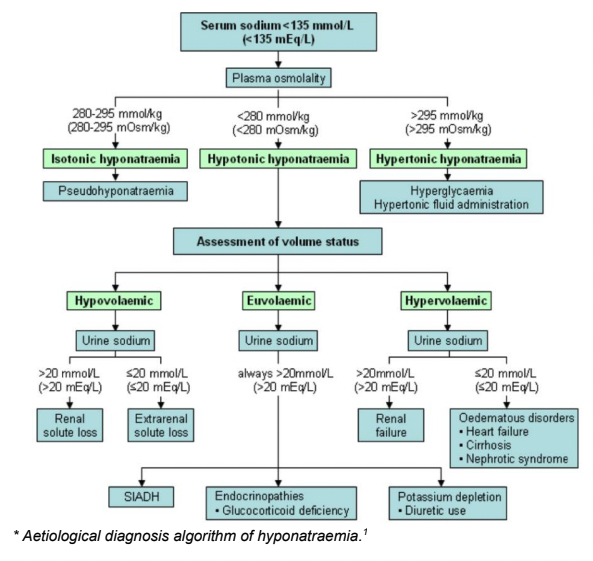
Hyponatraemia may be classified according to the serum tonicity as being hypertonic, isotonic, or hypotonic:
- Hypertonic hyponatraemia, also known as redistributive hyponatraemia, occurs when the presence of excess levels of an osmolyte such as glucose or mannitol causes water to shift from the intracellular to the extracellular compartment, diluting extracellular sodium.
- Isotonic hyponatraemia, is an artefact caused by high lipid or protein levels and is usually called pseudohyponatraemia.
- Hypotonic hyponatraemia, encompasses all other causes of hyponatraemia and is classified as hypovolaemic, euvolaemic, or hypervolaemic.
Click on image to enlarge
Hypovolaemic hypotonic hyponatraemia
- UNa > 20 mmol/L: Renal salt losses occur due to diuretics (especially thiazides), salt wasting nephropathy, cerebral salt wasting syndrome and mineralocorticoid deficiency.
- UNa < 20 mmol/L: Non-renal salt losses, usually GIT losses, e.g., vomiting and diarrhoea, burns, pancreatitis and severe hypoalbuminaemia resulting in third spacing of fluid.
Euvolaemic hypotonic hyponatraemia
- UNa > 20 mmol/L: High fluid intake, primary polydipsia, intense exercise, iatrogenic.
- SIADH: Malignancy, CNS disorders and pulmonary disease.
- Urine osmolality > 300 mmol/kg.
Hypervolaemic hypotonic hyponatraemia
- Cardiac failure, cirrhotic liver, nephrotic syndrome.
Corrected sodium = measured sodium + (0.3 x (glucose - 5.6))
[all units in mmol/L]
Criteria for Diagnosing SIADH:
- No drugs being administered which may mimic the condition.
- Normal endocrine function (thyroid, adrenal).
- No volume overload
- Hyponatremia
- Low serum osmolality (< 270 mosm/kg).
- Inappropriately concentrated urine (> 150 mosm/kg).
- Urine Na > 20 mmol/L.
- Corrects with fluid restriction.
Management of hyponatremia:
Also see: Diarrhoea, Acute.
- Depends on the cause (see algorithm below).
- Pseudohyponatraemia does not need treatment.
- SIADH should be fluid restricted.
- Sodium deficit requires replacement (e.g. renal/cerebral salt wasting, vomiting/diarrhoea).
Calculating sodium deficit:
(Na desired - Na actual) x weight x 0.6 = mmol Na required.
Serum sodium should not increase by greater than 10–12 mmol/L in a 24 hour period.
8.5% NaHCO3: 1 mmol Na/mL
5% NaCl: 0.85 mmol Na/mL
3% NaCl: 0.5 mmol Na/mL
0.9% NaCl: 0.15 mmol Na/mL
Hypernatraemia
Defined as serum Na > 145 mmol/L.
See: Diarrhoea, Acute.
Click on image to enlarge
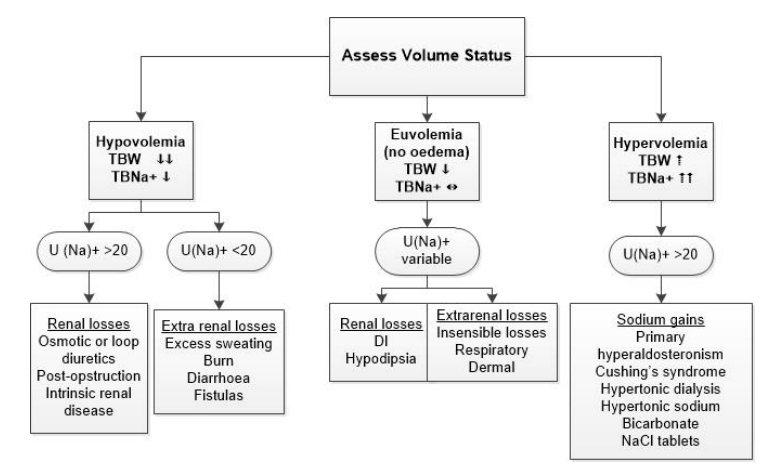
Hypervolaemic hypernatraemia
- Administration of bicarbonate, hypertonic saline and other fluids containing excess solute relative to free-water.
Hypovolaemic hypernatraemia
- Conditions that cause excessive amounts of free-water losses via the kidneys include central and nephrogenic diabetes insipidus (chronic kidney disease and nephrogenic diabetes insipidus (NDI), respectively).
- Acquired causes of NDI include amphotericin, lithium, hypokalaemia and hypercalcaemia. Mannitol and hyperglycaemia – osmotic diuresis.
- Non-renal free-water losses – from the GIT via suctioning, diarrhoea, vomiting; skin (drains, burns, hyperthermia), and from the respiratory tract in intubated patients.
Management of hypernatraemia:
In children, the two most common aetiologies are diabetes insipidus and hypernatraemic gastroenteritis.
- Diabetes insipidus requires extra fluid and desmopressin (if central). See: Diabetes insipidus.
- Hypernatraemic dehydration treatment:
a. Calculate free-water deficit and replace, aiming to decrease sodium slowly (maximum 10–15 mmol/L/24 hours). May, therefore, need to administer free-water deficit over 24 to 72 hours (depending on severity).
b. Oral ‘tap water’ preferable, otherwise D5W, IV, (taking note of increased glucose delivery). - Stop offending drugs.
- Replace excessive volume losses with fluid containing equivalent electrolyte concentrations (drains, fistulae, renal).
Water deficit calculation:
Water deficit = (current Na/140 -1) x 0.6 x weight (kg)
= total litres of water required to normalize sodium.
Amount to be administered per 24 hours is total water deficit divided by planned duration of correction (in days).
Standard Treatment Guidelines And Essential Medicines List For South Africa, Hospital Level, Paediatrics, 2023 Edition
Chapter 23: Paediatric Intensive Care, 23.6 Electrolyte Abnormalities, 23.6.1 Dysnatraemias In ICU