Desmopressin
Indications
Registered South African indications:
- Haemophilia A
- Von Willebrand's Disease
- Diabetes insipidus
- Urinary concentration capacity test
- Nocturnal enuresis
Cautions
Contraindications
- Hypersensitivity to the active ingredient or any of its excipients
- Severe renal impairment (eGFR <19ml/min/1.73m2)
- Habitual polydipsia
- Psychogenic polydipsia
- von Willebrand's Disease Type IIB
- Alcohol abuse
- Conditions requiring diuretic use
- Hypertension (renal function testing indication)
- Cardiac disease (renal function testing indication)
- Cardiac insufficiency (renal function testing indication; Haemostatic indication)
- Unstable angina pectoris (haemostatic indication)
Cautions
- Pregnancy
- Breastfeeding
- Moderate renal impairment (eGFR ≥20-49ml/min/1.73m2)
- Hepatic impairment
- Conditions characterised by fluid imbalance
- Conditions characterised by electrolyte imbalance
- Risk factors for increased intracranial pressure
- Cardiovascular disease
- Cystic fibrosis
- Oral fluid intake during diagnostic testing
- Repeat dosing for haemostatic indication
- Children younger than 1 year
Adult dosage
Forms avail. in SA and covered in this monograph: inj, tab, nas, slt, sol
Haemophilia A - mild, moderate
Von Willebrand's Disease
- IV: 0.3μg/kg as an infusion over 15-30min, 30min prior to surgery
Dilute dose with 50ml normal saline for infusion
Do Factor VIII assay before and 20min after infusion to assess patient's response; If Factor VIII coagulant activity is < 5% of normal, desmopressin cannot be relied on for haemostasis
Continue monitoring Factor VIII to gauge efficacy of repeated dosages
Diagnosis of central diabetes insipidus
- IM/SC: 2μg, as a single dose
- Intranasal (sol, nas): 20μg, as a single dose
See additional prescribing points for diagnosis of central diabetes insipidus test instructions
Central diabetes insipidus
- IV/IM/SC: 1-4μg, dly
Use IV administration only when intranasal administration unsuitable
When switching from intranasal administration to IV administration, IV dosage should be calculated at about 10% of the intranasal dose
- Intranasal (sol, nas): 10-20μg, 12-24hrly
- Oral (tab): Initial: 0.1mg, 8hrly; Maintenance: 0.1-0.2mg, 8hrly; Max: 1.2mg/24hrs
- Oral (slt): Initial: 60μg, 8hrly; Maintenance: 120-720μg/day, in 2-3 divided doses
Sublingual tablet: place under the tongue where it dissolves without need for water
Urinary concentration capacity test
- IM/SC: 2-4μg, as a single dose
- Intranasal (sol, nas): 40μg, as a single dose
See additional prescribing points for urinary concentration capacity test instructions
See additional prescribing points for administration directions for nasal solution
Primary nocturnal enuresis
- Oral (tab): Initial: 0.2mg, dly at night; Titrate at intervals of 3 days; Maintenance: 0.2-0.4mg, dly at night; Max: 0.6mg/24hrs
- Oral (slt): Initial: 120μg, dly at night; Titrate at intervals of 3 days; Maintenance: 120-240μg; Max: 360μg/24hrs
- Intranasal (sol, nas): Initial: 10μg, dly at night; Titrate at intervals of at least 1 week; Maintenance: 10-20μg, dly at night; Max: 20μg/24hrs
Primary nocturnal enuresis: desmopressin can be used for recurrent courses as needed; Treat for 3 months, then taper dosage and stop for 1 week to assess response; If enuresis recurs, restart for a further 3 months
See additional prescribing points for administration directions for nasal solution
Paediatric dosage
Paed. forms avail. in SA and covered in this monograph: inj, tab, nas, slt, sol
Haemophilia A - mild
Von Willebrand's Disease - type I
- See adult dosage
Weight > 10kg: Dilute dose with 50ml normal saline for infusion; Weight < 10kg: Dilute dose with 10ml normal saline for infusion
Do Factor VIII assay before and 20min after infusion to assess patient's response; If Factor-VIII coagulant activity is < 5% of normal, desmopressin cannot be relied on for haemostasis
Diagnosis of central diabetes insipidus
- See adult dosage
See additional prescribing points for diagnosis of central diabetes insipidus test instructions
Central diabetes insipidus
IV:
- Younger than 1 year: 0.2-0.4μg, 12-24hrly
- Between 1-12 years: 0.4-1.0μg, 12-24hrly
- Older than 12 years: See adult dosage
Use IV administration only when intranasal administration unsuitable
When switching from intranasal admin to IV admin, IV dosage should be calculated at about 10% of the intranasal dose
Oral (tab, slt):
- Younger than 4 years: Initial: 0.05mg, 8hrly
- Older than 4 years: See adult dosage
Monitor closely and individualise dosing to prevent excessive decrease in plasma osmolality, hyponatremia and possible convulsions
Intranasal (sol, nas):
- Between 3 months and 12 years: 5-30μg/day, in 1-2 divided doses; Max: 30μg/24hrs
- Older than 12 years: See adult dosage
See additional prescribing points for administration directions for nasal solution
Urinary concentration capacity test
IM/SC:
- Younger than 1 year: 0.4μg, as a single dose
- Older than 1 year: 1-2μg, as a single dose
Intranasal (sol, nas):
- Younger than 1 year: 10μg, as a single dose
- Older than 1 year: 20μg, as a single dose
For children it is recommended to use the intranasal preparation for this indication
See additional prescribing points for urinary concentration capacity test instructions
See additional prescribing points for administration directions for nasal solution
Primary nocturnal enuresis - short term treatment
Younger than 5 years
- Not indicated for use in children below 5 years
Older than 5 years
- See adult dosage
When used for primary nocturnal enuresis the fluid intake must be limited and then only to satisfy thirst from 1hr before until 8hrs after administration
Special populations
Pregnancy
- Caution
- Data on a limited number (n=53) of exposed pregnancies in women with diabetes insipidus indicate rare cases of malformations in children treated during pregnancy. To date, no other relevant epidemiological data are available. Animal studies do not indicate direct or indirect harmful effects with respect to pregnancy, embryonal/fetal development, parturition or postnatal development. Caution should be exercised when prescribing to pregnant women. Blood pressure monitoring is recommended due to the increased risk of pre-eclampsia
Breastfeeding
- Caution
- Results from analyses of milk from nursing mothers receiving high dose desmopressin (300 micrograms intranasally) indicate that the amounts of desmopressin that may be transferred to the child are considerably less than the amounts required to influence diuresis or haemostasis
Renal Impairment
- eGFR ≥50-89ml/min/1.73m2: No dose adjustment recommended
- eGFR ≥20-49ml/min/1.73m2: Caution; dose adjustment recommended
Only the intranasal formulations are recommended
Intranasal (sol, nas): Max: 20μg/24hrs
Oral and parenteral use should be avoided; except in emergency cases such as head trauma or surgery in the pituitary region - eGFR <19ml/min/1.73m2: Contraindicated
Hepatic Impairment
Elderly
Porphyria Information
Drugs in Sport
-
Prohibited - At all times
Adverse reactions
Central Nervous System Disorders
- Headache
- Aggression
- Emotional disturbances
- Seizures
Gastrointestinal Disorders
- Stomach pain
- Nausea
Endocrine and Metabolic Disorders
- Water retention
- Hyponatraemia
Skin and Subcutaneous Tissue Disorders
- Allergic skin reactions
Immune, Blood and Lymphatic System Disorders
- Hypersensitivity reactions
Interactions
- Non-steroidal anti-inflammatory drugs
- Agents known to induce syndrome of inappropriate antidiuretic hormone secretion
- Loperamide
- Indomethacin
Monitoring
- Blood pressure (inj)
- Heart rate (inj)
- Electrolytes
- Weight/water balance
Specific cases may require
- Factor-VIII assay
- Urine osmolarity
- Urine output
Prescribing points
Dosing in renal impairment
Desmopressin is not contraindicated in patients with central diabetes insipidus who have renal impairment, but dosing needs to be carefully prescribed by a specialist.
Diagnosis of central diabetes insipidus
Positive diagnosis: Failure to produce concentrated urine after water deprivation, followed by the ability to do so after the administration of desmopressin confirms the diagnosis of central diabetes insipidus; Failure to concentrate after the administration suggests nephrogenic diabetes insipidus
Urinary concentration capacity test
- Adults and children: Patients with normal renal function can be expected to achieve concentrations above 800mOsm/kg in the 5-9hrs following desmopressin dose. It is recommended that the bladder should be emptied at the time of administration. A restricted water intake must be observed.
- Infants normal urine concentration of 600mOsm/kg should be achieved in the 5hr period following administration. Fluid intake at the two meals after admin should be restricted to 50% of the ordinary intake in order to avoid water overload.
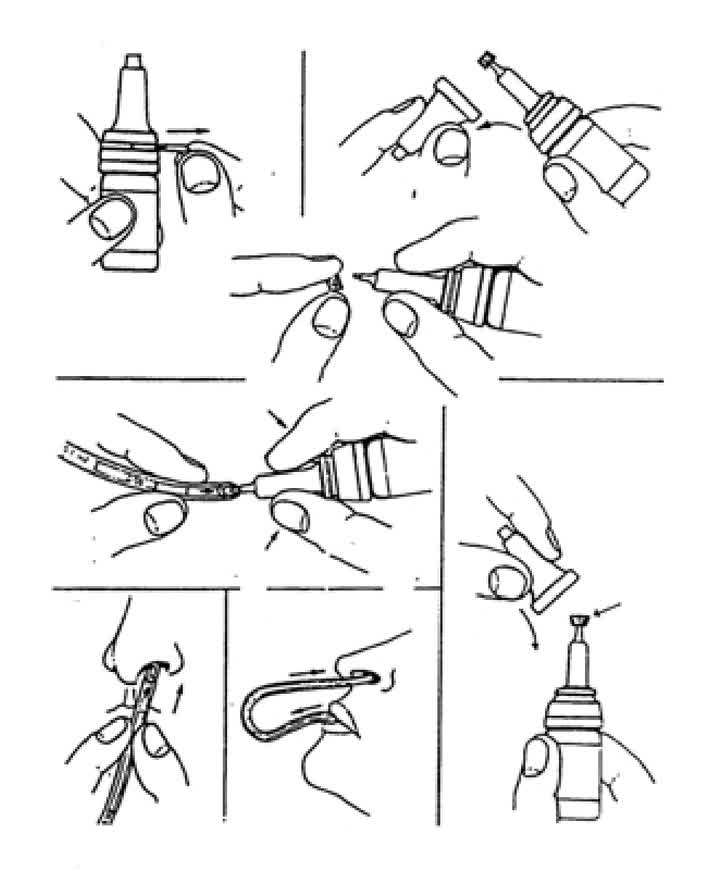
Administration directions: Intranasal solution
Performed with a plastic catheter (rhinyle tube). The rhinyle tube has a graduated scale corresponding to 2.5μg, 5μg, 10μg, 15μg and 20μg desmopressin acetate. As the concentration is 100μg/ml, the dose can be varied between 0.025-0.20 ml
If higher doses are needed it is recommended that these be divided into two doses; the one being given in the left nostril and the other in the right
Directions:
- Take the calibrated part of the rhinyle in one hand and place the fingers of the other hand around the cylindrical part of the closure. Insert the top of the dropper in a downward position into the arrow marked end of the rhinyle and squeeze the dropper until the solution has reached the desired calibration mark (dose is measured from the arrow marked end of the tube to the appropriate calibration).
- Disconnect the rhinyle from the bottle by withdrawing the bottle quickly downwards.
- Hold the rhinyle with the fingers approximately 1.5-2 cm from the end and insert into a nostril until the tip of the fingers reach the nostril
- Put the other end of the rhinyle into the mouth. Hold in breath. Tilt your head back and then blow with a strong puff through the catheter so that the solution reaches the right place in the nasal cavity. Through this procedure, medication is limited to the nasal cavity and the preparation does not pass down into the pharynx
Mechanism of action
Desmopressin is a synthetic analogue of the natural human hormone vasopressin. Structural changes to desmopressin result in a high antidiuretic activity with low uterotonic and vasopressor effects when compared to natural vasopressin. Desmopressin acts at renal tubular cells to increase water permeability leading to a decreased urine volume and increased urine osmolality. It also increases plasma levels of von Willebrand factor and factor VIII which gives this drug its haemostatic properties.
Dosage forms
- Nasal spray
- Solution
- Injection
- Tablet
- Sublingual tablet
Formulation
Tablet sublingual 120μg
- Minirin melt (Ferring) originator
Tablet sublingual 240μg
- Minirin melt (Ferring) originator
Tablet 0.1mg
- DDAVP (Ferring) originator
Tablet 0.2mg
- DDAVP (Ferring) originator
Intranasal solution (per ml) 0.1mg
- DDAVP (Ferring) originator
Injection (per ml) 4μg
- DDAVP (Ferring) originator
Nasal spray (per ml) 0.1mg
- DDAVP (Ferring) originator
References
1. SAMF_12th Edition_Page 255 2. SmPC: DDAVP Tablets 0.1mg, Ferring Pharmaceuticals Ltd: Last updated on eMC: 25 Jul 2012; Downloaded online; 07 Aug 2018 https://www.medicines.org.uk/emc/medicine/4217 3. SmPC: DDAVP/Desmopressin Injection, Ferring Pharmaceuticals Ltd: Last updated on eMC: 25 Jul 2012; Downloaded online; 07 Aug 2018 https://www.medicines.org.uk/emc/medicine/659 4. SmPC: Octim Nasal Spray, Ferring Pharmaceuticals Ltd: Last updated on eMC: 25 Jul 2012; Downloaded online; 07 Aug 2018 https://www.medicines.org.uk/emc/medicine/16420 5. https://drive.google.com/drive/folders/0B4_v8Xoq_6PoUHBnOVpKZERSdjg (22/03/2017_MDR_DDAVP_inj) 6. https://drive.google.com/drive/folders/0B4_v8Xoq_6PoUHBnOVpKZERSdjg (22/03/2017_MDR_DDAVP_intranasal sol) 7. https://drive.google.com/drive/folders/0B4_v8Xoq_6PoUHBnOVpKZERSdjg (22/03/2017_MDR_DDAVP_0.1, 0.2mg_tab) 8. https://drive.google.com/drive/folders/0B4_v8Xoq_6PoUHBnOVpKZERSdjg (22/03/2017_MDR_DDAVP_0.1mg/ml_Nasal spray) 9. https://drive.google.com/drive/folders/0B4_v8Xoq_6PoUHBnOVpKZERSdjg (22/03/2017_MDR_Minirin_60mcg melt, 120mcg. 240mcg_subl) 10. https://drive.google.com/drive/folders/0B4_v8Xoq_6PoUHBnOVpKZERSdjg (05/06/2002_Ferring_DDAVP_0.1, 0.2mg_tab) 11. U2D: Desmopressin: Drug information; Uptodate; Downloaded online; 30 Jul 2018 https://www.uptodate.com/contents/desmopressin-drug-information?source=search_result&search=desmopressin&selectedTitle=1~99 12. NAPOS The Drug Database for Acute Porphyria: Desmopressin; Accessed online; 28 Nov 2018 [http://www.drugs-porphyria.org/languages/UnitedKingdom/s3.php?l=gbr&atc_code=H01BA02] 13. South African Institute for Drug-Free Sport: DDAVP; Accessed online; 28 Nov 2018 [http://www.drugfreesport.org.za/online-medication-check/] 14. Clinical Pharmacologist - Dr. M Irhuma [https://trello.com/c/faA8kG4E/141-desmopressin-renal-impairment-dose-adjustments]
Brands & products
8 products · stale NAPPI snapshot · refreshed 5/28/2026 · 159 days oldTab Generic· 1 product
from R20.81/unit| Product | Strength | Pack | Sched | SEP | Unit | Disp fee | NAPPI |
|---|---|---|---|---|---|---|---|
| Minirin Melt 60 Μg | 60 µg | 30 | S4 | R624.19 | R20.81 | R176.29 | 3006595001 |
tabletGeneric· 2 products
from R30.47/unit| Product | Strength | Pack | Sched | SEP | Unit | Disp fee | NAPPI |
|---|---|---|---|---|---|---|---|
| Ddavp Tablet 0.1 Mg | - mg | 30 | S4 | R914.14 | R30.47 | R218.95 | 837563003 |
| Ddavp Tablet 0.2 Mg | - mg | 30 | S4 | R1179.97 | R39.33 | R258.06 | 703639003 |
SltGeneric· 2 products
from R38.31/unit| Product | Strength | Pack | Sched | SEP | Unit | Disp fee | NAPPI |
|---|---|---|---|---|---|---|---|
| Minirin melt | 120 mcg | 30 | S4 | R1149.34 | R38.31 | R253.55 | 722060001 |
| Minirin melt | 240 mcg | 30 | S4 | R2124.56 | R70.82 | R331.23 | 722061001 |
injectionGeneric· 1 product
from R174.43/unit| Product | Strength | Pack | Sched | SEP | Unit | Disp fee | NAPPI |
|---|---|---|---|---|---|---|---|
| Ddavp 1ml | 4 mcg | 1 | S4 | R1744.34 | R174.43 | R310.56 | 717754006 |
NssGeneric· 1 product
from R291.17/unit| Product | Strength | Pack | Sched | SEP | Unit | Disp fee | NAPPI |
|---|---|---|---|---|---|---|---|
| Ddavp nasal spray 5ml | - mg | 5 | S4 | R1455.86 | R291.17 | R294.87 | 837555019 |
NodGeneric· 1 product
from R400.20/unit| Product | Strength | Pack | Sched | SEP | Unit | Disp fee | NAPPI |
|---|---|---|---|---|---|---|---|
| Ddavp Intranasal Solution 0.1 Mg/Ml - Multidose | - mg | 2 | S4 | R800.41 | R400.20 | R202.21 | 717746003 |
- DDAVP
- Minirin Melt
Medical aid coverage
data not yet integrated- Comprehensive Series—
- Executive Plan—
- KeyCare Series—
- Priority Series—
- Saver Series—
Formulary scraper pending — coverage tier, co-pay and authorisation requirements will appear here once data is ingested.
- BonClassic—
- BonComprehensive—
- BonEssential—
- BonFit Select—
- BonSave—
- BonStart—
Formulary scraper pending — coverage tier, co-pay and authorisation requirements will appear here once data is ingested.
- Beryl—
- Emerald—
- Onyx—
- Ruby—
- Sapphire—
- Tanzanite One—
Formulary scraper pending — coverage tier, co-pay and authorisation requirements will appear here once data is ingested.
- Aquarium Option—
- Efficiency Option—
- Marine Option—
Formulary scraper pending — coverage tier, co-pay and authorisation requirements will appear here once data is ingested.
Interacts with 3 known drugs
Check against other drugs →Cited in 16 documents
- GuidelinesReferences8×
- GuidelinesPituitary Disorders6×
- GuidelinesDiabetes Insipidus3×
- GuidelinesEnuresis2×
- GuidelinesReferences - Endocrine System2×
- GuidelinesAbbreviations and Acronyms
- GuidelinesCommon prescribed drug dosage for children
- ArticlesDesmopressin for nocturnal enuresis in children
- GuidelinesDysnatraemias In ICU
- GuidelinesEnuresis
- GuidelinesIncontinence
- GuidelinesPathophysiology
- GuidelinesPharmaceutical Therapy for Enuresis
- GuidelinesSummary of Recommendations
- GuidelinesTreatment Outcomes & Conclusion
- GuidelinesUrinary Tract Infection