ESMOE: Neonatal Resuscitation
ESMOE: Neonatal Resuscitation
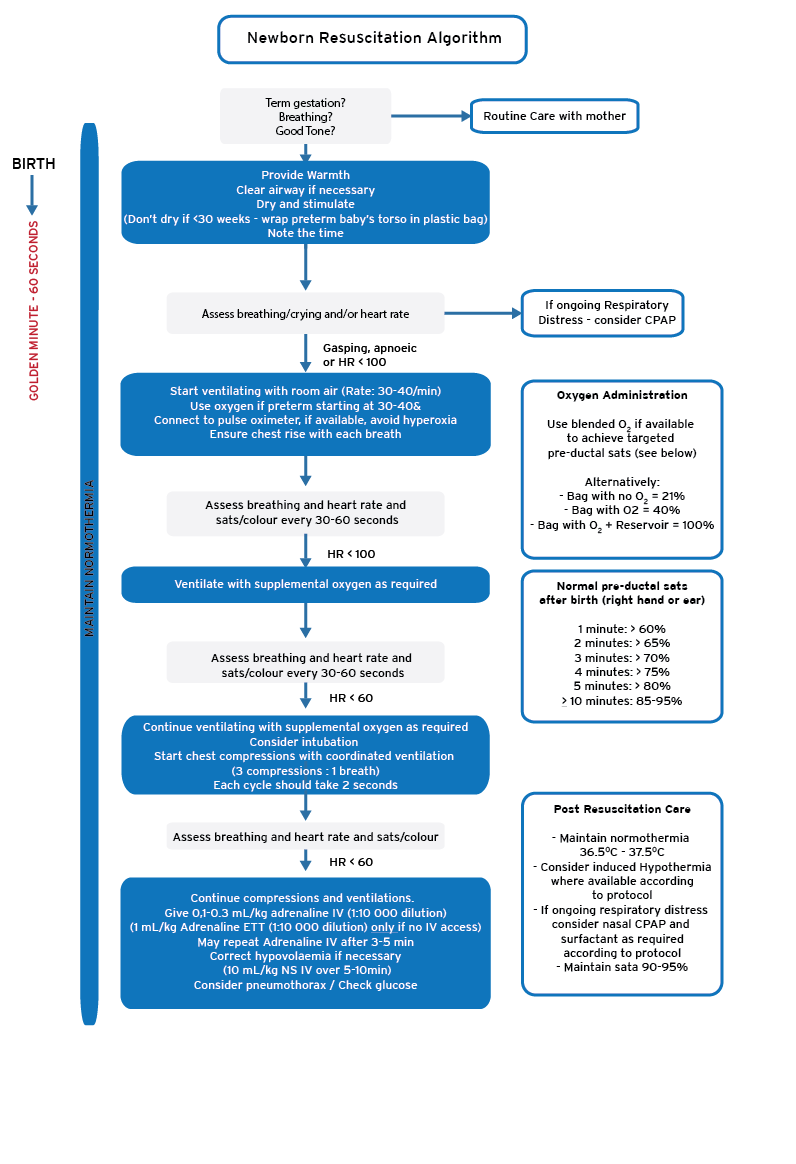
Neonatal Resuscitation Algorithm
Assessment of the newborn
- Colour
- Tone
- Breathing
- Heart rate
Airway
- Neutral position
- Jaw thrust (single or double)
- Consider suctioning under direct vision
- Can use oropharyngeal airway if required
Breathing
- If normal breathing (30-60 breaths per minute with no in-drawing or grunting) give to mother & observe
- If not breathing apply well-fitting face mask and give 5 inflation breaths with room air, and re-assess
- If chest does not rise re-assess airway
- If chest is seen to rise and heart rate 60-100 bpm & breathing not normal, continue with ventilation breaths (30-40/minute) & reassess after 30 seconds, including pulse oximetry if available
- If chest is seen to rise and heart rate <60 start chest compressions
Circulation
- Compress sternum below inter-nipple line
- 1/3 depth of chest towards the spine
- 3:1 (compressions to ventilations) ratio
- Reassess after 30 seconds
- If no response consider drugs
Immediate care of the newborn
- Check equipment & turn heater on
- Start the clock
- Dry baby and then wrap the baby in a warm dry towel
- Place head in neutral position
- Assess colour, tone, breathing & heart rate (APGAR score)
- Call for HELP if needed
- If not breathing start resuscitation
- After resuscitation make a clear plan of care for the baby
With chest compressions you are only trying to move a few teaspoons of oxygenated blood from the pulmonary veins to the coronary arteries (about 5cm).
Chest compressions are useless if the lungs have not been inflated so do not start until chest has been seen to rise.
Cord clamping - The cord can usually be clamped about a minute after birth, the baby being kept at approximately the same level as mother's uterus until this time. Very early clamping, & clamping while the baby is held above the level of the placenta can cause hypovolaemia.
Preventing heat loss
- Dry the baby and wrap in a pre-warmed towel
- Keep the delivery area draught free
- If the baby needs attention place the baby on a warm mattress under a radiant heater
- Avoid early washing if possible
DRUGS
Consider drugs if no response after 30 seconds of CPR. Drugs are useless if the lungs have not been inflated!
- Adrenaline (epinephrine)
- Preparation 1:10000 (=1g/10000mL = microg/mL)
- Dose 10 microg/kg (0.1 mL/kg of 1:10000)
- Route Umbilical venous catheter or via trachael tube
- Sodium bicarbonate
- Dextrose 10%
- Sodium chloride 0.9%
Neonatal Resuscitation Algorithm