Fluid management and electrolytes
Feeds and fluids TPN (parenteral nutrition) Hypoglycaemia Hyperglycaemia Electrolytes requirements of the newborn Hyponatraemia Hypernatraemia Potassium Calcium Magnesium Feeds and fluids Fluids are initially restricted below normal neonatal requirements of 150ml/kg/day because babies are born with a high total body water. However, in
Electrolytes requirements of the newborn
Feeds and fluids
Fluids are initially restricted below normal neonatal requirements of 150ml/kg/day because babies are born with a high total body water. However, in VLBWs and ELBWs the insensible losses can be very high, and one may need to increase fluids more rapidly.
Premature babies are expected to lose 5-15% of birth weight while term babies lose 5-10% BW in the first week. Water handling is limited by a low GFR and limited ability to concentrate urine (700mosm/L).
The table is a rough guide only.
| Total fluid* | Day 1 ml/kg/day | D 2 | D 3 | D 4 | D 5 | D 6 |
| Term | 60 | 80 | 100 | 120 | 140 | 150 |
| < 1500g (VLBW) | 80 | 100 | 120 | 140 | 160 | 180 |
| < 1000g (ELBW) | 100 | 120 | 140 | 160 | 180 | 180 |
*Calculate fluid based on birth weight if current weight is less than birth weight
IV fluid is started as potassium-free Neonatalyte (NonK NNL) on Day 1. This is usually changed to Neonatalyte (NNL) if the serum potassium is not elevated (<5.0) on Day 2.
For ELBW’s start 5% dextrose water for the first 24 hours only, then change to Non K or NNL depending on potassium result.
Insensible water loss (IWL) is increased by radiant warmers (add 20-40ml/kg/day). IWL is decreased by humidification and plastic coverings. All babies born <1.2 kg should be covered with plastic for the first week of life to limit insensible water loss.
Monitor HGT’s 3 hourly in all babies that are NPO. If the HGT is >8 ask the sister to call you if increasing and check for glycosuria. Babies with HGT’s > 12 can be started on a 5% cocktail and continue 3 hourly HGT monitoring. If the HGT’s continue increasing or measure HI discuss with the registrar. IV Actrapid may be indicated.
5% Dextrose Cocktail:
200 ml 5% dextrose water + 22 ml 0.9% saline + 1.5ml 10% calcium gluconate + 0.25ml 50% magnesium sulphate (may add 2ml 15%KCl- if the baby was on NNL and the potassium is normal.
Types of fluid:
| Potassium-free Neolyte | Neonatalyte | |
| Glucose | 100g/l | 110g/l |
| Sodium | 33mmol/l | 20mmol/l |
| Chloride | 33mmol/l | 21mmol/l |
| Calcium | 5mmol/l | 2.5mmol/l |
| Potassium | - | 15mmol/l |
| Magnesium | - | 0.5mmol/l |
| HPO4 | - | 3.75mmol/l |
| Lactate | - | 20mmol/l |
Oral feeds
Are started as soon as the baby is not in severe respiratory distress. Do not feed babies who need intubation or surfactant. Babies of birth weight >1500g can be fully orally fed if they are generally well and in room air after birth. Start at 60 ml/kg/day.
Babies of <1500g should have their feeds advanced at 20-30ml/kg/day to reduce the risk of NEC i.e. Weight (kg) X20ml)/ 8 feeds.
Breast milk feeds must be encouraged and prescribed as EBM. Babies <1500g are fed via NGT/ OGT. Once >1500g prescribe breast/ cup feeds and write the volume. It is important to give the first colostrum feed (even if just a few mls) for gut colonization as this is thought to affect programming of the immune system for life. If there is no EBM available, check whether baby is a candidate for donor breast milk: <1200g, <32 weeks GA, <2 weeks life. Please get signed consent ASAP. We do not keep babies NPO on IVF if no milk. Encourage the mum to continue expressing milk at home every 2-3 hours so her milk does not dry up. If no EBM or DBM is available, we use formula. If formula fed, PreNan® is used when babies weigh < 2000g. This can be switched to Nan® at >2000g.
Donor breast milk is usually stored in the freezer in 16B. It is donated by Netcare in consultation with our dieticians who allocate the milk and keep track of the donor numbers. We will soon have our own milk bank. The donors are HIV, Syphilis, Hep B and C tested and negative. Please get consent for DBM for babies <1.2kg, place it in the Red File, and alert the dietician. A prescription will need to be completed every week for the required amount of DBM necessary.
Breastfeeding should always be promoted, unless unavailable or contra-indicated e.g. mum in ICU or active substance use disorder. Mothers of premature infants should be encouraged, and assisted to express breast milk. Breast milk must be labelled and stored in the milk fridge in Ward 16B.
In HIV positive mothers counseling around feeding choice must be documented in the file. Mothers must be encouraged to breastfeed. Some breastfeeding is better than none. Mixed feeding with mum on treatment and baby on PMTCT prophylaxis is now acceptable. Please ensure that the AFASS (Affordable, feasible, acceptable, safe and sustainable) criteria are met if formula feeding is being considered.
Premature infants who are being exclusively breastfed, need to have a dieticians consult for FM-85 supplementation.
Vitamins:
Only started when the baby is on full oral feeds (160-180ml/kg/day):
- Abidec 0.6ml daily
- Folate 0.1mg daily
- Vitamin D 400IU daily
- Ferrous Gluconate 0.5ml/kg is started at day 14 if on full feeds
TPN/ITN (Total Parenteral Nutrition)
TPN should be started on:
- All babies with definite NEC (≥Bell Stage 2) as they generally require at least 5-7 days NPO
- All ELBWs on day 2/3 (if they look likely to survive)
- All VLBWs <1200g on day 2 life, while building feed volume
Some risks of TPN:
- Related to lipid: worsens hypoxia (CI in severe hypoxia), reduces protein-binding of bilirubin (CI with severe NNJ), not to be used within 24 hours of birth
- Related to amino acid: cholestasis
- Fungal sepsis and drip site ulcers are relatively common
The registrar will order TPN before 11am on weekdays, and on Friday for the weekend
TPN should be increased slowly, mainly due to the risk of hyper-triglyceridemia if lipid is increased too fast
- ITN 102 has 10% dextrose
- ITN 105 has 5% dextrose – use this if Hgt’s >8
- ITN 103 for babies >1.5kg (similar to 102 but a larger volume)
ITN should be started at 50ml/kg/day (1g/kg/day of lipid) and increased at 50ml/kg/day to a maximum volume of 150ml/kg/day (3g/kg/day of lipid).
Patients should be on full ITN within 3 days of initiation.
Stopping TPN:
Because of the cost and risks of TPN, we stop it as soon as it is clear the baby will tolerate full oral feeds within a few days, usually when feeds are about 100-120ml/k.
Hypoglycaemia
Hypoglycaemia -blood glucose <2.5mmol/l.
May be symptomatic, with jitteriness, lethargy, apnoea and seizures. These are non-specific features and may also be due to sepsis. It is important that a dextrostix be checked rapidly when such features are present.
Infant of a diabetic mother (IDM) are prone to hypoglycaemia. They can be observed and red flagged for HGT checks in post-nates if they are otherwise stable. If the HGT is <2.5 bring them to 16B for feeds and HGT checks. If HGT’s stable on oral feeds for 3 readings, the baby can be transferred to their mother. If the dextrostix does not improve with the simple measures described below, discuss with senior.
Symptomatic hypoglycaemia
Should be managed as follows:
- Take blood for laboratory blood glucose while dripping the baby
- Immediate IV Bolus 2-4 ml/kg of 10%DW. Add 1ml 50% dextrose to 4mls sterile water, ( or 2ml to 8ml if a larger volume is needed)
- IV maintenance of Non K cocktail at 90ml/kg/day if day 1 of life (gives 6 mg/kg/min of glucose)
- Repeat dextrostix every 30 minutes until >2.5mmol/l (preferably keep dextrostix >3mmol/l) and increase IV rate by 20ml/kg/day further if dextrostix still low (d/w registrar)
- Dextrostix at least 3 hourly
- Look for a cause e.g. IDM, polycythaemia, preterm, SGA
- Persistent hypoglycaemia, and above is unlikely – discuss with reg: consider doing a CRITICAL SAMPLE: blood glucose, lactate, insulin, Cortisol, Growth Hormone, Pyruvate and Amino acids; Urine for ketones. At a later stage urine for organic acids and reducing substances may be sent
- Baby may need a 12.5% dextrose solution (dw reg). Add 10 ml of 50% DW into a 200ml Non K or NNL
- If still hypoglycaemic the baby will need a UVL (central line) for a 15% dextrose solution (20ml in 200ml Non K or NNL- remove 20ml from the bag first.)
- If still hypoglycaemic, consider hyperinsulinism and start Diazoxide in consultation with the consultant. Dose 1-5mg/kg/day TDS
Asymptomatic hypoglycaemia:
In a term baby, if the dextrostix is 1.4- 2.4 mmol/l then feed the baby (according to age and weight) and repeat dextrostix half an hour after the feed. If dextrostix still <2.5 mmol/l, then admit for IV fluids, continue feeds.
If initial HGT <1.4mmol/l drip the baby, bolus 2-4ml/kg of 10%DW, run IV 10% NON K/ NNL at maintenance volume and repeat HGT in 20mins.
Once HGT is normal, do dextrostix at least 3 hourly.
With both hypo- and hyperglycaemia one should calculate the required glucose infusion rate in mg/kg/min. This can be compared to the normal glucose requirements in a term infant of 4-6mg/kg/min, or in a preterm infant of 6-8mg/kg/min. Glucose requirement of more than 12mg/kg/min to maintain normal blood glucose is suggestive of hyperinsulinism. The formula to calculate glucose infusion rate is:

Hyperglycaemia
Hyperglycaemia (plasma glucose > 8mmol/l) is common in VLBW infants, but keep in mind that it may also be a marker for neonatal sepsis or IVH. If dextrostix is elevated, then check urine dipstix. If ≥2+ glucose in the urine, then change to a 5% cocktail. If dextrostix does not respond within 3 hours, then:
- Reduce fluids to 120-150ml/kg/day (this gives glucose at 4-5mg/kg/min) and check dextrostix after a further 3 hours and confirm with a lab glucose
- If dextrostix is >20mmol/l and remains in a similar range, consider giving insulin 0.05U/kg as a stat dose. Check Hgt hourly after actrapid for 6 hours. If the HGT remains elevated consider an actrapid infusion starting at 0.05-0.1u/kg, do hourly hgt’s. Stop the actrapid infusion when hgt is <=12 and continue hourly hgt’s until stable
- Enteral feeds also help to improve plasma glucose by stimulating endogenous insulin secretion
Electrolytes requirements of the newborn
Daily requirements:
| Glucose | Term 4-6mg/kg/min Prem 6-8mg/kg/min |
| Na | 2-3mmol/kg/d |
| K | 2-4mmol/kg/d |
| Cl | 1-2mmol/kg/d |
Hyponatraemia (Serum Na < 130)
Sodium balance (Normal serum Na= 135-147mmol/L):
- Dual problem with sodium balance in prems: renal inability to conserve sodium (FeNa 5-15%) and inability to handle high sodium load (low GFR)
Stepwise Approach
- Is it true or pseudohypoNa? Look for hyperglycaemia. If on TPN (with lipid) then consider hyperlipidaemia. If in doubt do serum osmolality
- If true hypoNa then weigh baby, check for dehydration or oedema and try to assign to one of the 3 groups in the table below
- Within each group consider some of the commoner diagnoses given above. The cause may need to be treated specifically. If difficulty making a diagnosis, then a fractional excretion of sodium (FeNa) may be helpful (i.e., send urine electrolytes, and U&E)
Treatment
For true hyponatraemia due to excessive renal sodium losses requires giving replacement sodium. This can be calculated as follows:
mmol Na+ required = (desired Na+– actual Na+) x weight (kg) x 0.7
Max rate of Na+ replacement (mmol/l/hr) = weight x 0.7
Use 5% NaCl (concentration is 0.85 mmoL in 1 mL of 5% NaCl) as a rider or Normal saline 0.154mmol in 1ml (useful in ELBW infant).
True hyponatraemia due to water excess with or without oedema requires fluid restriction. Measure urine and Sodium osmolality.
In acute hypoNa (<48 hours), if the serum Na is < 120mmol/L or the hyponatraemia is symptomatic (e.g. seizures, encephalopathy, increased intracranial pressure), the Na should be partially corrected fairly quickly with isotonic or hypertonic saline. Discuss with senior.
Causes of hyponatraemia
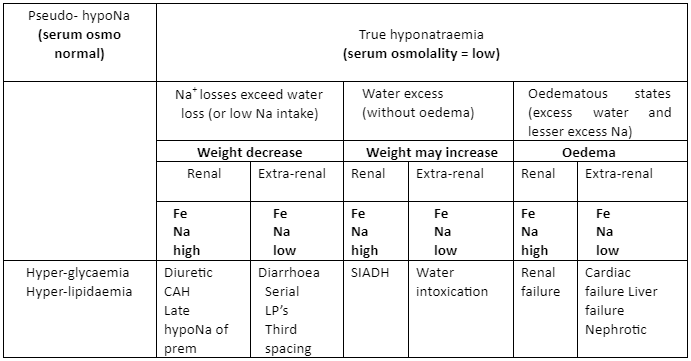
Click on the image to enlarge
Hypernatraemia
This is not uncommon especially in VLBWs, who may have large water losses through their thin skin and are therefore both hypernatraemic and dehydrated. Treatment is by covering prems <1.2kg with plastic for the first week of life, increasing fluids and rehydrating slowly.
Potassium
In newborns the normal range for K+ is higher than in older age-groups (approx 4-6.5mmol/L) however significant hyperkalaemia can occur.
Hypokalaemia (K+ <3mmol/L)
Can add extra 2ml 15% KCl per 200ml solution Neonatalyte (1ml 15% KCl = 2mmol KCl). The potassium concentration should not exceed 40mmol/L, and the rate at which K+ is infused should not exceed.
0.3mmol/kg/hr (unless exceptional circumstances, in which case a cardiac monitor must be used – discuss with senior).
Oral Mist KCl Infans has 3.5mmol/5ml. Usually 1ml/kg TDS for replacement.
Hyperkalaemia
Check that specimen was not haemolysed and if so repeat before active management unless clinically suggestive. Repeat K / U&E with a VBG and document result. Look for underlying cause esp. acidosis and renal failure.
Treatment of hyperkalaemia
| K+ 6-7 mmol/L | Remove K+ from all solutions (use non K NNL), stop ITN | ||
| K+ > 7 mmol/L | Do an ABG and ECG. Check pH, ionised calcium and Magnesium | ||
| K+ > 7.5 mmol/L | Action: Stepwise approach | ||
|
4% NaHCO3 (esp. if acidosis) |
2-4ml/kg slow iv | Effective hours | |
| 10% calcium gluconate | 1-2ml/kg in sterile H2O slow iv |
Effective in 30min |
|
| Salbutamol | 4 microgram/kg in 5 ml dextrose water over 5 minutes | Can repeat in 1 hr, onset 30-60 min effect lasts 3-4hr | |
| Kayexalate (only way to remove K+ from body) |
1g/kg for each mmol/L K+ reduction |
Mix with D/W and give as enema (3ml=1g) Onset 60min | |
Calcium
Hypocalcaemia should be treated if ionised < 1mmol/l. Give: 1ml/kg of 10% calcium gluconate diluted in an equal volume of sterile water IVI slowly over 10 mins.
Common causes of hypocalcaemia: Perinatal asphyxia, IDM, post-exchange transfusion. If recurrent, get an endocrine consult. PTH level.
Magnesium
If <0.5mmol/l replace with 0.2ml/kg 50% MgSO4 diluted in 1ml/kg sterile water IVI or 0.1-0.2ml/kg IMI.
Rahima Moosa Mother and Child Hospital - Neonatal Care Handbook 2023; Fluid management and electrolytes; Feeds and fluids, TPN (total parenteral nutrition), Hypoglycaemia, Hyperglycaemia, Electrolyte requirements of the newborn, Hyponatraemia, Hypernatraemia, Potassium, Calcium, Magnesium
Last checked for updates: January 2024