General Anaesthesia - Maintenance of Anaesthesia
Description Medicine treatment DESCRIPTION After induction, the focus shifts to the maintenance of an adequate level of hypnosis, immobility and analgesia. Anaesthetic goals include maintaining normothermia and normoglycaemia, maintenance of cardiovascular stability, prevention of hypoxia and hyper/hypocapnia, providing appropriate analgesia, and the prevention of post-operative complications. ME
DESCRIPTION
After induction, the focus shifts to the maintenance of an adequate level of hypnosis, immobility and analgesia. Anaesthetic goals include maintaining normothermia and normoglycaemia, maintenance of cardiovascular stability, prevention of hypoxia and hyper/hypocapnia, providing appropriate analgesia, and the prevention of post-operative complications.
MEDICINE TREATMENT
Inhalational (volatile) anaesthesia
These are delivered with a combination of oxygen and medical air/nitrous oxide. The recommendation is to use a combination of oxygen and air, especially if unable to monitor inhaled oxygen concentration. The use of nitrous oxide risks hypoxia, and offers little benefit intraoperatively. The use of nitrous oxide should be limited to use with a minimum oxygen concentration of 30%, with oxygen analysis. The use of nitrous oxide to provide analgesia is variable depending on altitude and is discouraged, as this effect is limited to the period of its use, with no provision for post-operative analgesia.
The Minimum Alveolar Concentration (MAC) defines the anaesthetic depth for inhaled agents at which 50% of patients respond to a painful stimulus with movement.
Table 1: Age-related MAC values
| Age (months) | Isoflurane | Sevoflurane |
| 1 | 1.6 | 3.2-3.3 |
| 2 | 1.9 | 3.2-3.3 |
| 14 | 1.8 | 2.5 |
| 44 | 1.6 | 2.5 |
Intravenous anaesthetic agents
These agents can be delivered by continuous infusions where volatile agents are contraindicated.
- Propofol, IVI, 7.5 - 15 mg/kg/hr. Infusions of more than 4 mg/kg/hr for more than 24 hours should be avoided due to the risk of propofol infusion syndrome.
- Ketamine, IVI, 10 - 40 μg/kg/min. Excessive salivation can be managed with an anti-sialogogue such as glycopyrrolate.
Analgesia
- Multimodal analgesia (the use of multiple pharmacological agents in combination) is strongly advised to facilitate optimal pain management through synergy of various agents, and to minimise the dose of opiates required for effective analgesia. This allows for avoidance of the unwanted side effects typically associated with opioids, e.g. respiratory depression, nausea, hypotension, sedation.
Simple analgesia
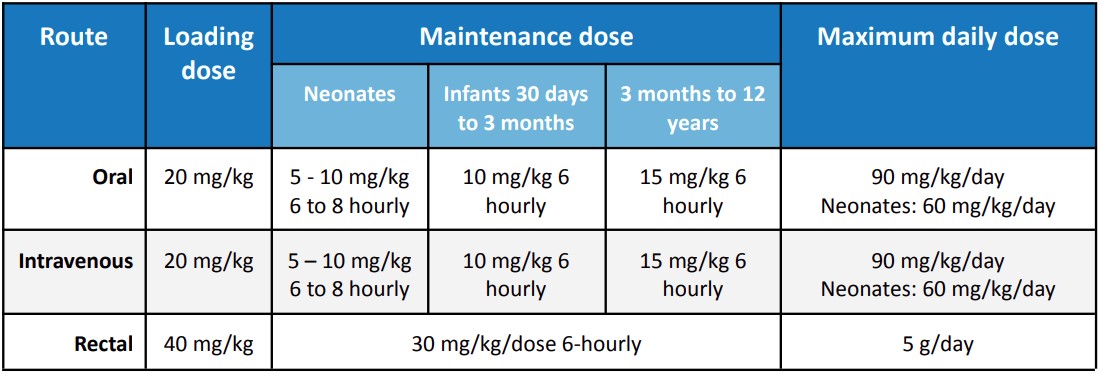
- Oral paracetamol is cost effective and has excellent bioavailability. Oral paracetamol can be administered when patients are being kept NPO for general anaesthesia. (See Table 2 for dosing.)
- Ibuprofen syrup, 5 - 10 mg/kg orally (can be given preoperatively).
Table 2: Paracetamol doses in children
Click on table to enlarge
Opiate analgesia
For most cases, unless a regional technique has been employed, a combination of a short and longer acting opioid are used. Fentanyl is a short-acting opioid used to provide intraoperative analgesia, and morphine is a long-acting opioid used for both intraoperative and post-operative analgesia.
- Fentanyl, IV, 0.5 - 2 μg/kg boluses as required, titrated to indicators of pain – patient movement, heart rate, BP and respiratory rate (where patient is breathing spontaneously). Note that these parameters are non-specific indicators for pain. Correlate with painful stimuli and expected procedure-specific pain severity. Fentanyl is a potent opioid with a rapid onset and short duration of action. Bradycardia may occur, but blood pressure is usually preserved. Apnoea can occur. Respiratory support may be required.
- Morphine, IV, 0.05 - 0.2 mg/kg boluses as required. Morphine is a delayed onset, long-acting opioid. Respiratory depression (decreased minute ventilation or apnoea) precedes analgesic effect. Respiratory support may be required. Can cause bradycardia and hypotension, especially in patients who are hypovolaemic or unstable. Note that there is no ceiling dose for morphine – children who have developed opioid tolerance or with severe pain may need higher doses. Titration is an important aspect of safety.
| Drug | Onset of action | Duration of action | Dose |
| Fentanyl | 1–5 minutes | 30–60 minutes | 0.5–2 μg/kg |
| Morphine | 20–50 minutes | 4–6 hours | 0.05–0.2 mg/kg |
- Ketamine, IV, 0.3 mg/kg stat. Consider using to decrease opioid requirements and address elements of neuropathic surgical pain.
- Local anaesthetic infiltration of the wound by the surgeon with bupivacaine +/- adrenaline (see maximum allowable dose) or regional anaesthesia technique.
Muscle relaxant during maintenance phase
- Rocuronium bromide, IV:
- Maintenance doses: IV, 0.3 - 1 mg/kg, as needed (may be guided by nerve stimulator). Note that repeated doses may lead to prolonged muscle relaxation.
OR
- Vecuronium, IV:
- Maintenance doses: IV, 0.1 mg/kg, as needed (may be guided by nerve stimulator).
OR
- Cisatracurium, IV. Preferred in patients with renal impairment:
- Maintenance doses: IV, 0.1 - 0.2 mg/kg.
Reversal of muscle relaxant
Always reverse non-depolarising muscle relaxants. A combination of an acetylcholinesterase inhibitor and either glycopyrrolate OR atropine to counteract the excess acetylcholine which will produce muscarinic side effects. Glycopyrrolate is preferred as it has a slower onset of action, producing less tachycardia and less central nervous system effects with a longer duration of action.
- Acetylcholinesterase inhibitor: Neostigmine, IV, 50 μg/kg.
PLUS
- Glycopyrrolate, IV, 10 μg/kg OR atropine, IV, 20 μg/kg.
For convenience, can be dosed as follows:- 1 mL of neostigmine 2.5 mg/mL plus 2 mL glycopyrrolate 0.2 mg/mL plus 7 mL sodium chloride 0.9%. Give 1 mL/5 kg of this solution IV.
To reduce secretions, only if required (especially if ketamine is given):
- Glycopyrrolate, IV, 5 - 10 μg/kg (preferred).
OR
- Atropine, IV, 20 μg/kg.
Prophylaxis for post-operative nausea and vomiting (PONV)
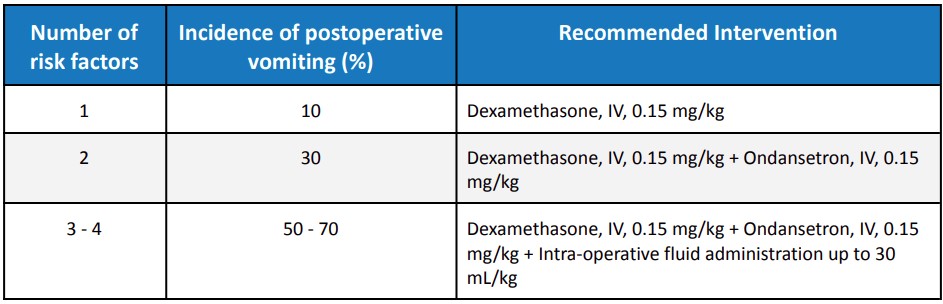
A risk assessment should be conducted for every child.
The postoperative vomiting in children score (POVOC) can be used:
- Duration of surgery > 30 minutes.
- Age > 3 years.
- Strabismus surgery.
- Personal or direct family history of PONV.
Table 3: POVOC score
Click on table to enlarge
Other strategies to decrease PONV are encouraged and include avoidance of nitrous oxide, multi-modal analgesia to reduce opioid requirements, and the consideration of a total intravenous anaesthesia technique.
The risk for PONV increases significantly peri-adolescence. During this time, girls are at higher risk when compared to boys.
Hypotension under General Anaesthesia
An appreciation of normal values for age for blood pressure are essential for the safe conduct of anaesthesia in children. Most cases of hypotension in children are due to hypovolaemia, and a bolus of 5 - 10 mL/kg of isotonic fluid should be given, and the response assessed. With persistent hypotension, a cause needs to be sought and addressed. For the diagnosis of hypotensive states or shock, and appropriate management, please refer to Intensive Care Chapter: section on Inotropes and vasopressors.
Standard Treatment Guidelines and Essential Medicines List for South Africa, Hospital Level, Paediatrics, 2023 Edition
Chapter 22:Anaesthestics, 22.1 Anaesthetic And Post-anaesthetic Care Of Children, 22.1.2 General Anaesthesia, 22.1.2.3 Maintenance Of Anaesthesia