Local and Regional Anaesthesia
Description Medicine treatment DESCRIPTION Local anaesthesia is accomplished by either local infiltration of soft tissue or the instillation of local anaesthetic into potential or existing body spaces such as the epidural space, sub-arachnoid spinal spaces or around major nerves or plexuses. Appropriate care is always used to limit overdose and avoid toxicity. Use appropriate agents, avoid adrena
DESCRIPTION
Local anaesthesia is accomplished by either local infiltration of soft tissue or the instillation of local anaesthetic into potential or existing body spaces such as the epidural space, sub-arachnoid spinal spaces or around major nerves or plexuses.
Appropriate care is always used to limit overdose and avoid toxicity. Use appropriate agents, avoid adrenaline (epinephrine) where end-artery blood supply exists and ensure the agents are in the correct sites. This should be learnt under appropriate learning conditions.
MEDICINE TREATMENT
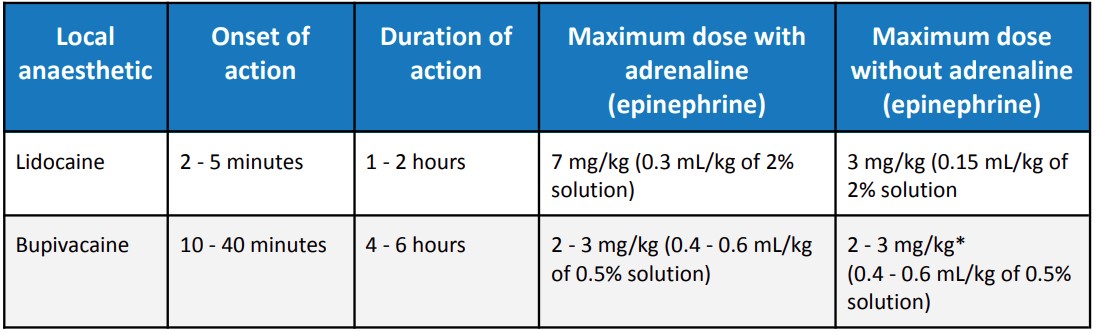
Choice of local anaesthetic agent should be guided by desired onset and duration of action. Bupivacaine is the local anaesthetic agent of choice due to duration of action. These agents, particularly bupivacaine, are cardiotoxic – every effort must be made to prevent intravascular injection. The use of ultrasound is strongly advised. Maximum doses must be strictly adhered to.
Table 1: Local anaesthetic agents
Click on the table to enlarge
*In infants under 12 months, overweight children, or children with liver dysfunction (where levels of α-acid glycoprotein are likely to be low), use a maximum dose of 2 mg/kg.
*If using continuous regional anaesthesia technique (e.g. via indwelling catheter), use 2 mg/kg as maximum dose over a 4 - 6 hour period.
Note: Lipid emulsion 20% must be readily available where these techniques are performed, in the event of inadvertent intravascular injection or drug error leading to overdose and Local Anaesthetic Systemic Toxicity (LAST). For management of LAST, see below.
Note: Do not use adrenaline (epinephrine) containing local anaesthetic solutions in sites where vascular (end-artery) compromise may result from vasoconstrictor use, i.e. fingers, toes, penis and eyes.
Caudal Anaesthesia
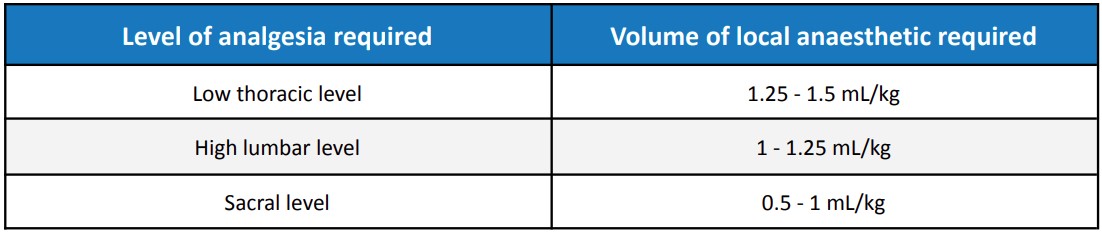
Caudal anaesthesia is a commonly utilised technique in children and provides good analgesia for common procedures. This technique must be learnt in an appropriate learning situation, as it has the potential to cause serious harm.
- Calculate the maximum dose of bupivacaine allowed for patient weight.
- Dilute with 0.9% sodium chloride (ONLY) to the desired volume.
- Adjuncts can be used to prolong and improve the quality of the block:
- Dexamethasone 0.1 - 0.5 mg/kg given IV prolongs the duration of analgesia provided by the caudal anaesthesia.
Note: Only medicines with proven safety should be injected into the caudal space due to the potential for neurotoxicity and other adverse effects.
Table 2: Recommended volumes for caudal anaesthesia
Click on the table to enlarge
Other Regional Anaesthetic Techniques
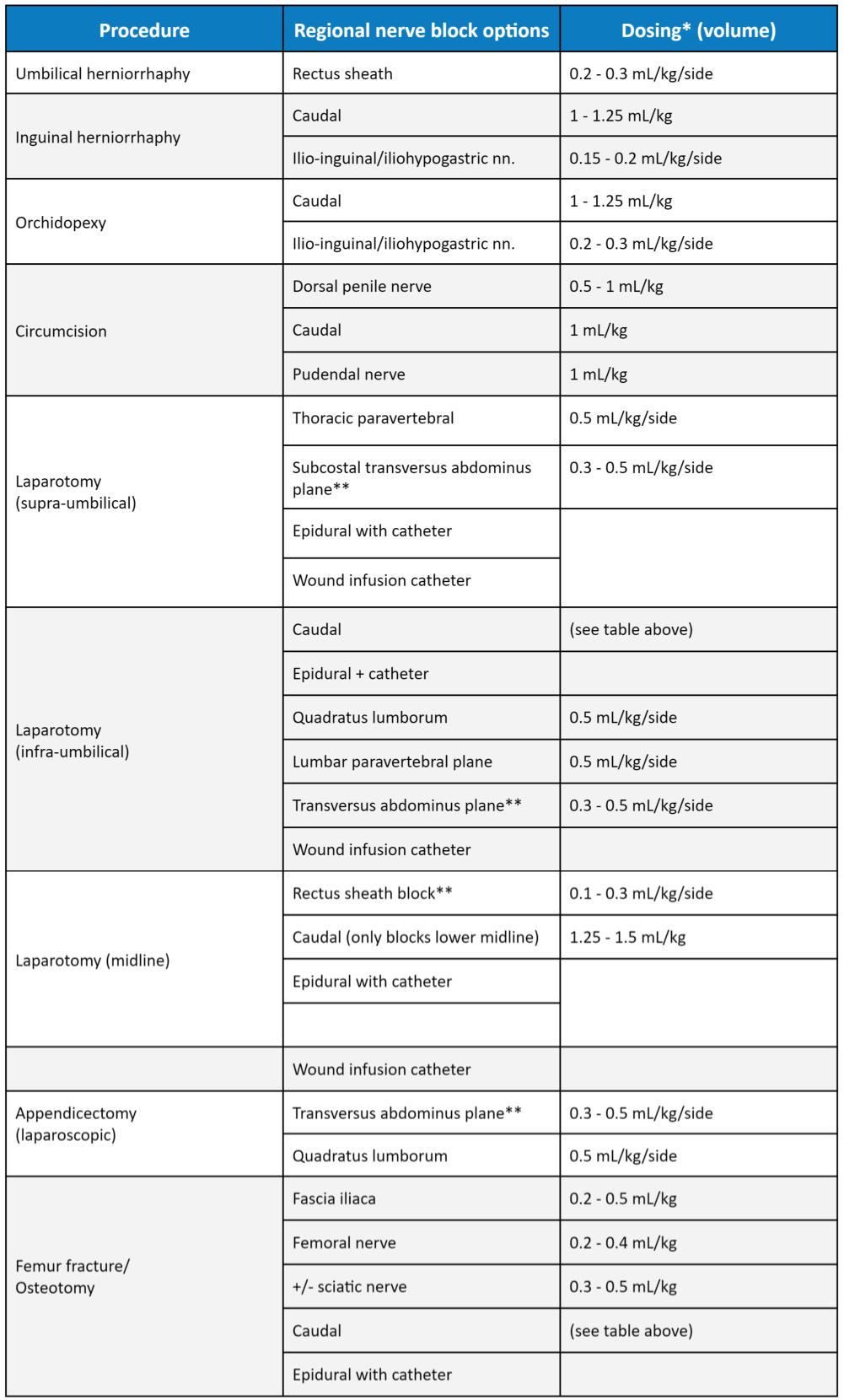
These techniques should be learnt in an appropriate learning situation. The use of ultrasound is strongly recommended to improve safety. Always adhere to maximum allowable local anaesthetic doses.
Epidural volumes should take into consideration the dermatomal and visceral cover required. Generally allow 0.5 - 1 mL/dermatome, staying within the toxic dose range.
For wound infusion catheters infusions of bupivacaine:
- If < 4 months or < 5 kg: use 0.1% bupivacaine at 0.2 ml/kg/hour
- If > 4 months or > 5 kg: use 0.2% bupivacaine at 0.2 ml/kg/hour
Click on table to enlarge
**Provides somatic analgesia only
Standard Treatment Guidelines and Essential Medicines List for South Africa, Hospital Level, Paediatrics, 2023 Edition
Chapter 22: Anaesthestics, 22.1 Anaesthetic And Post-anaesthetic Care Of Children, 22.1.1 Local And Regional Anaesthesia