Malaria: Prevention Guidelines (Summary)
Malaria: Prevention Guidelines (Summary)
Personal protection measures
Chemoprophylaxis
High-risk groups
Chemoprophylaxis regimens
Dose schedule
Interactions between malaria chemoprophylaxis and other drug treatment
Drug choice according to Traveller’s condition/situation
Diagnosis of malaria – early diagnosis is essential
Rapid diagnostic tests (RDTs)
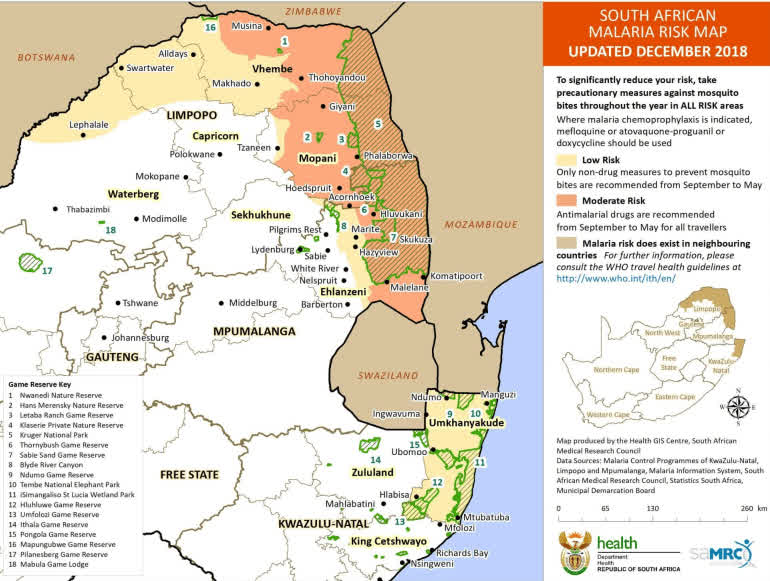
Malaria risk map RSA 2018
September to May is the main malaria season in South Africa
Kruger National Park, neighbouring areas
The risk of malaria during this period is moderate and chemoprophylaxis needs to be considered for all travellers.
KwaZulu-Natal
The risk remains and is confined to far northern KZN.
Other countries
Mozambique has year-round malaria and the risks in southern Zambia, Zimbabwe (Victoria Falls), Botswana (Okavango delta) and Namibia (Caprivi) will likewise increase during the rainy season.
Personal protection measures are essential
- Insect repellent (DEET) application
- Wearing of long pants, socks
- Sleeping under a repellent impregnated mosquito net
- Use air-conditioning / fans
Chemoprophylaxis
- Consider for all travellers to moderate and high-risk areas
- Adherence to chemoprophylaxis is critical – completion of the course is essential
- It does not mask the symptoms of malaria
Travellers who have been to a malaria area and develop a fever must seek medical assistance promptly even if they have taken chemoprophylaxis
High-risk groups
The following should be advised not travel to malaria areas:
- pregnant women
- young children under age of five years
- immunocompromised individuals,
- persons on chemotherapy,
- immunosuppressant doses of cortisone,
- HIV infection with a CD4 count below 250 cells/mm3,
- splenectomised individuals.
The following are a summary: download the complete guidelines from www.santhnet.co.za
Chemoprophylaxis regimens
| Doxycycline | Mefloquine | Atovaquone-Proguanil |
|
| Efficacy | Highly effective | Highly effective | Highly effective |
| Side effects | Skin photosensitivity, oesophageal ulceration, GIT upset, candida infections | Nausea, strange dreams, dizziness, insomnia, headaches | Headache, abdominal discomfort |
| Contraindications | Pregnancy, lactation, children under 8 years, OC use | History of psychiatric illness, cardiac arrhythmia, infants < 5 kg | Renal impairment (GFR <30), children under 11 kg |
| Special precautions | Use sunscreen, take with full glass of water, avoid lying down after taking dose | Travellers requiring fine motor co-ordination (pilots, divers) | Take with milk or food to increase absorption |
| Dosage interval | Daily | Weekly | Daily |
| Time to start before entering malaria area | 24-48 hrs | 1 week | 24-48 hrs |
| Time to continue after leaving malaria area | 30 days | 4 weeks | 7 days |
| Benefit | Cost-effective | Good for long term travellers | Good for short term travellers |
| Resistance | Rare | Rare but has been described in SE Asia | Rare |
- Although mefloquine is given as an option for chemoprophylaxis, there are currently no mefloquine-containing products available in South Africa – Lariam® has been discontinued in this country and Cipla have manufacturing issues regarding Mefliam® that will take a while to be resolved.
- This means that there is currently no product that can be used for pregnant travellers or children weighing less than 11 kg. As these are also the travellers at highest risk of complicated malaria, they should be strongly advised not to go to malaria risk areas. If they have no option but to go, they should use all methods available to prevent getting bitten by the mosquitoes, and should seek immediate medical attention should they have any signs of illness.
- Both doxycycline and atovaquone-proguanil are now S2 and are available from pharmacies without a prescription
Dose schedule
| Option |
Mefloquine |
Doxycycline | Atovaquone-proguanil |
||
| Adult dose |
250 mg (1 tablet) once weekly | 100 mg once daily | 250 mg atovaquone/100 mg proguanil (1 tablet) once daily | ||
| Paediatric dose |
Infants over 3 months of age or weighing more than 5 kg: | Contraindicated in children under 8 years of age | Paediatric formulation (62.5 mg atovaquone and 25 mg proguanil) for children weighing more than 11 kg | ||
| Weight(kg) | Weekly Dose | Children over 8 years of age: 2 mg/kg | Weight (kg) | Daily dose (paed tablet) | |
| 5-20 21-30 31-45 > 45 |
¼ tablet ½ tablet ¾ tablet Adult dose |
11-20 21-30 31-40 > 40kg |
1 tablet 2 tablets 3 tablets Adult dose |
||
| Administration in relation to meals |
Best taken with food and adequate fluid | Take after a meal with a full glass of water. Do not lie down for at least one hour after dosing |
Take with food and with adequate fluid | ||
Interactions between malaria chemoprophylaxis and other drug treatment
| Antimalarial | Other drug |
Comment |
| Mefloquine | Amiodarone | Both increase QT interval. Increased risk of torsade des pointes. |
| Antipsychotics e.g. phenothiazines, pimozide | Increased risk of ventricular arrhythmias. Mefloquine should not be used in patients with a history of a psychiatric illness. | |
| Antiretrovirals; efavirenz, nevirapine protease inhibitors | Theoretical risk of reduced levels of mefloquine, (not clinically significant). Theoretical risk of reduced levels of protease inhibitors, (not clinically significant). |
|
| Beta blockers e.g. atenolol, propranolol etc. | Potential for increased risk of electrocardiographic abnormalities, bradycardia and cardiac arrest. Therefore, mefloquine is not recommended for patients with cardiac conduction abnormalities, but mefloquine prophylaxis may be used safely in individuals without arrhythmia who are using beta blockers. | |
| Calcium channel blockers e.g. nifedipine, verapamil, diltiazem etc. | Possible increased risk of severe bradycardia. However, CDC states that there is no evidence to justify precautions for concomitant mefloquine therapy in patients using calcium channel blocking agents. | |
| Digoxin | Increased plasma levels of digoxin. Use with caution. Monitor levels. | |
| Halofantrine | Concurrent use may result in serious cardiac effects. Treatment with halofantrine is contraindicated when mefloquine has been used for prophylaxis. | |
| NOACs | May increase plasma levels of dabigatran and rivaroxaban, which may increase risk of bleeding. | |
| Oral cholera and typhoid vaccines | Inactivation of the immunisation possible. Complete immunisation three days before taking mefloquine. | |
| Primaquine | May increase the serum levels and side effects of mefloquine. | |
| Quinine or quinidine | Quinine may inhibit the metabolism of mefloquine, thereby increasing mefloquine levels. The combination may produce electrocardiographic abnormalities, cardiac arrest, or could result in potentially serious cardiac conduction abnormalities. On the other hand, a small, limited study conducted in 13 adults with single doses of both drugs showed a lack of a clinically significant cardiovascular pharmacodynamic interaction. The combination may increase the risk of seizures. A loading dose of quinine should not be given if mefloquine has been used for prophylaxis in the preceding 24 hours. | |
| Rifampicin | Decreased plasma concentration of mefloquine via induction of mefloquine metabolism. | |
| Tricyclic antidepressants | Increased risk of ventricular arrhythmias. Mefloquine should not be used in patients with a history of a psychiatric illness. | |
| Valproic acid | Accelerated sodium valproate metabolism may result in low valproic acid serum concentrations and loss of seizure control. Monitor valproic acid levels. Mefloquine is contraindicated in epileptics. | |
| Doxycycline | Alcohol | In alcoholic patients the serum levels of doxycycline may fall below minimum therapeutic concentrations, but this does not apply to acute intake of alcohol. |
| Antacids containing: calcium, bismuth, aluminium, magnesium, calcium supplements | Reduces the absorption and serum concentrations of doxycycline significantly, compromising therapeutic efficacy. If possible use alternative therapy, or administer doxycycline at least two hours before, or four to six hours after antacids. | |
| Antiretrovirals | No theoretical or known interaction | |
| Carbamazepine, barbiturates and phenytoin | Reduce the plasma half-life of doxycycline by approximately 50 per cent and may result in a reduction of efficacy. (See Epilepsy Section) | |
| Iron | Decreased absorption of doxycycline and iron salts. Efficacy may be reduced. Separate dosages by as much as possible. Give iron at least three hours before or two hours after the doxycycline dose. | |
| Methotrexate | One case report exists of a cancer patient who was receiving high-dose methotrexate and developed methotrexate-induced gastrointestinal and haematological toxicities in association with increased methotrexate levels after a course of doxycycline was introduced. Monitor patients closely, especially when methotrexate is administered in high doses. | |
| Isotretinoin | An increased incidence of pseudotumour cerebri has been reported in patients on other tetracyclines. It is unknown whether doxycycline is also potentially problematic. | |
| Milk and dairy products | Absorption of doxycycline may be reduced by up to 30 per cent because of the calcium ions found in milk. Avoid for at least one hour before or two hours after taking doxycycline. The small amounts of milk used in coffee and tea appear not to matter. | |
| Oral contraceptives | May reduce efficacy of contraceptives, if diarrhoea or vomiting occurs. | |
| Rifampicin | Increased doxycycline clearance. Potential loss of doxycycline efficacy. Monitor patient response. | |
| Warfarin | Potentiation of anticoagulant effect possible, monitor INR. | |
| Atovaquone - proguanil |
Antiretrovirals: protease inhibitors, zidovudine | Theoretical risk of reduced level of atovaquone. Theoretical risk of reduced level of indinavir. Zidovudine levels may be increased. |
| Live typhoid vaccine | A decreased immune response to typhoid vaccine. Allow 10 days to elapse between the last dose of live typhoid vaccine and the administration of proguanil. | |
| Magnesium trisilicate | Reduces absorption of proguanil. Separate doses as much as possible (two to three hours). | |
| Metoclopramide | Atovaquone plasma levels reduced, resulting in therapeutic failure. | |
| Rifampicin, rifabutin | Atovaquone plasma levels reduced, resulting in therapeutic failure. | |
| Tetracycylines | Atovaquone plasma levels reduced, resulting in therapeutic failure. | |
| Warfarin | May potentiate effect of Warfarin, monitor INR. |
Drug choice according to Traveller’s condition/situation
| Condition/situation |
Mefloquine |
Doxycycline |
Atovaquone-proguanil |
| Pregnancy - Avoid travelling to a malaria area | Drug of choice if pregnant women is at risk of malaria | Not recommended, but there are some data to support its use within the first 15 weeks of pregnancy if the risk of malaria is high | Not recommended due to lack of information |
| Women of child-bearing potential or on oral contraceptives | Ideally use reliable contraception during and for three months after taking last dose. Will not compromise contraceptive efficacy. | Avoid pregnancy during and for one week after taking last dose. Contraceptive failure may occur if the traveller presents with vomiting or diarrhoea. | Avoid pregnancy during and for three weeks after taking last dose. Will not compromise contraceptive efficacy. |
| Breastfeeding - Baby must be given its own prophylaxis | Insufficient data, but WHO states that it is safe to use. | Only use if there is no other option. (ACIP* says it can be used) |
Avoid use, as data are lacking |
| Young children - Avoid taking children under the age of 5 years to a high risk area | Can be used in children over 3 months of age or >5 kg. Generally well tolerated by children. | Only use in children >8 years of age. | Paediatric tablets can be given to children weighing more than 11kgs. |
| Diabetics. | Insufficient data - monitor blood glucose levels. | May increase hypoglycaemic effect of insulins - monitor blood glucose levels. | No known problems. Monitor blood glucose levels. |
| Epilepsy | Contraindicated. May also interact with valproic acid. | May interact with phenytoin, phenobarbitone and carbamazepine, reducing the half-life of doxycycline & possibly resulting in prophylaxis failure. | Can be used. |
| Hepatic impairment | Contraindicated in severe impairment | Administer with caution to hepatically impaired patients or those receiving hepatotoxic drugs. | Safe to use in mild to moderate hepatic impairment, but no data on use in severe hepatic impairment |
| Individuals requiring fine motor co-ordination and spatial discrimination e.g. pilots. | Do not use. | Safe to use. | Safe to use. |
| Persons on oral anticoagulants. Caution: Changes in INR can be very dangerous, resulting in bleeding or clotting. Preferably avoid high risk malaria areas. |
Insufficient data - monitor INR. Start therapy in advance to monitor possibility of interaction. | May potentiate anticoagulant effect. Monitor INR. | Proguanil may potentiate the effect of oral anticoagulants. Monitor INR. |
| Persons requiring long-term therapy. | Can be used for up to 3 years and even longer if justified by risk of exposure. | Can be used for 2 years and even longer if justified by risk of exposure | Can used for up to 1 year and even longer if justified by risk of exposure |
Diagnosis of malaria – early diagnosis is essential
Suspect malaria in any person presenting with fever with a travel history to or is resident in a malaria transmission area, irrespective of the time of year, irrespective of whether they have taken chemoprophylaxis.
Symptoms of malaria infections commonly develop 10 to 14 days after an infective mosquito bite but may be prolonged especially if prophylactic drugs have been taken.
RAPID DIAGNOSTIC TESTS (RDTs)
Combination tests are available but are less sensitive. Use of such tests in the South African context is discouraged.
RDT Limitations:
- very scanty infections may be missed.
- cannot be used to determine severity of infection: do not measure parasite load.
- cannot be used to monitor progress of treatment or to confirm clearance of parasites
- remain positive for some time after successful treatment.
- occasional false negative or false positive results, so RDT results should be confirmed by conventional microscopy whenever possible,
Effective treatment
Malaria must be treated as a medical emergency. The sooner effective treatment is started, the better the prognosis.
Download the complete Guidelines at https://www.santhnet.co.za/
Last checked for updates with SASTM: Aug 2023
Drugs mentioned
- Mefloquine21
- Doxycycline18
- Atovaquone11
- Methotrexate5
- Valproic Acid4
- Quinine3
- Rifampicin3
- Warfarin3
- Carbamazepine2
- Digoxin2
- Halofantrine2
- Phenytoin2
- Zidovudine2
- Amiodarone
- Atenolol
- Diltiazem
- Efavirenz
- Indinavir
- Isotretinoin
- Metoclopramide
- Nevirapine
- Nifedipine
- Phenobarbitone
- Pimozide
- Propranolol
- Rifabutin
- Rivaroxaban
- Sodium Valproate