Management of Anaesthetic and Post-Anaesthetic Complications
Description Medicine treatment DESCRIPTION Various events may occur during and after anaesthesia, which require management. MEDICINE TREATMENT Laryngospasm Maintain a good seal and attempt bag-mask ventilation, maintaining continuous positive pressure. Deepen the level of anaesthesia with a volatile anaesthetic agent (if laryngospasm is partial) – may overcome laryngospasm without the need for su
DESCRIPTION
Various events may occur during and after anaesthesia, which require management.
MEDICINE TREATMENT
Laryngospasm
- Maintain a good seal and attempt bag-mask ventilation, maintaining continuous positive pressure.
- Deepen the level of anaesthesia with a volatile anaesthetic agent (if laryngospasm is partial) – may overcome laryngospasm without the need for suxamethonium.
- If laryngospasm is complete (no movement of air) and the patient starts to desaturate, act quickly and consider:
- Propofol, IV, 1 - 2 mg/kg.
AND/OR - Lidocaine, IV, 1 - 2 mg/kg.
- Suxamethonium, IV, 1 - 2 mg/kg. If no IV access: Suxamethonium 3 - 4 mg/kg IM into the tongue (intralingually) with massage (submental route is preferred, see diagram below). Massage speeds onset of action significantly. (Produces 5 - 10 minutes of neuromuscular blockade within 30 - 60 seconds). Causes paralysis and apnoea.
- Propofol, IV, 1 - 2 mg/kg.
Note: Do not wait for patient to become significantly hypoxic and bradycardic. Call for help early.
Note: Avoid suxamethonium in patients with or at risk of hyperkalemia, scoline apnoea, certain neuromuscular diseases and a family history of malignant hyperthermia.
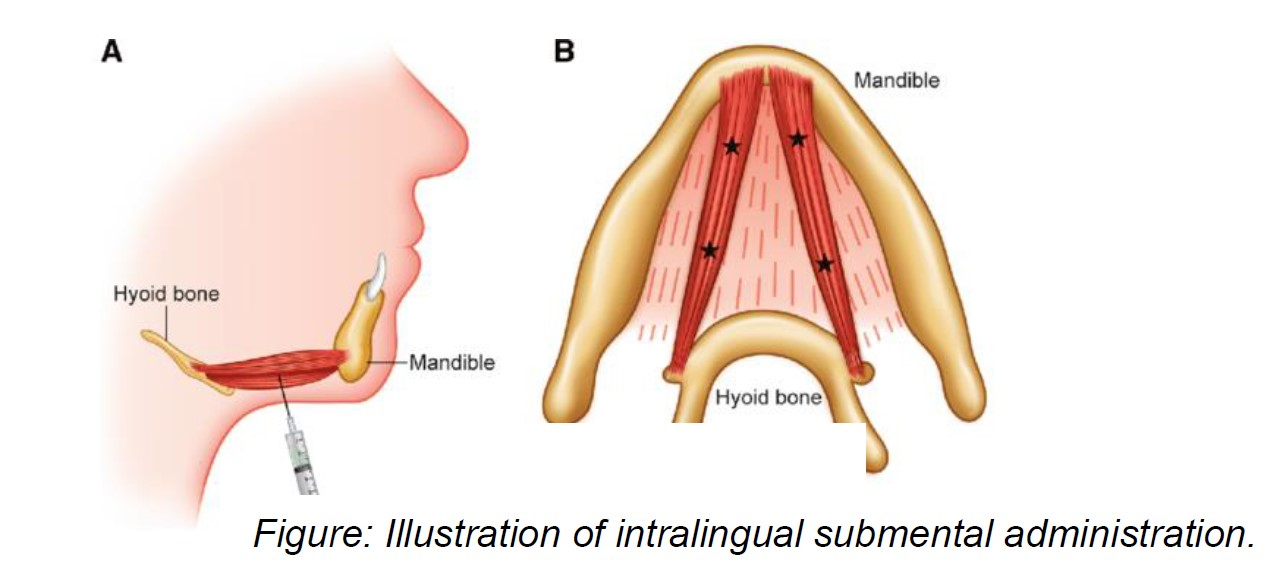
Click on image to enlarge
Image Reference 3
| Route of administration | Quadriceps | Intralingual submental | Intralingual submental with massage |
| Time to 90% twitch suppression |
295 seconds | 265 seconds | 133 seconds |
Bronchospasm
Intraoperatively, exclude precipitating factors, e.g. ET tube at carina or mainstem bronchus intubation, blocked tubing or equipment, light anaesthesia, secretions, aspiration, allergic reactions.
Management
- Increase FiO2.
- Increase volatile agent (except desflurane; if using, change to different agent).
- ß2-agonists can be delivered via different routes:
- Nebulised fenoterol via in-line nebuliser (need independent oxygen source). Attach onto the circuit at the patient-end of HME and ventilate. Note that capnography will be inaccurate.
- Salbutamol, IV, 15 μg/kg over 10 minutes.
- Magnesium sulphate, IV, 30 - 50 mg/kg (maximum 2 g) slowly over 20 minutes.
If no response, consider:
- Ketamine, IV bolus, 0.5 mg/kg or consider infusion at 1 - 3 mg/kg/hr (may increase secretions).
- Adrenaline, IV, 0.1 - 1 μg/kg or infusion at 0.05 - 1 μg/kg/min.
- Hydrocortisone, IV, 1 - 2 mg/kg stat.
Opioid-induced respiratory depression
- For reversal of apnoea/respiratory depression: Naloxone, IV, 0.01 mg/kg, repeated every 2 minutes, if required, up to 4 times. Maximum dose: 0.4 mg.
- For reversal of post-operative sedation: Naloxone, IV, 0.002 mg/kg/dose, repeated every 2 minutes, as required, up to 4 times.
Note: All patients need to be kept under direct observation until the effect of the opiates has completely worn off. Further doses of naloxone may be needed as naloxone has a shorter duration of action than most opiates (e.g. morphine). Because naloxone antagonises opiates at the mu receptor, the analgesic effect will also be reversed. This occurs at higher doses of naloxone, hence the need for titration. The lowest dose of naloxone to reverse respiratory depression should be used.
Post operative nausea and vomiting
Use an agent of a different class if prophylaxis given.
- Ondansetron, slow IV, 0.15 mg/kg. (No benefit if already used as prophylaxis). Maximum dose: 4 mg.
Malignant hyperthermia
Malignant hyperthermia is a life-threatening anaesthetic emergency triggered by exposure to volatile anaesthetic agents and suxamethonium.
Management involves supportive and specific therapies, which centre on the administration of dantrolene. For a comprehensive management guideline, refer to the Association of Anaesthetists of Great Britain and Ireland’s (AAGBI):
- Stop the triggering agent.
- Stop surgery or provide an alternate method of hypnosis intravenously (e.g. ketamine, propofol).
- Give dantrolene, IV, 2.5 mg/kg immediately. This is followed by 1 mg/kg IV boluses to a maximum cumulative dose of 10 mg/kg.
Local anaesthetic systemic toxicity (LAST):
This is a life-threatening emergency caused by inadvertent intravascular injection or overdose of local anaesthetic agents. LAST is comprised of neurological and cardiovascular features with eventual cardiovascular collapse and cardiac arrest if high plasma concentrations are reached. The management is supportive and specific. For a comprehensive management guideline, refer to the Association of Anaesthetists of Great Britain and Ireland’s (AAGBI) guideline:
- Stop injecting the local anaesthetic.
- Early administration of lipid emulsion 20% is a priority. Provide cardiovascular and respiratory support while awaiting lipid emulsion and until return of spontaneous circulation. Apply Advanced Paediatric Life Support algorithms should cardiac arrest occur. Good cardiopulmonary resuscitation is of paramount importance to ensure a good outcome. Treat arrythmias, but do not use lignocaine.
- Start lipid emulsion, IV, 1.5 mL/kg AND start infusion of 15 mg/kg/hr. The bolus of 1.5 mL/kg can be repeated after 5 minutes if the patient remains unstable. The maximum dose of lipid emulsion is 12 mg/kg. Propofol is not a suitable replacement.
- Treat seizures.
Dysrhythmias
See Cardiac dysrhythmias.
Standard Treatment Guidelines and Essential Medicines List for South Africa, Hospital Level, Paediatrics, 2023 Edition
Chapter 22:Anaesthestics, 22.1.4 Management Of Anaesthetic And Postanaesthetic Complications