Management of RR-TB in Children Above 15 Years of Age and Non-Pregnant Adults
Key points regarding the Short Regimen for RR-TB (BPaL-L) Initial approach to patients diagnosed with RR-TB Inclusion and exclusion criteria for Short RR-TB Regimen Switching from BPaL-L to long individualized regimen Longer Individualized Regimens for RR-TB: Summary Points WHO Drug Groupings Recommended dosing of drugs for RR-TB treatment in persons weighing ≥30 kg Key points regarding the Short
Key points regarding the Short Regimen for RR-TB (BPaL-L)
Initial approach to patients diagnosed with RR-TB
Inclusion and exclusion criteria for Short RR-TB Regimen
Switching from BPaL-L to long individualized regimen
Longer Individualized Regimens for RR-TB: Summary Points
Recommended dosing of drugs for RR-TB treatment in persons weighing ≥30 kg
Key points regarding the Short Regimen for RR-TB (BPaL-L)
- Most People with a diagnosis of RR-TBwill be eligibleto receive the short BPaL-L.
- The short regimen contains the following medication bedaquiline, pretomanid and linezolid with or without additional levofloxacin for 6 months. This can be extended to 9 months at the clinician's discretion.
- If fluoroquinolone resistance is detected, BPaL can be used without levofloxacin or moxifloxacin for 6 months.
- Prior use of bedaquiline, delamanid or pretomanid and linezolid (>1 month) is not a contraindication for BPaL-L. However, resistance to these agents must be excluded. If found to be resistant to bedaquiline, linezolid, delamanid or pretomanid the client is no longer eligible for BPaL-L regimen.
- Severe extra-pulmonary RR-TB meningitis, pericarditis, osteoarticular, abdominal or disseminated/miliary disease may not be treated with BPaL-L.
- Linezolid dose is 600 mg/daily. This should be given for at least 8 weeks. In the case of toxicity or intolerability the dose can be interrupted (while other medicines in the regimen are continued) for a total of a maximum of 8 weeks throughout the treatment course.
- There is no specified intensive or continuation phase for these regimens and all drugs should be continued throughout treatment, if possible, unless limited by toxicity or intolerance.
- HIV-positive patients with any CD4 count, regardless of ART status, qualify to receive the short RR-TB regimen if they meet the inclusion criteria listed above.
- Pyridoxine does not need to be prescribed in patients receiving BPaL-L.
Initial approach to patients diagnosed with RR-TB
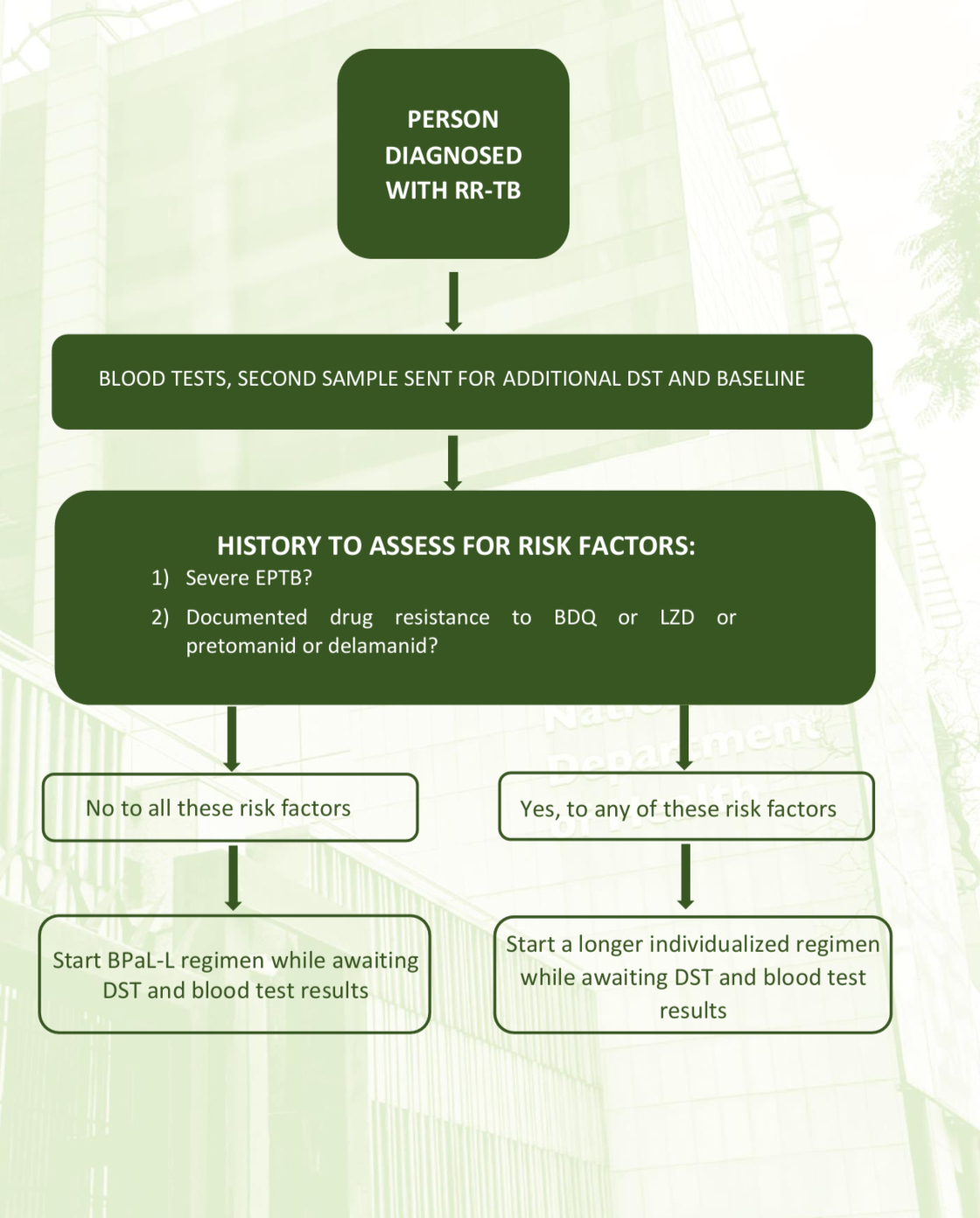
Click on the image to enlarge.
Inclusion and exclusion criteria for Short RR-TB Regimen
The short RR-TB regimen in this chapter refers to the 6-month BPaL-L and BPaL regimens [18]. It does not refer to the 9-month regimen currently used per the 2019 Clinical Reference Guide.
| Inclusion Criteria | Exclusion Criteria | |
| Resistance patterns | - Individuals with: RR-TB: resistance, based on initial genotypic result, while awaiting further susceptibility results | - Documented resistance to Bedaquiline or Linezolid. - RR-TB with additional resistance to pretomanid or delamanid - XDR-TB (resistance to the fluroquinolones and/ resistance to bedaquiline or linezolid) |
| Clinical criteria | - Non-severe extra-pulmonary RR-TB, including lymphadenopathy or pleural effusion. - Persons with extensive pulmonary disease (i.e. bilateral, cavitary disease with significant fibrosis, scarring or cavities in three or more lung zones) should have their treatment extended to 9 months. |
- Persons with severe extrapulmonary RR-TB meningitis, pericarditis, osteoarticular, abdominal or disseminated/miliary disease |
| Specific populations | - Children under the age of 15 years (since pretomanid safety is not yet confirmed in this population) - Pregnant women (since pretomanid safety is not yet confirmed in this population) |
Patients with extensive disease can have their regimen extended to 9 months at the discretion of the clinician.
Switching from BPaL-L to long individualized regimen
It is important to recognize when a person needs to switch from the short RR-TB regimen to a longer regimen. Input should be sought from the PCAC or NCAC where needed. A switch to a long individual regimen should be strongly considered in these situations:
- Resistance to Bedaquiline, pretomanid, clofazimine, delamanid or linezolid is detected.
- There is a positive culture result at month 4 (delayed culture conversion or reconversion back to positive). Resistance to bedaquiline, pretomanid, clofazimine, delamanid or linezolid must be excluded.
- Bedaquiline, linezolid or pretomanid is prematurely and permanently discontinued because of toxicity.
- Delamanid testing is currently not being routinely done, the NTBRL is planning on starting to test for pretomanid. Clofazimine will also not be routinely tested, it will only be tested as part of EDST. Delamanid resistance testing should be requested if history of > 1 month exposure as resistance is a contraindication to BPaL-L regimen and would then require an individualized regimen.
- The patient is clinically deteriorating or has not clinically improved. Other causes must be excluded in a culture negative patient.
- Extended DST is required.
If the patient switches to a longer regimen due to short RR-TB regiment treatment failure, the treatment episode should be registered as “treatment failure” and the patient should be assigned a new treatment episode.
Longer Individualized Regimens for RR-TB: Summary Points
- Persons who do not qualify for the short RR-TB regimen will receive a long individualized 18-month regimen.
- The commonest reason for a long regimen is bedaquiline resistance.
- Resistance to pretomanid, delamanid and linezolid are also an indication that the patient needs to be in the longer regimen.
- For persons aged 15 years and above who do not meet the short regimen inclusion criteria, treatment with the long regimen will consist of an individualized regimen given for a period of 18 months.
- Pyridoxine 50 mg should be prescribed for patients receiving a regimen containing TRD or hdINH.
- For persons aged 15 years and above without CNS RR-TB disease, a regimen of consisting of as many category A drugs that are still considered to be susceptible, with terizidone and clofazimine. In addition, select category C based on likely efficacy – consider an individual’s prior drug exposure, toxicity history and documented resistance.
- Treatment of CNS disease should consist of drugs with adequate CNS penetration to which the client’s isolate is likely to be susceptible.
- The regimen should be designed using the WHO drug grouping approach.
- Children under the age of 15 years should be treated as per "Management of RR-TB in children under 15 years of age"
WHO Drug Groupings
Steps to designing a Long-Individualized Treatment Regimen [19,20].
| Groups and Steps | Medicine | Comments |
| Group A: Include all three medicines, where possible | Levofloxacin or Moxifloxacin | Include for CNS disease. Omit in fluoroquinolone-resistant RR-TB. |
| Bedaquiline | Include if no resistance. | |
| Linezolid | Include for all including CNS disease, unless contraindication or resistance. In patients with Hb < 8 g/dL, neutrophils < 0.75 x 10⁹/L and/or platelets < 50 x 109/L, only consider reintroducing or initiating in hospital under close monitoring. | |
| Group B: Add one or both medicines, if possible | Clofazimine | Possible cross resistance to bedaquiline. |
| Terizidone | Include for CNS disease. | |
|
Group C: Add to complete the regimen and when medicines from Group A and B cannot be used |
Ethambutol | Only use as a reliably effective drug if susceptibility demonstrated on DST. |
| Delamanid | Include for CNS disease. | |
| Pyrazinamide | Include for CNS disease. Only use as a reliably effective drug if susceptibility demonstrated on DST. | |
| Imipenem-cilastatin, or meropenem, or ertapenem | Adequate CNS penetration. Must be given in combination with amoxicillin/clavulanic acid. | |
| Amikacin | Administer if not enough other drug options to compose an effective regimen. Only administer if there is documented susceptibility, if formal hearing tests can be done, and if the patient consents to its use after the risks and benefits of the drug have been explained. Therapeutic drug monitoring must be done. | |
| Ethionamide | Consider for CNS disease. Should only be given if inhA mutation is not present. | |
| Para-aminosalicylic acid | Use in rescue regimens. |
An individualized long regimen should be offered for persons aged 15 years and above who are not responding to treatment, who have been failed by a previous RR-TB treatment regimen (especially one containing bedaquiline, pretomanid, delamanid, linezolid and/or clofazimine), or who have RR-TB with documented or suspected resistance to bedaquiline/clofazimine, linezolid and pretomanid/delamanid.
Recommended dosing of drugs for RR-TB treatment in persons weighing ≥30 kg
National Department of Health Clinical Management of Rifampicin-Resistant Tuberculosis, September 2023
Management of RR-TB in Children Above 15 Years of Age and Non-Pregnant Adults