Management of Shocked Child
Management of a shocked child
General and supportive measures
SIGNS OF SHOCK
- Tachycardia
- Cold peripheries
- Weak pulse pressure
- Prolonged capillary filling > 3 seconds
- Decreased level of consciousness
- Agitation/confusion
- Skin pallor
- Hypotension is a sign of uncompensated shock and failure to act urgently will result in irreversible shock and death.
GENERAL AND SUPPORTIVE MEASURES
- Follow the ABCD’s algorithm
- Identify and treat the underlying cause.
- Classify type of shock and treat appropriately
- Ensure good intravenous or intra-osseous access.
- Oxygen, high flow, 15 L/minute via facemask with reservoir bag or 6–10, keep sats > 92%
- Take appropriate bloods, e.g. cross match, urea and electrolytes, coagulation studies, full blood count and blood cultures.
- Treat with appropriate IV antibiotics if sepsis is suspected.
- Monitor and maintain vital signs and urinary output (at least 1mL/kg/hr).
- Correct metabolic parameters.
HYPOVOLAEMIC SHOCK (Dehydration, intravenous fluid loss/shift)
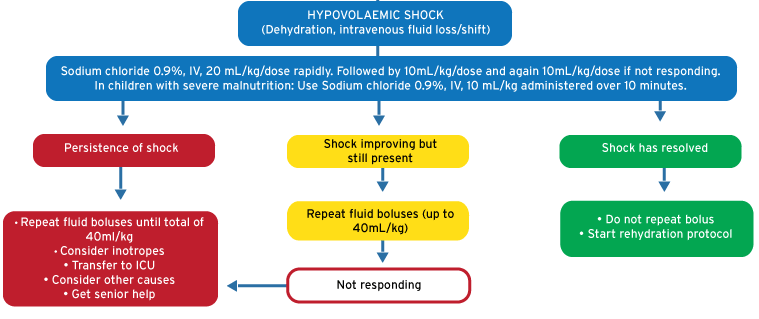
Monitor for fluid or circulatory overload, i.e. increasing respiratory rate, increasing basal crepitations, increasing pulse rate, increasing liver size/tenderness, increasing JVP.
SEPTIC SHOCK
Children receiving treatment for septic shock should be in an ICU. The resuscitation and treatment must be immediate.
- IV Fluids: Sodium chloride 0.9%, IV, 20 mL/kg/dose rapidly. Followed by 10mL/kg/dose and again 10mL/kg/dose if not responding. In children with severe malnutrition: Use 10 mL/kg administered over 10 minutes. Review after each bolus to see if shock has resolved.
- Inotropes: Consider if shock has not resolved after 20 ml/kg of sodium chloride 0.9% fluid bolus or if tissue perfusion and blood pressure do not improve satisfactorily on adequate fluid volume replacement. Titrate inotropes against the response, and add additional agent if poor response. Start with Epinephrine (adrenaline), IV infusion, 0.01–1 mcg/kg/minute. If inadequate response: Add Dobutamine, IV, 5–15 mcg/kg/minute.
- Unresponsive septic shock: Hydrocortisone, IV, 1 mg /kg/dose, 6 hourly until shock has resolved.
- Antibiotic therapy: Start antibiotics early. Give 3rd generation cephalosporin, Cefotaxime, IV, 75 mg/kg/dose, 8 hourly (neonates) or Ceftriaxone, IV, 50 mg/kg/dose, 12 hourly in children >2 months.
CARDIOGENIC SHOCK
Ideally children receiving treatment for cardiogenic shock should be in high care or ICU.
Inotropic support: When perfusion is poor and blood pressure response is unsatisfactory, despite adequate fluid replacement. Dobutamine, IV, 5–15 mcg/kg/minute. If tissue perfusion and blood pressure do not improve satisfactorily consider: Epinephrine (adrenaline), IV infusion, 0.01–1 mcg/kg/minute.
If poor ventricular contractility and increased afterload are considered as the primary problem, do not give epinephrine (adrenaline) but consider adding an afterload reducing agent to the dobutamine infusion but only with specialist advice.