Perioperative Analgesia
Standard Treatment Guidelines and Essential Medicines List for South Africa, Hospital Level, Adults 2019 Edition
Please click on the link below to access the most up-to-date version of this guideline. The content on this page is currently being updated to align with the latest publication. Always check the version number at the bottom of the screen to confirm which version you are using.
Postoperative Pain in the Recovery Room
Postoperative Analgesia Ward Prescriptions
ICD-10 Code: R52.9
- The perioperative period includes the preoperative, intraoperative and post-operative stages of surgery.
- Perioperative analgesia should be multi-modal, i.e. use analgesics, where possible, from different classes to reduce side effects from high doses of a single agent (e.g. paracetamol, NSAID and a weak/strong opioid) with either a regional block or wound infiltration with local anaesthetic.
- Patients with pain before surgery should be given analgesia preoperatively.
- Paracetamol may be given orally with premedication to prophylactically reduce perioperative pain.
- Intraoperatively, analgesics are given intravenously and/or a central neuraxial or regional local anaesthetic block may be used. The analgesic effect of these may extend into the early postoperative period.
- Postoperatively analgesics are given IV, IM and/or rectally, until the patient is able to take oral medication. Patients with a functioning block may not require analgesia until the block wears off but analgesics should be prescribed in anticipation of this.
- Pain severity should be assessed frequently post-operatively (see Postoperative Analgesia Ward Prescriptions).
PERIOPERATIVE ANALGESICS
Oral analgesics
- Paracetamol, oral, 1 g 4–6 hourly when required.
- Maximum dose: 15 mg/kg/dose.
- Maximum daily dose: 4 g in 24 hours.
AND
- Tramadol, oral, 50–100 mg, 4-6 hourly.
- Avoid in head injury and epilepsy.
- Improved effect when given with paracetamol.
AND
- NSAIDs, e.g.:
- Ibuprofen, oral, 400 mg 8 hourly with meals.
Note:
Do not administer NSAIDs to patients at risk of hypovolaemia, renal impairment or gastrointestinal bleeding. Avoid in patients with asthma who experience bronchospasm with NSAIDs.
Intravenous analgesics
- Fentanyl, IV, 1–2 mcg/kg
- Onset ± 3 minutes, duration of action 30–60 minutes. Higher doses last longer.
- Morphine, IV/IM, 3–5 mg as a single dose then further boluses at intervals of 5-10 minutes and monitor all vitals closely.
- Dilute 10 mg up to 10 mL with sodium chloride 0.9%.
- Total maximum dose: 10 mg
- Repeat after 4 hours if necessary.
- Monitor response to pain and effects on respiration and BP.
- Onset 5-10 minutes. Duration of action ± 3 hours.
- Histamine release may cause intraoperative hypotension.
- Ketamine, IV, 0.1-0.3 mg/kg – a subanaesthetic dose given pre-incision may reduce persistent post-surgical pain.
POSTOPERATIVE PAIN IN THE RECOVERY ROOM
ICD-10 Code: R52.0
- Pain should be assessed on arrival in the recovery room and at regular intervals postoperatively. Pain Scores should be recorded with other routine postoperative observations.
- A Numeric Rating Scale (NRS) can be used to score pain:
Source: Breivik H, Borchgrevink PC, Allen SM, Rosseland LA, Romundstad L, Hals EK, Kvarstein G, Stubhaug A. Assessment of pain. Br J Anaesth. 2008 Jul;101(1):17-24.
Click on the image to enlarge.
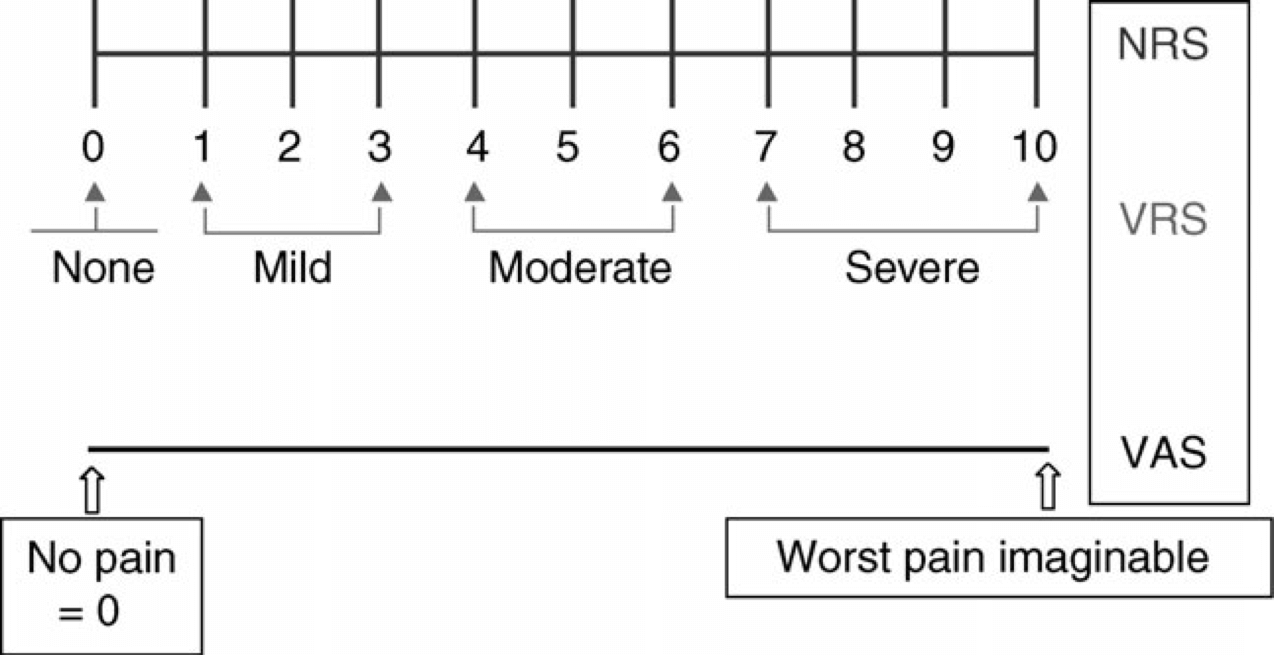
- The patient is asked to indicate on the scale the numeric value that best indicates their pain intensity or verbally if they cannot visualise the scale.
Severe pain (use lower doses if pain less):
- Morphine, IV, to a total maximum dose of 10 mg (See Prescribing Information for Specific Medicines, for individual dosing and monitoring for response and toxicity).
- Monitor consciousness level and pulse oximetry continuously. Also monitor respiration, heart rate and BP at 5 minute intervals and for at least 20 minutes after the last IV morphine bolus.
- In patients at high risk for respiratory depression, tramadol may be used instead of morphine as it causes less respiratory depression (although respiratory depression may still occur with tramadol).
Tramadol is a weak opioid agonist and increases spinal cord levels of serotonin and noradrenaline.
- Tramadol, IV, 50–100 mg, over 3 minutes to reduce side-effects of nausea and vomiting (Specialist prescribed).
- Ceiling effect i.e. higher doses do not improve pain relief.
In addition to morphine or tramadol, diclofenac may also be given to supplement analgesia and reduce opioid requirements:
- Diclofenac, deep IM, 75 mg 12 hourly.
- Administer for a maximum of 2 days.
- Avoid the same injection site.
- Counsel patient prior to injection of adverse events (scarring) at inject site, if applicable.
POSTOPERATIVE ANALGESIA WARD PRESCRIPTIONS
- Analgesia should be prescribed according to the severity of pain anticipated from the surgery and the anticipated, appropriate, postoperative route of administration.
- Pain should be assessed at regular intervals on the ward postoperatively. Pain scores should be recorded with other routine postoperative observations.
- Respiratory rate should be monitored for opioid-induced respiratory depression.
Examples of ward prescriptions for postoperative analgesia according to anticipated pain severity
ICD-10 Code: R52.9
Mild pain:
- Paracetamol, oral, 1 g 4–6 hourly when required.
- Maximum dose: 15 mg/kg/dose.
- Maximum daily dose: 4 g in 24 hours.
AND
- NSAIDs, oral, e.g.:
- Ibuprofen, oral, 400 mg 8 hourly after meals.
CAUTION
Concomitant use of more than one oral NSAID has no additional clinical benefit and only increases toxicity.
Use of all NSAIDs is associated with increased risks of gastrointestinal bleeding, renal dysfunction, and cardiovascular events (stroke and myocardial infarction).
NSAIDs should be used judiciously at the lowest effective dose for the shortest duration. Explore and manage exacerbating factors for pain. See Chronic pain.
Do not use NSAID in pregnancy or while breastfeeding.
AND
- Tramadol, oral, 50–100 mg, 6 hourly.
- Avoid in head injury and epilepsy.
- Improved effect when given with paracetamol.
Moderate pain:
- Paracetamol, oral, 1 g 4–6 hourly when required.
- Maximum dose: 15 mg/kg/dose.
- Maximum daily dose: 4 g in 24 hours.
AND
- NSAIDs, oral, e.g.:
- Ibuprofen, oral, 400 mg 8 hourly with meals.
CAUTION
Concomitant use of more than one oral NSAID has no additional clinical benefit and only increases toxicity.
Use of all NSAIDs is associated with increased risks of gastrointestinal bleeding, renal dysfunction, and cardiovascular events (stroke and myocardial infarction).
NSAIDs should be used judiciously at the lowest effective dose for the shortest duration. Explore and manage exacerbating factors for pain. See Chronic pain.
Do not use NSAID in pregnancy or while breastfeeding.
AND
- Tramadol, oral, 50–100 mg, 4-6 hourly.
- Avoid in head injury and epilepsy.
- Improved effect when given with paracetamol.
OR
- Morphine, IM, 0.1–0.2 mg/kg, 4 hourly or IV via a patient controlled analgesia device (see below).
Severe pain:
- Morphine, IM, 0.1–0.2 mg/kg, 4 hourly or IV via a PCA device.
AND
- Paracetamol, oral, 1 g 4–6 hourly when required.
- Maximum dose: 15 mg/kg/dose.
- Maximum daily dose: 4 g in 24 hours.
AND
- NSAID, e.g.:
- Ibuprofen, oral, 400 mg 8 hourly with meals.
Note
Patient controlled analgesia
If a device is available that will administer patient controlled analgesia:
Morphine, IV, in boluses of 1 mg every 6-10 minutes, with a maximum dose of 0.1–0.2 mg/kg 4 hourly.
- In the elderly and frail, the dose of morphine should be reduced and the dosage interval increased.
If unable to take oral medication, stop oral ibuprofen and use:
- Diclofenac, deep IM, 75 mg 12 hourly, to upper, outer quadrant of buttock.
- Administer for a maximum of 2 days.
- Avoid the same injection site.
- Counsel the patient prior to injection of adverse events (scarring) at injection site if applicable.
Standard Treatment Guidelines and Essential Medicines List for South Africa, Hospital Level, Adults 2024 Edition