Pharmacological Treatment of Allergic Rhinitis
Intranasal corticosteroids Systemic antihistamines Intranasal antihistamines Topical nasal decongestants Leukotriene receptor antagonists The efficacy of the various classes of drugs for the treatment of AR is listed in Table 3 43,44 and Figure 4. 19 TABLE 3: Efficacy of various classes of drugs for allergic rhinitis. Pharmacological agent Nasal obstruction Rhinorrhoea Sneezing Nasal itching Intr
Leukotriene receptor antagonists
The efficacy of the various classes of drugs for the treatment of AR is listed in Table 343,44 and Figure 4.19
TABLE 3: Efficacy of various classes of drugs for allergic rhinitis.
| Pharmacological agent | Nasal obstruction |
Rhinorrhoea | Sneezing | Nasal itching |
| Intranasal corticosteroids | +++ | +++ | ++ | + |
| Antihistamines | + | +++ | +++ | +++ |
| Combination intranasal corticosteroids and antihistamines |
+++ | +++ | +++ | +++ |
| Intranasal cromones | + | + | + | + |
| Intranasal decongestants | ++++ | - | - | - |
| Anticholinergics | - | ++ | - | - |
| Leukotriene-receptor antagonists |
++ | + | - | - |
Source: Adapted from Seedat RY. Treatment of allergic rhinitis. Curr Allergy Clin Immunol. 2013;26(1):11–16 and Sur DKC, Plesa ML. Treatment of allergic rhinitis. Allerg Rhinitis. 2015;92(11):985–992
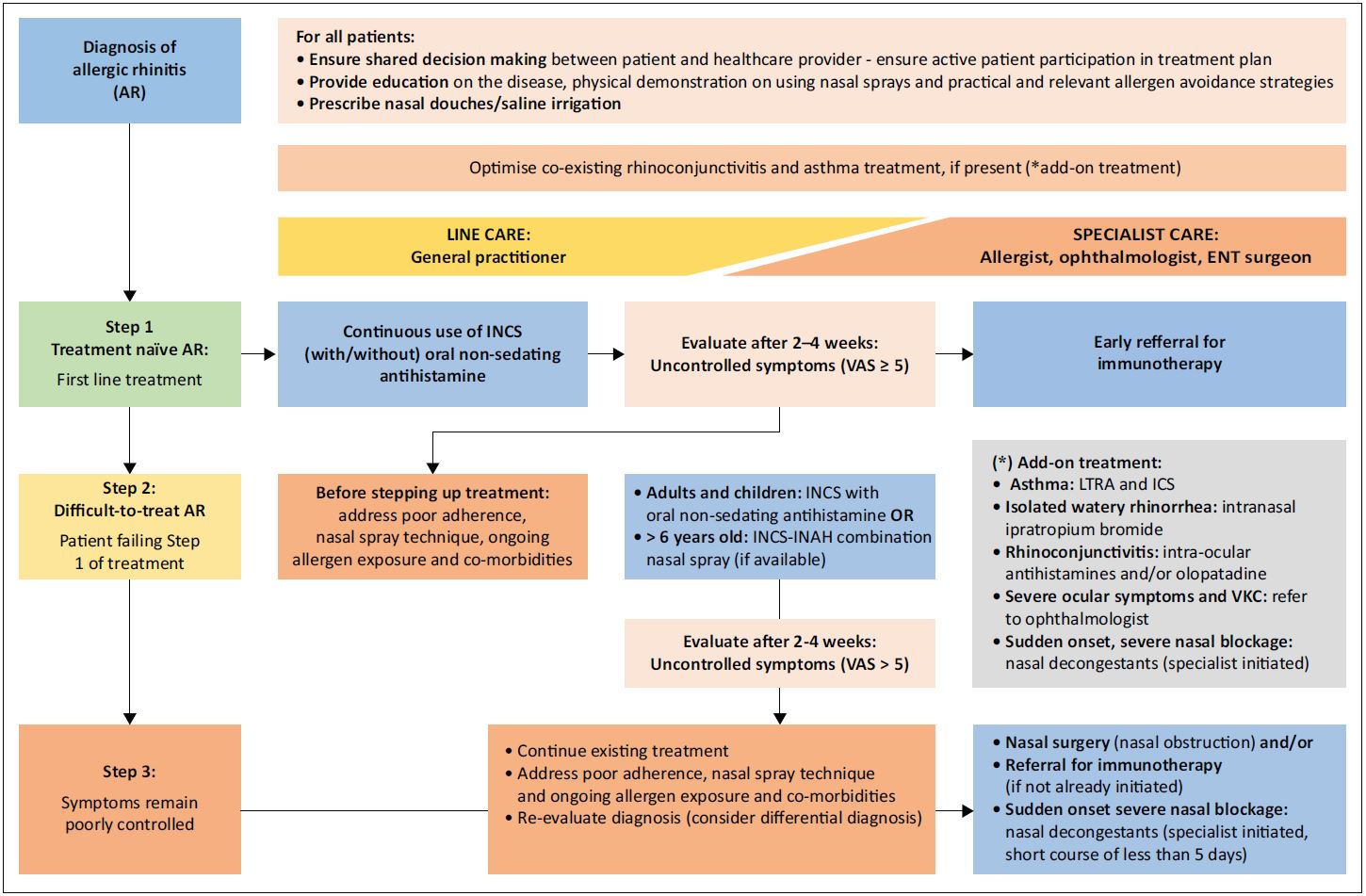 Click on the image to enlarge
Source: Adapted from Hellings PW, Scadding G, Bachert C, et al. EUFOREA treatment algorithm for allergic rhinitis. Rhinology. 2020;58(6):618–622. https://doi.org/10.4193/Rhin20.376
SAR, seasonal allergic rhinis; PAR, perennial allergic rhinis; INCS, intranasal corcosteroid; INAH, intranasal anhistamine; VAS, visual analogue scale; LTRA, leukotriene receptor antagonists; ICS, inhaled corcosteroids; VKC, vernal keratoconjuncvisFIRST; ENT, ear, nose and throat.
FIGURE 4: Flow diagram describing Management of Allergic Rhinitis.
Intranasal corticosteroids
Intranasal corticosteroids are the pharmacological treatment of choice for all forms of AR as they are effective against a wide range of symptoms.17,19,25,29 They are used intermittently for seasonal disease and continuously for perennial disease.30 Efficacy should be reviewed after 2–4 weeks in treatment-naïve patients. If still symptomatic, a combination of INCS and antihistamine is advised.
Side effects of INCS are mostly because of local irritation and include nasal dryness, a burning sensation inside the nose, blood-tinged nasal secretions and epistaxis.21 Hydrating the nose with saline may reduce these side effects. Erroneously aiming the spray towards the nasal septum is an important contributor to local side effects.
All newer INCS are safe and effective. However, these molecules have structural differences that influence glucocorticoid receptor-binding affinity and topical antiinflammatory potency. These differences also alter the physicochemical properties such as solubility, lipophilicity and permeability, which in turn influence the pharmacokinetic properties and the systemic activity and therapeutic index.45,46 Molecules such as fluticasone propionate, fluticasone furoate, ciclesonide and mometasone furoate have increased glucocorticoid receptor selectivity and binding affinity and greater uptake and retention in the nasal tissue and have negligible systemic bioavailability (< 1%) compared to
molecules such as budesonide, beclomethasone dipropionate and triamcinolone.46,47
Intranasal corticosteroids decrease the release of inflammatory mediators and cytokines from inflammatory cells and provide effective symptomatic relief when used continuously or as needed. They are most effective when used regularly, or at least in prolonged ‘blocks’ of treatment, as the onset of action is 7 h to 12 h, with maximum benefit after 2 weeks of regular use. Intranasal corticosteroids with increased topical potency do not necessarily offer a therapeutic advantage relative to those with less potency.47,48,49,50
Intranasal corticosteroids are less likely to cause systemic side effects (e.g., adrenal suppression, bone fractures, growth suppression and ocular side effects) compared to oral and inhaled corticosteroids because of the lower dose and lower bioavailability.48 Care should still be taken when multiple different steroid formulations (e.g., topical, inhaled and intranasal) are used.
Short-term use of INCS drops can be considered for severe congestion (1–2 weeks), but long-term use of INCS drops, as opposed to nasal sprays, is strongly discouraged, as these have higher systemic bioavailability and are significantly more likely to cause systemic side effects.
Depot intramuscular steroid injections should not be used for the treatment of AR.9,51 Complications associated with their use include hypothalamic–pituitary–adrenal‑axis (HPA) suppression, hyperglycaemia, osteoporosis, avascular necrosis of the femoral head and gluteal subcutaneous atrophy.51
Systemic antihistamines
H1-AH dampen the effects of histamine during the early and late phase of allergic reactions. They are effective against itching, sneezing and rhinorrhoea but have little efficacy against congestion.
H1-AH are functionally classified as first- or newer- (second and third) generation AH. Third-generation formulations (e.g., desloratadine, levocetirizine and fexofenadine) are metabolites or enantiomers of second-generation AH and are theoretically safer and more efficacious than secondgeneration types.52
First-generation AH have poor receptor selectivity (also acts on serotonergic, cholinergic, α-adrenergic receptors, also act on cardiac potassium ion channels)53 and high lipid solubility, causing significant blood–brain barrier transgression. Because of the non-selectivity of receptor binding and propensity to side effects (including cardiac and gastrointestinal side effects, sedation, dry mouth, blurred vision),52,53 SAARWG strongly discourages the use of first-generation AH in the routine management of AR.30 Second- and third-generation AH are less sedating than the first-generation AH because of reduced brain H1 receptor occupancy.54 Fexofenadine does not cross the blood-brain barrier. Rupatidine is a platelet-activating factor antagonist in addition to its antihistaminic properties.55 In a systematic review of 45 randomised controlled trials, second-generation AH use in children was generally safe; however, some may cause sedation in certain patients.56
The SAARWG recommends the exclusive use of newer generation AH for AR treatment, with careful selection based on each patient’s unique profile. If side effects occur, a different, non-sedating AH may be tried; however, the EUFOREA guidelines on AR in children discourage AH switching, and an intranasal AH or INCS is preferred.57
Intranasal antihistamines
Topical INAH act rapidly (within 15 min) and have proven to be more effective than oral AH in the control of AR.58 They are effective and safe in children with AR.17,57,58 The major side effect is a bitter taste in the mouth, which is less with olopatadine than azelastine.57 However, INAH (e.g., olopatadine and azelastine) are costly and not readily available in SA. In 2021, a combination intranasal spray, mometasone/olopatadine became available in SA, with approval for use in teenagers and adults.
Topical nasal decongestants
Nasal decongestants contain phenylephrine, oxymetazoline and xylometazoline that cause vasoconstriction of the nasal mucosa when applied topically, increasing airflow and relieving congestion. However, they have no effects on the other symptoms of AR and may worsen rhinorrhoea. Use for more than 5 to 10 consecutive days can cause rhinitis medicamentosa (rebound congestion). They should be used only for a short period when nasal congestion is dominant and always with an INCS.59
Leukotriene receptor antagonists
Leukotriene receptor antagonists are similar in efficacy to oral AH but are more effective in improving night-time than daytime nasal symptoms than AH.59 They are less effective than INCS in improving overall symptoms and QoL and should not be used as first-line treatment.25 Combinations of AH and LTRA are discouraged because of cost, unless concomitant asthma (especially exercise-induced and/or aspirin-exacerbated respiratory disease) is present.17 In this case, an LTRA (rather than an oral AH) should be considered as an add-on to INCS, together with guideline-directed asthma treatment.60 A summary of South African Allergic Rhinitis Working Group – recommended practice points for the pharmacological treatment of allergic rhinitis is available in Table 4.60
TABLE 4: Summary of South African Allergic Rhinitis Working Group -recommended practice points for the pharmacological treatment of allergic rhinitis.
| No. Recommended practice points |
| 1. INCS are considered the first-line treatment for AR and are effective for all the nasal symptoms of AR. |
| 2. Maximal effect of INCS on symptom relief occurs only after 2 weeks of continuous use. |
| 3. The use of saline sprays or rinses is effective to remove mucus, allergens and inflammatory cells, and regular use, preceding the use of INCS, should be encouraged. |
| 4. For moderate to severe allergic rhinitis, a combination INCS-local AH spray should be considered early in the treatment ladder, if available. |
| 5. Newer-generation oral AH should be used as add-on therapy to INCS, if necessary. |
| 6. No newer-generation oral AH have been consistently shown to be more efficacious than another. |
| 7. AH address pruritus, sneezing and rhinorrhoea but, as opposed to the INCS, have minimal effects on nasal congestion. |
| 8. Newer generation oral AH can be used as monotherapy (first line), but only if a patient is reluctant to use INCS |
| 9. The choice of newer generation AH should be individualised, considering issues such as pregnancy, drug interactions and cost. |
| 10. Some non-sedating (newer generation) oral AH are registered for use in children aged 6 months and older (and are often prescribed ‘off-label’), while most other AH are registered for safe use in children older than 2 years of age.61,62 |
| 11. Older generation AH (alone or in combination with systemic corticosteroids or systemic decongestants) should not be used to treat viral infections. |
| 12. AH do not prevent asthma in children with AR and/or eczema. |
| 13. In children (< 6 years of age), faster drug elimination may require twice daily instead of daily dosing (e.g., cetirizine and levocetirizine). |
| 14. Currently, no data have been published on the ‘development of tolerance’ to AH, and no scientific evidence exists that encourages patients to rotate through different AH after a certain period of using a specific drug. |
| 15. Because of unnecessary medication costs involved in dual therapy, the SAARWG, in line with the ARIA guideline, discourages the use of leukotriene receptor antagonists (LTRA) combined with oral AH in AR, unless concomitant asthma (especially exercise-induced and/or aspirin-exacerbated respiratory disease) is present. If this is the case, an LTRA (rather than an oral AH) is the drug of choice as add-on with INCS.17 |
Source: From Gray CL, Davis M, Friedman R, et al. The diagnosis and management of allergic rhinitis: Summary of recommendations by the South African Allergic Rhinitis Working Group (SAARWG) 2015. Curr Allergy Clin Immunol. 2015;28(4):285–295
AR, allergic rhinitis; ARIA, Allergic Rhinitis and Its Impact on Asthma; INCS, intranasal corticosteroids.
Click here to access the PDF.
Richards GA, McDonald M, Gray CL, et al. Allergic rhinitis: Review of the diagnosis and management: South African Allergic Rhinitis Working Group. S Afr Fam Pract. 2023;65(1), a5806. https://doi.org/10.4102/safp.v65i1.5806