Post Cardiac Arrest Care
Description General Measures Medical Treatment Referral ICD-10 code: I46.0 DESCRIPTION Post cardiac arrest care starts following successful CPR. During this time the patient is vulnerable to several processes, including: the underlying disease condition or injury causing the cardiac arrest post cardiac arrest haemodynamic instability post cardiac arrest brain injury the sequelae of global ischaem
ICD-10 code: I46.0
DESCRIPTION
Post cardiac arrest care starts following successful CPR. During this time the patient is vulnerable to several processes, including:
- the underlying disease condition or injury causing the cardiac arrest
- post cardiac arrest haemodynamic instability
- post cardiac arrest brain injury
- the sequelae of global ischaemia and reperfusion.
Care should be aimed at reversing or minimising the above processes to optimise the likelihood of neurologically intact survival.
GENERAL MEASURES
The priorities of management post cardiac arrest include:
Determining the cause of cardiac arrest
- careful history and physical examination
- bedside tests such as 12-lead ECG, blood glucose, Hb, pulse oximetry, blood gases
- special investigations such as chest x-ray, eFAST, CT of the brain
Treating reversible conditions
This will be specific to the presentation and clinical findings.
Evidence of ST elevation myocardial infarction (STEMI) on ECG should prompt urgent treatment. See ST elevation myocardial infarction (STEMI).
Note:
Prolonged CPR may be a contraindication to administration of thrombolytic or fibrinolytic agents. Consult a specialist to determine whether referral for percutaneous intervention is possible.
Supportive care and prevention of complications
Airway
- Ensure that the airway is patent and protected.
- Endotracheal intubation may be required in patients that do not rapidly regain consciousness following return of spontaneous circulation.
Breathing
- Maintain oxygen saturation ≥ 94%.
- Avoid hyperoxia by weaning the inspired oxygen concentration to the lowest percentage required to maintain a SpO2 ≥ 94%.
- Maintain PaCO2 within normal range in ventilated patients where feasible.
Circulation
- Correct hypovolaemia if present, with judicious IV fluids.
- Monitor response to fluids: pulse rate, BP, urine output, skin perfusion, development of basal crepitations.
- If hypotension persists despite fluid resuscitation, in the absence of ongoing blood loss, commence inotropes (e.g. adrenaline (epinephrine)).
- Aim to maintain mean arterial blood pressure (MAP) above 65 mmHg.
- If brain or spinal cord injury is suspected, it is reasonable to increase the target MAP to 80 mmHg.
Neurological care
- Position head up 30 degrees.
- Monitor for seizures. Treat promptly and load with an anti-epileptic agent if seizures occur.
Blood glucose control
- Maintain blood glucose between 8 and 10 mmol/L and avoid hypoglycaemic episodes.
Temperature control
- Aim for normothermia by preventing fever in unconscious patients in the first 24 hours, using physical cooling methods e.g.: ice packs and fans, and antipyretics.
Deep vein prophylaxis
- Consider prophylaxis for venous thrombo-embolism, as required. See Venous thrombo-embolism.
MEDICAL TREATMENT
Hypoglycaemia
- Dextrose 50%, rapid IV injection, up to 50 mL.
Assess clinical status and finger prick glucose level over the next 5–10 minutes.
Hypovolaemia
- Sodium chloride 0.9%, IV.
- Consider giving a bolus of 1 litre during CPR if an increase in preload may benefit the patient, e.g., hypovolaemic shock, distributive shock, haemorrhagic shock.
- Cautious fluid administration is advised during CPR if an increase in the preload could be detrimental, e.g., massive pulmonary embolism or cardiac tamponade.
Hypotension (after volume correction)
- Adrenaline (epinephrine), IV infusion, start at 0.1 mcg/kg/minute titrated according to the response.
- Dilute 10 mg i.e. 10 ampoules of adrenaline 1:1 000 in 1 L sodium chloride 0.9%.
- Infuse according to weight and clinical response.
- Infusion rate: mL/hour:
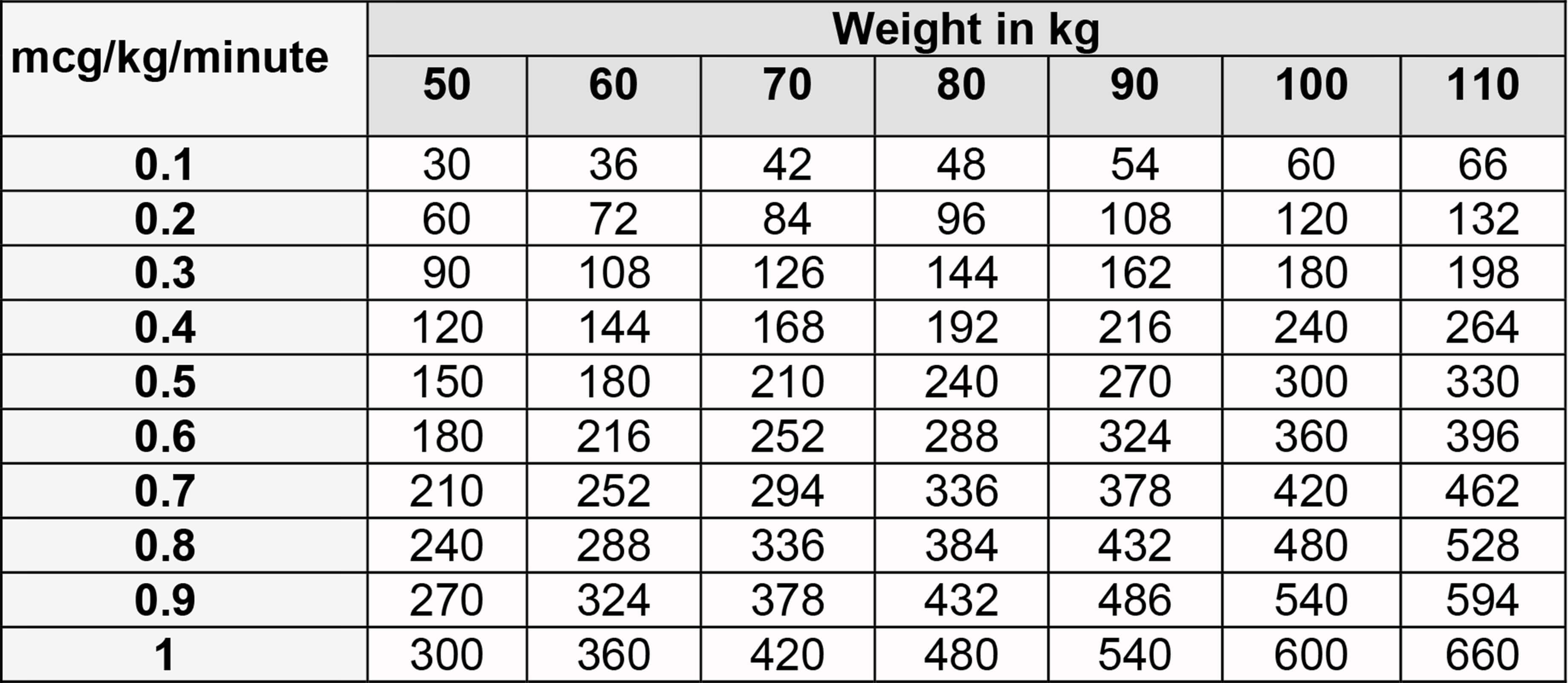
Click on above image to enlarge
Seizures
Treat seizures in post cardiac arrest, similar to management of status epilepticus. See Status epilepticus.
LoE:IIIbxiv
Fever
- Paracetamol, oral, 500 mg - 1 g 4–6 hourly when required (to a maximum of 4 g in 24 hours).
- Maximum dose: 15 mg/kg/dose.
REFERRAL
- Following successful resuscitation, cases should be discussed with a hospital with intensive care facilities for transfer.
- If evidence of myocardial infarction is present or if strongly suspected, cases should be discussed with a cardiology service.
Click here for the Supporting NEMLC report and reviews_(2020-4 review cycle).
Standard Treatment Guidelines And Essential Medicines List For South Africa, Adult Hospital level, 2020-4_Version 1_June 2024
Chapter 20: Emergencies and Injuries