Post Operative Care
Description Medicine treatment Referral DESCRIPTION Vital signs should be monitored more frequently in the immediate post-operative period after discharge from the recovery area. Inadequately treated pain has adverse effects on multiple organ systems. Pain management should be individualised for each patient – according to the expected severity and type of pain. Analgesia should be prescribed reg
DESCRIPTION
Vital signs should be monitored more frequently in the immediate post-operative period after discharge from the recovery area. Inadequately treated pain has adverse effects on multiple organ systems. Pain management should be individualised for each patient – according to the expected severity and type of pain. Analgesia should be prescribed regularly if pain is expected to be moderate to severe.
MEDICINE TREATMENT
Analgesia should be prescribed according to the predicted severity of pain. Procedures associated with mild pain include incision and drainage of an abscess, manipulation of a mildly displaced fracture, and inguinal hernia repair. Procedures associated with moderate–severe pain include tonsillectomy, laparotomy, appendicectomy, testicular torsion, and severely displaced fractures. Avoid ‘as necessary’ or ‘pro re nata’ (PRN) dosing. Scheduled analgesia is essential in managing moderate and severe pain.
Table 1: Recommended post-operative analgesia
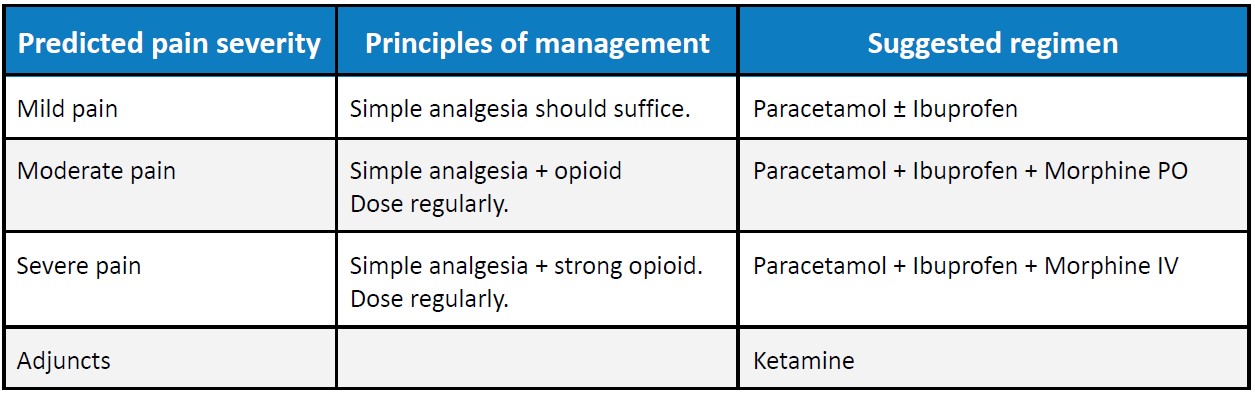
Click on table to enlarge
Simple analgesia: Paracetamol
- See doses in Table 2: Paracetamol doses in children in Maintenance of anaesthesia
Simple analgesia: Non-Steroidal Anti-Inflammatory Drugs (NSAIDs)
- Ibuprofen, oral, 5 - 10 mg/kg/dose 8 hourly
Opioid analgesia
- Strong opioid: Morphine, oral:
- 0 - 1 month of age: 0.05 mg/kg 6 hourly.
- 1 - 12 months of age: 0.05 - 0.2 mg/kg/dose 4 - 6 hourly.
- > 12 months of age: 0.2 - 0.4 mg/kg/dose 4 - 6 hourly.
- Strong opioid: Morphine, IV. Morphine infusion for older child (more than 3 months of age):
- Ventilated: Morphine, IV, 20 - 40 μg/kg/hour infusion.
- i.e. Morphine 1 mg/kg mixed with 50 mL dextrose 5% or sodium chloride 0.9% at 1 - 2 mL/hour.
- Unventilated: Morphine 5 - 20 μg/kg/hour infusion.
- i.e. Morphine 1 mg/kg mixed with 50 mL dextrose 5% or sodium chloride 0.9% at 0.25 - 1 mL/hour.
- Ventilated: Morphine, IV, 20 - 40 μg/kg/hour infusion.
Adjuncts
- Ketamine, IV, 0.2 - 0.5 mg/kg/hour.
- i.e. Ketamine 5 mg/kg mixed up to 50 mL sodium chloride 0.9% at 2 - 5 mL/hour.
Ketamine is a safe and effective analgesic adjunct, with significant opioid sparing effect, even at low doses. This dosing regimen will not result in haemodynamic changes, or unwanted psychotropic effects.
Note: Patients on morphine infusions should have continuous oxygen saturation monitored and adequate nursing care. Label syringes appropriately.
REFERRAL
- Inability to provide appropriate care.
Standard Treatment Guidelines and Essential Medicines List for South Africa, Hospital Level, Paediatrics, 2023 Edition
Chapter 22:Anaesthestics, 22.1.3 Post Operative Care