Potassium Abnormalities In ICU
Rapid changes in serum potassium result in the critical clinical features, mainly cardiac and therefore, absolute values may not reflect commonly described clinical changes associated with absolute levels, e.g.: children with chronic renal failure may tolerate very high levels of potassium with little clinical effect. Click on image to enlarge Hypokalaemia: See: Diarrhoea, acute . Normal potassiu
Rapid changes in serum potassium result in the critical clinical features, mainly cardiac and therefore, absolute values may not reflect commonly described clinical changes associated with absolute levels, e.g.: children with chronic renal failure may tolerate very high levels of potassium with little clinical effect.
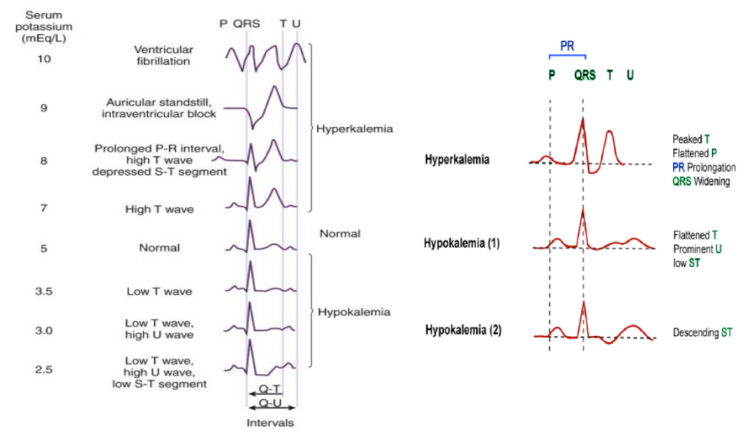
Click on image to enlarge
Hypokalaemia:
See: Diarrhoea, acute.
Normal potassium = 3.5–4.5 mmol/L.
Replacement of potassium in ICU:
If potassium 2.5–3.4 mmol/L – replace orally – 1 mmol/kg per dose.
- Potassium chloride tablets (600 mg) = 8 mmol.
- Mist. potassium citrate 30% suspension = 2.8 mmol/mL.
If potassium < 2.5 mmol/L, will need intravenous replacement.
- IV potassium only to be used where appropriate monitoring is available which must include continuous ECG and bedside serum potassium/blood gas analysis.
- Ensure slow administration, over 4 hours.
Always discuss with a specialist first before commencing any IV potassium.
- Replacement dose = 1–2 mmol/kg (given slowly over 4 hours).
- Maximum rate of replacement = 0.5 mmol/kg/hour.
- Recommended dose = 1.2 mmol/kg = 0.3 mmol/kg/hour for 4 hours.
- 15% KPO4 and 15% KCL both contain 2 mmol/mL of potassium.
- ECG monitoring is strongly recommended during IV potassium replacement.
Example of IV replacement in a 10 kg child:
Dose = 1.2 mmol x 10 kg = 12 mmol of potassium = 6 mL of 15% potassium solution.
Recommended: Add the 6 mL of potassium (either KCl or KPO4 - depending on the patient’s clinical characteristics) to 14 mL of 0.9% saline, to create a 20 mL solution. Then administer the solution at 5 mL/hour over 4 hours.
Please note that this only holds true for a child who is not receiving any additional potassium intravenously.
Note:
In stable patients with severe hypokalaemia, slow correction with oral potassium supplementation can be considered in non-ICU environments.
Acute hyperkalaemia in ICU:
Hyperkalaemia: K > 5.5 mmol/L.
Moderate hyperkalaemia: K > 6 mmol/L.
Severe hyperkalaemia: K > 7 mmol/L.
Management of hyperkalaemia:
- Stop any potassium containing fluids/supplemental potassium.
- Treat the cause.
- Treatment of hyperkalaemia:
- Calcium gluconate 0.6 mL/kg diluted 1:4, IV, slowly.
OR if life threatening hyperkalaemia, consider: - Calcium chloride (10%) 0.2 mL/kg (maximum 10 mL) diluted 1:4 with sterile water, IV, slowly over 10 minutes (must be administered via a CVC line).
- Salbutamol nebulisation or salbutamol 4 µg/kg, IV, over 20 minutes. (Note – ineffective in severe metabolic acidosis.)
- Sodium bicarbonate 8.5% 1 mL/kg diluted 1:1 with sterile water, IV. (Note – more effective with severe acidosis of pH < 7.15.)
- Dextrose/insulin: 1 mL/kg of 50% dextrose + 1 mL/kg of sterile water + 0.1 units/kg rapid acting insulin. (this concentration is only suitable for administration via a central line, use a 10% solution via peripheral lines)
- Calcium gluconate 0.6 mL/kg diluted 1:4, IV, slowly.
Standard Treatment Guidelines And Essential Medicines List For South Africa, Hospital Level, Paediatrics, 2023 Edition
Chapter 23: Paediatric Intensive Care, 23.6 Electrolyte Abnormalities, 23.6.2 Potassium Abnormalities In ICU