Protocol for the Acute Management of Spontaneous Preterm Labour at Tygerberg Hospital
Definitions Risk factors for preterm labour/preterm birth Management: Initial assessment & work-up of preterm labour Management: No cervical changes but regular contractions Management: Confirmed spontaneous preterm labour regular contractions with cervical changes Management: Role of Tocolysis in PTL Management: Role of antenatal steriods in preterm labour Management: Role of magnesium sulph
Risk factors for preterm labour/preterm birth
Management: Initial assessment & work-up of preterm labour
Management: No cervical changes but regular contractions
Management: Confirmed spontaneous preterm labour regular contractions with cervical changes
Management: Role of Tocolysis in PTL
Management: Role of antenatal steriods in preterm labour
Management: Role of magnesium sulphate in preterm labour
Management: Role of routine empiric antibiotics in preterm labour
Management: Discharge advice after preterm birth
A. Definitions
Preterm Labour:
- Onset of labour after the gestation of ≥ 24w0d and before 37w0d
- Onset of labour determined by:
- Documented regular uterine contractions (at least one every 10min) with
- Documented cervical change:
- Dilation of >2cm at internal os and cervix length ≤ 1cm (80 % effacement) or
- Documented rupture of membranes
Threatened Preterm Labour:
- Presumed labour after the gestation of ≥ 24w0d and before 37w0d with
- Documented regular uterine contractions (at least one every 10min) but
- With no evidence of cervical change
B. Risk factors for preterm labour/preterm birth
Past History:
- Previous 2nd trimester pregnancy loss
- Previous preterm birth
- Previous cervical procedures
Current Pregnancy:
- Recent history of UTI or other Genito-Urinary infection
- Domestic violence
- Polyhydramnios
- Multiple pregnancy
- Ante-partum haemorrhage
- Placenta praevia
- Short cervix on ultrasound (≤25mm)
IF RISK FACTORS ARE IDENTIFIED DECIDE IF QUALIFY FOR ANTENATAL MEDICAL OR SURGICAL INTERVENTION – SEE PROTOCOL: RISK OF PTL (PROGESTERONE/CERVICAL CERCLAGE)
- There is no evidence that patients in acute preterm labor benefit from progesterone supplementation
NB! For the purpose of the protocol, viability [for fetal monitoring with CTG] will be defined as:
- Sure gestation of 27w0d AND 800g
OR
- When the gestational age is uncertain, the decision regarding full active intervention is based NOT on the estimated fetal weight but on an ultrasound-based average gestational age of 27 weeks 0 days or more. Provided criteria are met (see protocol for peri-viable birth)
C. Management: Initial assessment & work-up of preterm labour
Initial management of painful contractions & intact membranes < 37w0d:
- General assessment:
- Obtain history, especially whether any symptoms of rupture of membranes and predisposing risk factors for preterm labour
- Check antenatal card for MSU, HIV, Syphilis results and normal detail scan
- Ensure correct gestation (Sure gestation = early ultrasound ± Dates / SF)
NB! If patient is unbooked or lost her card:
- Check for results on the computer, if not available do rapid HIV, Rh and Syphilis tests
- Request registrar on call to do basic scan, exclude gross abnormality and get EFW (Use the complete basic scan report form supplied)
But do not delay management while waiting for the above
- General examination
- Maternal vital signs, urine dipstick, including hydration status
- Asses uterine activity by abdominal palpation
Further management requires the patient to be experiencing palpable uterine contractions
- Consider ultrasound if gestational age, placental location, fetal presentation is unknown
- Obtain baseline CTG [if viability criteria are met]
- If pathological CTG – Do intra-uterine resuscitation according to protocol. If no recovery, immediately prepare patient for Caesarean Section and inform the registrar in charge
2. Perform sterile speculum examination:
- If evidence of ruptured membranes:
- Follow protocol for preterm rupture of membranes
- If no evidence of rupture of membranes:
- Visualize cervix to determine if there is significant dilatation
3. Perform digital cervical assessment: *Only perform assessment if intact membranes!
- To determine dilation, effacement, position, consistency and station
4. Side-room and special investigation:
- Ward Hb (if no recent Hb on record for last 2 weeks)
- Mid stream urine specimen for culture and sensitivity
D. Management: No cervical changes but regular contractions
1. Threatened preterm labour in patient with a low background risk for preterm labour [If no cervical changes but contractions suggestive of labour (cervix long and closed)]:
- Do not admit patient yet
- Monitor uterine activity and repeat digital cervical assessment four hours later
- If there are no cervical changes 4-6 hours later, and the patient is at low risk for preterm labour, she can be discharged with advice to return if the contractions increase in severity, if there is a show or rupture of membranes. Make a clear note on the antenatal chart and give appropriate patient advice/counselling
2. Threatened preterm labour in high risk patient for preterm labour:
- If she is at high risk for preterm labour as identified on the history (see Section B):
- If the clinical assessment suggests that the woman is in suspected preterm labour and she is ≤29w6d pregnant or less, advise treatment for preterm labour as described below
- If the clinical assessment suggests that the woman is in suspected preterm labour and she is 30W0D pregnant or more, consider transvaginal ultrasound measurement of cervical length as a diagnostic test:
NB! In these cases (≥30w), a trans-vaginal cervical length can be done by accredited doctor that has been assessed by the Ultrasound Unit.
IF
The cervical length is >15mm this can be seen as a valuable negative predictor.
These patients can be discharged with advice and a note on the antenatal card.
BUT
If the cervical length is ≤15mm (or if ultrasound is not available) consider admission and treatment for PTL.
- If ultrasound is not available, alternative management for 30w0d pregnant or more:
- Monitor uterine activity, and repeat digital cervical assessment four hours later
- If there are no cervical changes 4-6 hours later, admit in ward F2 (but do not prescribe any tocolysis or steroids yet) and observe until the next morning. (Inform the registrar of the admission)
- The plan in the notes should state that the cervix should be re-assessed the next morning on the ward round (or at least 6-8 hours after the second cervical examination). Write a clear nursing instruction that the doctor on call must be informed if there is an increase in severity of contractions, vaginal bleeding, a show or rupture of membranes
D. Management: Confirmed spontaneous preterm labour regular contractions with cervical changes
- Look for a possible cause for the preterm labour
- Do urine MCS (before commencement of antibiotics)
- Admit to Emergency Centre (Labour ward) for:
- Tocolysis & suppression of labour
- Antenatal corticosteroid administration
- Magnesium Sulphate for neuroprotection (if <32weeks gestation)
- If delivery is imminent also inform the doctor on call for paediatrics
- Suppress labour unless contraindications (see Section below). Try and continue suppression of labour until 48 hours have passed since the first dose of steroids
- Transfer patient to the antenatal ward if contractions have subsided for > 6h. Repeat cervical assessment before transfer
- The patient can be discharged if she was successfully suppressed [i.e. no contractions for 48 hours]. Repeat cervical assessment before discharge. Make good notes on the antenatal card and change her risk category to high risk
- Follow up in 1-2 week at HRC; continue follow up until 34 weeks. Reassess patient for level 1 / MOU follow up from 34 weeks onwards
E. Management: Role of Tocolysis in PTL
1. Value:
- Tocolytic therapy has been shown to prolong pregnancy to provide benefit of administering antenatal corticosteroids
- Tocolytic therapy may play a role in safe transport for women with preterm labour
2. Indication for Tocolysis:
- Women in preterm labour 26w0d - 33w6d sure gestation or EFW 700g – 2000g if unsure gestation (but CTG monitoring only if viability criteria are met)
3. Contraindications for Tocolysis:
- Mother does not consent to suppression
- If ≥ 34w0d sure gestation or EFW ≥ 2000g in unsure gestation
- Pathological or suspicious fetal heart rate pattern
- Lethal fetal anomaly
- Intra uterine fetal death
- Suspected chorioamnionitis (clinical signs of infection)
- Severe hypertensive conditions in pregnancy
- Abruptio Placentae
- Severe IUGR (<3rd percentile)
4. Relative contraindications for Tocolysis (To be assessed and discussed with your consultant):
- If less than 26w0d sure gestation or EFW < 700g if the gestation is unsure
- Ante-partum haemorrhage of unknown cause
5. Drugs & Dose:
- Calcium channel blocker: Short acting Nifedipine (Adalat®) To be used as 1st line treatment (>32w0d)
- Dose: 1st preload with 200ml 0.9% saline IVI then 20mg loading dose orally (do not chew or take sublingually) and 10mg after 30 min if contractions persist. Continue with 10mg 4 hourly per os for 48 hours
- Contraindications: All cardiac diseases, hypotension and hypertension diseases. (Unless discussed and decision made by consultant – make clear notes!)
- Side effects: Flushing, headache, dizziness, nausea
- Prostaglandin synthetase inhibitor – Indomethacin (Indocid®)
- To be used as 2nd line treatment after Nifedipine, if initial tocolysis was not successful. OR 1st line <32w0d
- Dose: 100mg rectal suppository 12hrly for 3 doses
- Contraindications: pre-existing gastrointestinal ulcers/lesions, known allergy to NSAIDS, significant renal or hepatic impairment, sure gestation of ≥ 32w0d (If unsure gestation an EFW ≥ 1500g)
- Side effects: Nausea, heartburn, fluid retention, and suppression of platelet function
NOTE: Concomitant use of Nifedipine and Indomethacin as initial management for tocolysis should only be prescribe under consultant guidance
- If at this stage tocolysis is not effective in stopping the contractions, the use of a beta2 stimulant (Salbutamol) as an adjunct in the dose as below can be considered
- Beta-mimetic – Salbutamol
- Dose: 250μg (1⁄2 x 0.5ml of 500μg ampoule diluted in 20ml saline) slowly IV as soon as possible
Can continue infusion: 2mg (4 ampoules) in 200ml saline at 1ml/minute and increase every 10 minutes by 1ml/minute until maximum of 4ml/minute or pulse >120 bpm - Contraindication: Cardiac arrhythmias, maternal tachycardia (pulse > 110bpm), all underlying cardiac and diabetic disease. (Unless discussed and decision made by consultant – make clear notes!)
- Side effects: Cardiac or cardiopulmonary arrhythmias, pulmonary oedema, myocardial ischemia, tachycardia, hypotension
- Dose: 250μg (1⁄2 x 0.5ml of 500μg ampoule diluted in 20ml saline) slowly IV as soon as possible
NB! Salbutamol infusions can only be started if the maternal monitoring can be done with continuous ECG and oxygen saturation monitoring. Increase salbutamol dosage until contractions is suppressed OR maternal pulse rate 110-120 bpm maximum.
6. Continuous/prolonged and repeated tocolysis:
- Benefits of prolonging or maintenance tocolytic after 48 hours are unsure. Unless a clear maternal cause can be identified continuation of tocolysis for >48hrs should be discussed with your consultant
- Role of tocolysis in another or 2nd episode of preterm labour is unclear. Unless a clear maternal cause can be identified, these patients should be discussed with your consultant
F. Management: Role of antenatal steriods in preterm labour
1. Value:
- This is the most beneficial intervention for patients in true preterm labour
2. Indications:
- All pregnant women between 26w0d and 33w6d gestation who are at risk of preterm birth within 7 days should receive a single course of corticosteroids
- For a gestational age of 24, 25 or 26 weeks OR an estimated weight of ≥ 500g but <700g, limited neonatal care will be offered after birth (IV fluids, warmth, oxygen, KMC care). All attempts should therfore be made to prolong the gestation to a more advanced gestational age, if possible and where the maternal condition allows for it
- Corticosteroids can be given if delivery is anticipated within one week, even if no fetal monitoring will be offered (consultant decision)
- MgSO4 for neuroprotection can be given after evaluation of the mother and the fetus and if there is imminent delivery (even if no fetal monitoring is done).
- <24w0d please discuss management with consultant and refer to TBH peri-viability protocol
3. Relative Contraindications:
- Severe maternal infection/septicaemia
4. Drugs and Dose:
- Betamethasone
- Dose: 12mg IM, repeat the same dosage after 24 hours
The first dose should be given as soon as possible (even at the referring centre)
- Dose: 12mg IM, repeat the same dosage after 24 hours
- Dexamethasone
- 2nd line if betamethasone unavailable or if course has been initiated by another facility prior to transfer
- Dose: 8mg IM, repeat 8 hours apart for 3 doses
- Rescue dose can be considered in women who have already had a course of corticosteroids more than 7 days ago and are at very high risk of giving birth in the next 48 hours
NB! The use of antenatal corticosteroids in pregnancies complicated by maternal diabetes mellitus is not contraindicated and the decision should be made with your consultant.
5. Side-effects and complications:
- May accentuate glucose intolerance/hyperglycaemia (avoid glucose screening for 48hrs and do not react on glucosuria; except in known diabetics- refer to the protocol on correction doses
- Pulmonary oedema (NB! Use with caution in multiple pregnancy and β2 stimulant use)
G. Management: Role of magnesium sulphate in preterm labour
1. Value:
- Decreases the incidence and severity of cerebral palsy and gross motor dysfunction in neonate
- Some tocolytic value
2. Indications:
- Pregnancies at high risk of preterm birth within 24 hours
- ≤ 32w0d gestation
3. Contraindications:
- Myasthenia gravis
- Myocardial compromise or cardiac conduction defects
- Impaired renal function
- Caution in pulmonary oedema
4. Dose:
- 4g intravenously over 20 minutes followed by maintenance dose of 1g/hour
- Ideally within 24 hours of birth
- If labour is successfully tocolysed, infusion can be stopped after 6 hours at confirmatory cervical review
- If labour continues, infusion should continue until birth to a maximum of 24 hours even if birth has not occurred
- Do not administer more than one course of magnesium sulphate for neuroprotection as there are limited data regarding any benefit in pregnancies that do not deliver after the initial course
5. Side effects and complications:
- Nausea and vomiting
- Headache
- Muscle weakness
- Visual disturbances
- Palpitations
- Magnesium toxicity: depressed reflexes, respiratory paralysis, cardiac arrest
- Antidote: 10ml 10% calcium gluconate slowly IVI
H. Management: Role of routine empiric antibiotics in preterm labour
1. Value:
- The true value of antimicrobial cover in women with spontaneous preterm labour with intact membranes without evidence of infection remains doubtful
- In developing countries infections play a significant role in the pathogenisis of spontaneous preterm labour
2. Indication for antibiotics:
- Overt maternal or fetal infection
- Preterm or prolonged rupture of membranes
- Group B streptococcal colonisation, bacteriuria or infection during the current pregnancy (On UMCS)
OR
- Have had group B streptococcal colonisation, bacteriuria or infection in a previous pregnancy, and have not had a negative test for group B streptococcus
3. Drugs & Dose (only if antibiotics are needed- see above):
- First line:
- Ampicillin 1g every 6 hours for 48 hours, then oral amoxicillin 500g 8 hourly for 5 days
AND - Azithromycin 1g orally STAT
- Ampicillin 1g every 6 hours for 48 hours, then oral amoxicillin 500g 8 hourly for 5 days
- If severe penicillin allergy:
- Clindamycin 600mg IVI 8 hourly for 48 hours, then oral clindamycin 450mg 8 hourly for 5 days
AND - Azithromycin 1g orally STAT
- Clindamycin 600mg IVI 8 hourly for 48 hours, then oral clindamycin 450mg 8 hourly for 5 days
I. Management: Discharge advice after preterm birth
- Ensure that the discharge note is in the possession of the patient with adequate advice for the next pregnancy. Advise the patient on the importance of a pre-conceptual visit and advice
- Patients with preterm birth and poor outcome in pregnancy need to be followed at the postnatal clinic in 6 weeks for placenta histology/ baby autopsy results and/ or infectious/ chromosomal screening
- Identify selected patients at discharge [After telephonic counselling with Special Care/Maternal Medicine] who should book at Special Care clinic for preconceptional counselling and screening when the next pregnancy is planned again
- If pregnant, book at nearest local clinic and ask for referral to a high-risk antenatal service. (Bring along current discharge note if possible.)
Preterm labour
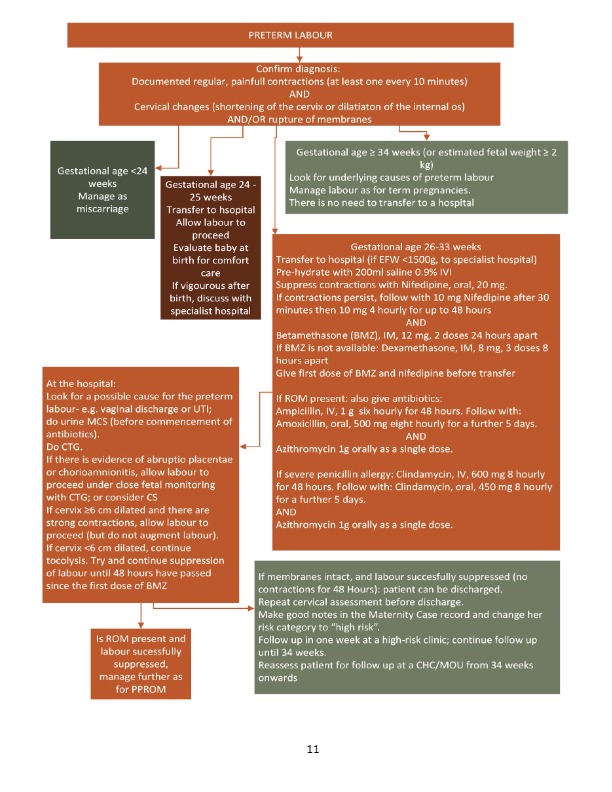
Click on the image to enlarge
Click here to open the above image PDF view
Click here to open the above content in the original PDF view
Tygerberg Hospital, Department of Obstetrics and Gynaecology; Protocol for the acute management of spontaneous preterm labour at Tygerberg Hospital; Version: August 2023; Last checked for updates by EMGuidance: Oct 2023