Pulmonary Oedema, Acute
Description General measures Medicine treatment ICD-10 code: J81 DESCRIPTION A life-threatening condition with abnormal accumulation of fluid in the lungs. Common causes include acute decompensation of chronic underlying heart failure and acute renal failure (e.g. acute nephritis). Patients with acute decompensated heart failure appear extremely ill, restless, poorly perfused and sweaty, tachypno
ICD-10 code: J81
DESCRIPTION
A life-threatening condition with abnormal accumulation of fluid in the lungs.
Common causes include acute decompensation of chronic underlying heart failure and acute renal failure (e.g. acute nephritis).
Patients with acute decompensated heart failure appear extremely ill, restless, poorly perfused and sweaty, tachypnoeic, tachycardic, and hypoxic, with increased work of breathing, and frothy sputum.
GENERAL MEASURES
Maintain open airway. Consider non-invasive positive pressure ventilation.
Position in Fowler’s position, unless hypotensive or comatose.
Correct electrolyte disturbances.
Determine and correct any dysrhythmias.
MEDICINE TREATMENT
- Administer oxygen using face mask to deliver 40% oxygen at a rate of 6–8 L per minute.
Fluid overload suspected/detected:
- Furosemide, slow IV, 40 mg.
- If response is adequate, follow with 40 mg in 2-4 hours.
- If no response within 20-30 minutes: furosemide, IV, 80 mg.
Followed by:
- Nitrates, e.g.:
- Isosorbide dinitrate, SL, 5 mg repeat every 5-10 minutes, if necessary.
- Monitor blood pressure. Do not administer if hypotensive.
OR
- Glyceryl trinitrate, IV, 5–200 mcg/minute, titrated to response.
- Guidance on preparation and administration included below.
CAUTION
Glyceryl trinitrate IV formulation must be diluted before infusion
STEP 1: Select the concentration as required for the individual patient
- For patients who are fluid congested or require higher doses for a clinical response, consider using a more concentrated solution e.g. 200 or 400 mcg/mL.
STEP 2: Select the volume of the diluent
- Patients who are likely to require treatment for a longer duration e.g. unstable angina prepare a larger volume e.g. 500mL.
- Compatible diluents include sodium chloride 0.9% or dextrose 5%.
STEP 3: Confirm the formulation of glyceryl trinitrate available and mix with diluent
- Confirm the strength of the GTN solution i.e. whether a 1mg/mL or 5mg/mL formulation is available.
- Depending on the formulation available, select the number of ampoules to be used based on the concentration and volume of the diluent as decided in Step 1 and 2 above.
- Ensure that the equivalent volume of diluent is removed from the bag before adding the total GTN volume e.g. if 100mLs of GTN is to be added, first remove 100mL of diluent from the bag before adding the GTN.
STEP 4: Set the flow rate for infusion
- Flush the PVC tube before administering to patient.
- Start with the lowest flow rate possible based on the concentration of the solution prepared.
- Increase by 5 mcg/minute every 5 minutes until response achieved or until the rate is 20 mcg/minute.
- If no response after 20 mcg/minute increase by 20 mcg/minute until response. Monitor blood pressure carefully.
E.g. To prepare a 200mcg/mL solution for a patient likely to require several hours of the GTN infusion:
Use 10 ampoules (100mL) of the 1mg/mL GTN formulation mixed with 400mL of diluent (100mL to be removed from a 500mL bag). Initiate the infusion at a flow rate 3mL/hr and titrate the infusion rate based on the patient’s response.
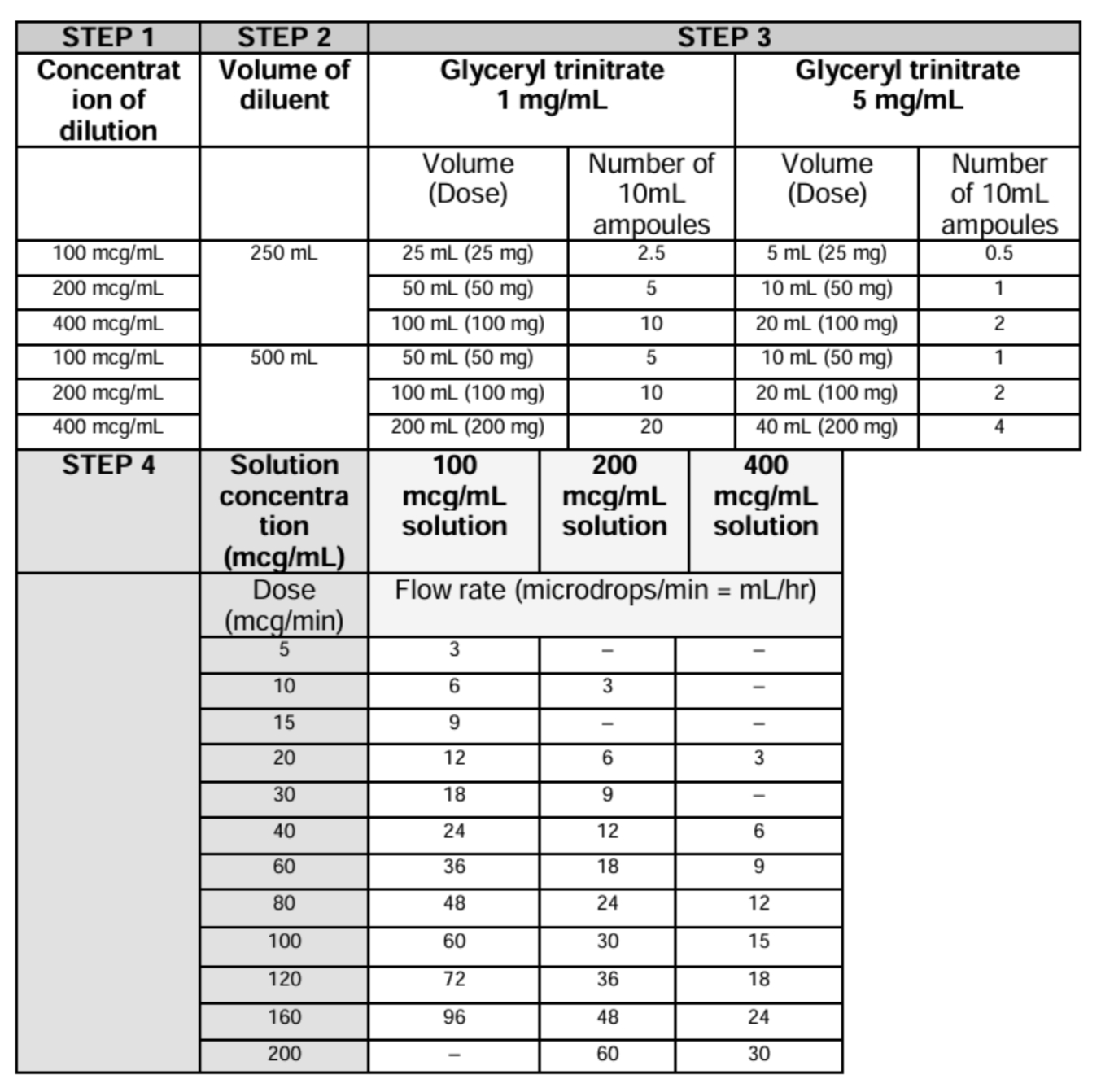
Click on the image to enlarge.
No fluid overdose present:
Initiate nitrates, followed by furosemide.
If hypotensive consider inotropic support, e.g.:
- Dobutamine, IV infusion, 5–20 mcg/kg/minute.
- Dilute 1 vial (250 mg/20 mL) up to 50 mL with sodium chloride 0.9% or dextrose 5%. (Solution = 5 mg/mL or 5 000 mcg/mL)
- Administer under constant ECG monitoring.
- Rate of infusion in mL/hour: see weight-dose table in section: Cardiogenic shock.
- Monitor the blood pressure continuously.
CAUTION
Do not use morphine for pulmonary oedema, as there is observational data providing a signal of harm.
Click here for the Morphine Pulmonary Oedema PHC/Adult Hospital Review May 2022.
Click here for the NEMLC Recommendations for medicine amendments (2020-4 review cycle).
Standard Treatment Guidelines And Essential Medicines List For South Africa, Adult Hospital level, 2020-4_Version 1_June 2024
Chapter 20: Emergencies and Injuries