Respiratory Distress in the Newborn
Description Diagnostic criteria General and supportive measures Medicine treatment Referral ICD-10 code: P22.9 DESCRIPTION Newborn experiencing difficulty with breathing. Causes of respiratory distress include: Pulmonary causes Extrapulmonary causes - respiratory distress syndrome (surfactant deficiency), - meconium aspiration, - pneumonia, - pneumothorax, - transient tachypnoea of newborn
Description
Diagnostic criteria
General and supportive measures
Medicine treatment
Referral
ICD-10 code: P22.9
DESCRIPTION
Newborn experiencing difficulty with breathing.
Causes of respiratory distress include:
| Pulmonary causes | Extrapulmonary causes |
|
- respiratory distress syndrome (surfactant deficiency), - meconium aspiration, - pneumonia, - pneumothorax, - transient tachypnoea of newborn - pulmonary haemorrhage, - pulmonary hypertension, - hypoplastic lungs, and - diaphragmatic hernia. |
- sepsis, - cardiac failure irrespective of cause, - hypothermia/hyperthermia, - hypoglycaemia, - anaemia, - polycythaemia, - hypovolaemic shock, and - perinatal hypoxia.
|
Respiratory distress syndrome (RDS), meconium aspiration syndrome (MAS) congenital pneumonia and transient tachypnoea of the newborn (TTN) are the most common causes of respiratory distress in newborns.
DIAGNOSTIC CRITERIA
Clinical
- Pulmonary and/or extrapulmonary disorders presenting with two or more of the following signs in a newborn baby:
- tachypnoea (≥ 60 breaths/minute),
- expiratory grunting,
- intercostal and sternal retractions (recession), and
- central cyanosis while breathing room air.
Investigations
- Chest X-ray to determine the underlying pathology.
- Echocardiography, if available, to exclude cardiac causes of respiratory distress.
- Haematocrit, blood glucose and temperature.
GENERAL AND SUPPORTIVE MEASURES
- Identify and treat the underlying cause, e.g. Chest tube and underwater drainage of a pneumothorax.
- Admit to a neonatal high care/intensive care facility, if available.
- Handle the neonate as little as possible.
- Nurse a non-intubated infant in the prone position.
- Keep in a neutral thermal environment (incubator or infant crib with overhead heater). Keep the room temperature at 26–28°C, and anterior abdominal wall skin temperature at 36.5–37.5°C
- Monitor:
- blood pressure,
- respiratory rate,
- peripheral perfusion,
- heart/pulse rate,
- haematocrit,
- acid-base status,
- blood glucose,
- body temperature,
- blood gases,
- SaO2,
- minerals and electrolytes,
- fluid balance.
- Nutrition:
- Provide adequate IV dextrose to maintain blood glucose ≥ 2.6 mmol/L.
- Commence oro/nasogastric feeding as soon as possible after birth.
- If enteral feeding is not possible 24 hours after birth, start IV hyperalimentation.
- Ventilation (non-invasive or invasive) is needed if:
- An oxygen saturation of at least 90% or PaO2 of at least 60mmHg (8 kPA) cannot be maintained with an inspiratory oxygen concentration of ≥ 60% with or without nasal CPAP;
- The PaCO2 rises to > 55 mmHg (7.5 kPa) with uncompensated respiratory acidosis (pH ≤ 7.20), irrespective of oxygen saturation or PaO2.
(1 kPa = 7.5 mmHg; 1 mmHg x 0.133 = 1 kPa)
MEDICINE TREATMENT
To eliminate central cyanosis and to maintain oxygen saturation of haemoglobin 90–95%:
- Oxygen, warmed and humidified via nasal cannula.
- If a pulse oximeter or facility for blood gas analysis is available, oxygen, humidified via nasal cannula to maintain oxygen tension in the blood at 60– 80 mmHg.
- If a pulse oximeter or facility for blood gas analysis is not available, regulate the inspired oxygen concentration in such a way that the least amount of oxygen that will prevent central cyanosis is used.
- Keep PaO2 at 60–80 mmHg (8 - 10.5 kPa) and PaCO2 at 35–45 mmHg (4.5 – 5.5 kPa) (arterial blood gas analysis).
Nasal CPAP is needed if the neonate has a good respiratory drive with a PCO2 of ≤ 55 mmHg but unable to maintain a SaO2 of 90–95% on an inspiratory oxygen concentration of ≥ 60% (FiO2) and pneumothorax has been excluded.
Administer nasal CPAP at 4–6 cmH2O and monitor SaO2, blood gas and acid-base status.
OR
- Oxygen/air mixture, high-flow, warmed and humidified via nasal prongs. (Under specialist supervision.)
- Do not exceed 6 L/minute. The flow/minute (L/min) approximates the pressure generated in cm of water.
Stabilise circulation and blood pressure
- Neonatal maintenance solution, IV infusion, 60–80 mL/kg/24 hours (day 1 of life) and adapt to daily maintenance requirements.
AND/OR
- Sodium chloride 0.9%, 10–20 mL/kg over 1–2 hours.
- For preterm infants restrict to 10 mL/kg.
AND/OR
- Fresh frozen plasma, 10–20 mL/kg over 1–2 hours.
OR
- Lyophilised plasma, 10–20 mL/kg over 1–2 hours.
Inotropic support
- Dopamine, IV, 5–15 μg/kg/minute, continued until blood pressure has stabilised.
- Response to inotropic support will be unsatisfactory if the circulating blood volume is not corrected.
Anaemia
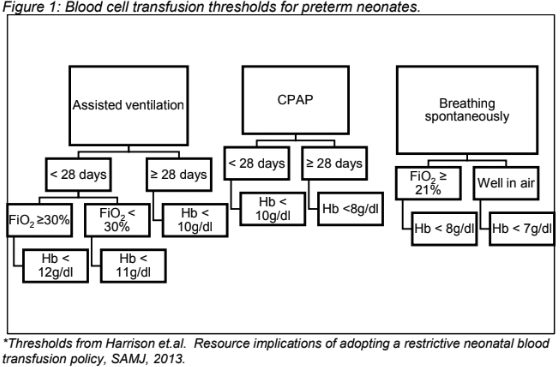
Click on the image to enlarge
- If anaemia is present according to thresholds in figure 1 above: Packed red cells, IV, 10–15 mL/kg over 3-4 hours in haemodynamically stable patients. More rapid transfusions may be appropriate in bleeding and haemodynamically unstable patients.
Metabolic acidosis
If pH ≤ 7.0 and the metabolic acidosis does not respond to normalisation of PaO2, PaCO2, blood pressure, volume expansion (hydration) and correction of anaemia:
- Sodium bicarbonate, 4.2%, IV, administered slowly.
- 1 mmol = 2 mL
- HCO3 needed (mmol) = base excess x 0.3 x body mass (kg).
- (½ correct base deficit initially.)
CAUTION
Do not administer Ca++ containing infusions with sodium bicarbonate solution.
Respiratory distress syndrome (Surfactant deficiency)
In consultation with a paediatrician.
If surfactant deficiency is suspected or present, provide respiratory support.
- Mild surfactant deficiency: nasal CPAP 4–6 cmH2O.
- Moderate surfactant deficiency: ‘in-out’ surfactant followed by nasal CPAP 4– 6 cmH2O. Intubate infant and administer surfactant via naso- or orotracheal tube. Ventilate for a few minutes with a T-Piece resuscitation device or resuscitation bag with a CPAP generating device. Extubate baby and put on nasal CPAP 4– 6 cmH2O. Babies may be put on nasal CPAP directly after ‘in-out’ surfactant administration, omitting the ventilation step following ‘in-out’ surfactant.
- The LISA (Less Invasive Surfactant Administration) method may be used if the doctor is competent in the procedure. Baby is intubated with a size 8 feeding tube whilst on CPAP. The surfactant is administered through the feeding tube slowly over 5 minutes.
- Severe surfactant deficiency: intubate baby and ventilate with a ventilator. Administer surfactant via the naso- or orotracheal tube. If a ventilator is not available, then ‘in-out’ surfactant followed by nasal CPAP can be used.
Short term intubation ('In-out' endotracheal surfactant administration)
- Nasal CPAP as required.
- If inadequate oxygenation on nasal CPAP, pre-oxygenate with bag-mask or Tpiece ventilation to maintain preductal saturation between 90–95%.
- Intubate orally, give surfactant and follow with gentle manual ventilation or CPAP, as required, for 5 minutes:
- Surfactant, 100 mg/kg.
- Extubate and recommence nasal CPAP.
Infection
- If infection, e.g. bronchopneumonia, is present or suspected, give antibiotics after blood cultures have been taken.
- Consider the antibiotic sensitivity profile of micro-organisms in a particular hospital when prescribing antibiotics.
- Aminoglycoside, e.g.:
- Gentamicin, IV, for 5–7 days in the first week of life.
- If < 32 weeks gestation of age: 5 mg/kg/36 hours.
- ≥ 32 weeks gestation of age: 5 mg/kg/24 hours.
- After first week, 5 mg/kg/24 hours for all gestations.
- Gentamicin, IV, for 5–7 days in the first week of life.
PLUS
- Ampicillin, IV, for 5–7 days.
| Gestational Age | Postnatal Age | Dose |
| ≤ 34 weeks | ≤ 7 days | 50 mg/kg/dose every 12 hours |
| 8 to 28 days | 75 mg/kg/dose every 12 hours | |
| >34 weeks | ≤ 28 days | 50mg/kg/dose every 8 hours |
Review after 48 hours. If infection is confirmed, or very strongly suspected, continue for 5–7 days.
Where available, gentamicin doses should be adjusted on the basis of therapeutic drug levels.
- Trough levels (taken immediately prior to next dose), target plasma level < 1 mg/L.
- Peak levels (measured 1 hour after commencement of IV infusion or IM/IV bolus dose), target plasma level > 8 mg/L.
REFERRAL
- No improvement or deterioration despite adequate treatment.
- Development of respiratory failure and need for ventilatory support.
Standard Treatment Guidelines And Essential Medicines List For South Africa, Hospital Level, Paediatrics, 2023 Edition
Chapter 19: Prematurity And Neonatal Conditions, 19.2 Newborn, 19.2.2 Respiratory Distress In The Newborn