Resuscitation of the Newborn
Be prepared! Be at the delivery! Check the equipment and emergency medicines! Ask 3 questions to evaluate the infant: Is there good tone? Is the infant breathing adequately and not just gasping? Is the heart rate above 100 beats per minute? If the answer to all three questions is ‘yes’, the newborn does not need resuscitation. If the answer to any of the three questions is ‘no’, the newborn needs
Be prepared!
Be at the delivery!
Check the equipment and emergency medicines!
Ask 3 questions to evaluate the infant:
- Is there good tone?
- Is the infant breathing adequately and not just gasping?
- Is the heart rate above 100 beats per minute?
If the answer to all three questions is ‘yes’, the newborn does not need resuscitation.
If the answer to any of the three questions is ‘no’, the newborn needs resuscitation.
Assess the infant using the above 3 questions every 30 seconds during resuscitation. If the newborn is improving, then the intervention, e.g. bag-mask ventilation can be stopped. Only if the baby is not responding or getting worse, is further intervention needed, e.g. chest compressions (see algorithm below).
Check that each step has been effectively applied before proceeding to the next step. The algorithm follows the assumption that the previous step was unsuccessful and the newborn is deteriorating.
Use the lowest inspiratory oxygen concentration to alleviate central cyanosis and restore a heart rate to above 100 beats per minute. There is evidence that resuscitation with 100% oxygen may be harmful to the baby.
- Oxygen resuscitation of newborns:
- ≥ 32 weeks gestation: begin with 21%.
- 28–31 weeks gestation: begin with 21–30%.
- < 28 weeks gestation: begin with 30%.
If baby is breathing but oxygen saturation is not within target range: free-flow oxygen administration may begin at 30%.
An unsatisfactory response to resuscitation includes:
- A sustained slow heart rate, usually ≤ 60/minute or a progressive decrease in heart rate until cardiac arrest occurs.
- Episodes of cardiac arrest, with a progressively weaker response to chest compressions, positive pressure ventilation and medicines.
- A decreasing blood pressure, increasing acidosis, severe hypotonia with central cyanosis or intense pallor.
- Apnoea or weak, irregular and inefficient respiratory efforts.
- Consider discontinuation of resuscitation if the unsatisfactory response to resuscitation persists for > 20 minutes and underlying conditions, e.g. pneumothorax, diaphragmatic hernia have been excluded or > 10 minutes of unresponsive cardiac arrest (asystole) and/or > 20 minutes of unsustainable respiration.
- Admit newborns with a favourable response to resuscitation to a neonatal high or intensive care unit, if available, for post-resuscitation care See Hypoxia/Ischaemia of the Newborn.
- Include analgesia for babies likely to be in pain.
MEDICINES USED DURING NEONATAL RESUSCITATION
| Medicine | Indications | Dosage | Effect |
| Adrenaline (epinephrine) |
Asystole Heart rate < 60/min. |
IV, 0.1 mL/kg of a 1:10 000 dilution, which may be repeated up to three times. ET, 1 mL/kg of a 1:10 000 solution. |
Increase Heart rate Increase Myocardial contractility. Increase Arterial pressure. |
| Naloxone | Maternal administration of opiates + apnoeic infant. | ET/IV/SC/IM, 0.1 mg/kg. | Corrects apnoea and/or hypoventilation. |
| Fluids: sodium chloride 0.9% | Hypovolaemia | Slow IV, (5–10 min) 10–20 mL/kg. | Increase Blood pressure and improves tissue perfusion. |
| Dextrose | Hypoglycaemia | IV, 250–500 mg/kg (2.5–5 mL/kg of 10% dextrose water). | Corrects hypoglycaemia |
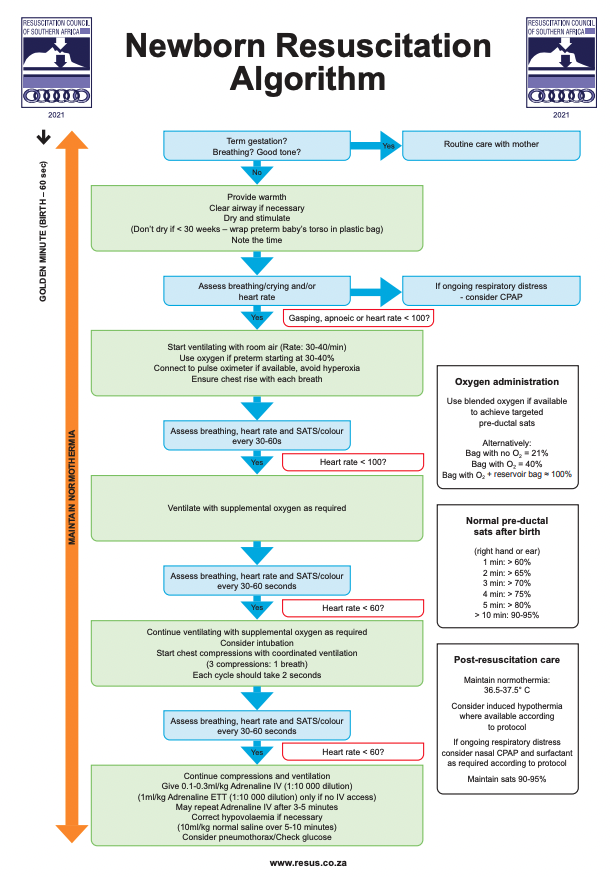
Published with kind permission from the Resuscitation Council of Southern Africa.
Click on the image to enlarge
Standard Treatment Guidelines And Essential Medicines List For South Africa, Hospital Level, Paediatrics, 2023 Edition
Chapter 19: Prematurity And Neonatal Conditions, 19.1 Resuscitation Of The Newborn