Treatment
These are the approved guidelines published by the South African Society of Psychiatrists to provide an overview on treatment and management of commonly diagnosed psychiatric illnesses. The guidelines include consensus recommendations, based on peer contribution and using the international evidence based guidelines that are suitable for the local South African health service.
Please note that parts of this guideline may be out of date, an update will be published as soon as it is available.
Treatment goals
The goals of treatment of OCD are to reduce symptom frequency and severity and to improve functioning and quality of life. Treatment goals also encompass minimising medication adverse effects, helping the patient develop coping strategies for their OCD and related stressors, and educating the patient and family regarding the disorder and its treatment.[7]
General aspects of treatment
In this discussion, we assume that the patient is an adult. Nevertheless, there are increasing data on the pharmacotherapy of OCD in children.[9,10] Indeed, the algorithm (see Fig. 1 below) can readily be adapted for children, bearing in mind considerations such as differences in dosing and differences in risk-benefit determination (e.g. clinicians are less likely to use untested augmentation strategies in children). Consultation with a child psychiatrist may well be indicated in such cases.
The initial treatment of OCD can arguably be either medication or psychotherapy as both approaches are efficacious. Several factors may complicate OCD, thus impacting on decisions about the choice of pharmacotherapy and other interventions. The most important factors, along with their treatment implications, are listed below. In addition, prior response to treatment and patient preference are important considerations.
Severity
Patients with severe symptoms may require brief hospitalisation to help contain symptoms. In general, however, the principles of behaviour therapy suggest that patients should attempt to continue with their ordinary daily routines where possible.
Melancholia
There is some evidence that tricyclic antidepressants (TCAs) may be more effective than selective serotionin reuptake inhibitors (SSRIs) in patients with depression accompanied by melancholic features[11] and in possibly related subgroups such as in-patients with depression,[11-13] although not all evidence is consistent.[14] Melancholic features of depression include loss of pleasure in activities, lack of reactivity to pleasurable stimuli, and various neurovegetative symptoms such as exacerbation of depression in the morning, early-morning awakening, and significant weight loss. The only TCA that is effective in OCD is clomipramine.
Tourette’s disorder
This disorder is characterised by both motor and vocal tics. Many patients with Tourette’s disorder have comorbid OCD. Although this OCD may respond to standard OCD treatments, additional medication that targets the tics (e.g. dopamine blockers such as haloperidol, pimozide, or risperidone) may be necessary for resolution of the range of symptoms that characterise the disorder.[15]
Pregnancy, lactation, menopause
Pharmacotherapy should ideally be avoided during pregnancy and lactation. Nevertheless, where clinical considerations outweigh the risk of medication, such intervention should be considered after consultation with a specialist. In particular, there is growing literature pointing toward the relative safety of fluoxetine in pregnancy.[16]
Comorbid medical disorders and medications
Clinicians need to be aware of the multiple interactions between medications used in the treatment of OCD and other medications, as well as the impact of a medication’s adverse effects on medical disorders. Fortunately, certain SSRIs have relatively few interactions with other medications, and the SSRIs as a class are well tolerated inmost medical disorders.
Pharmacological treatment
Acute treatment
Patient motivation and ability to comply with pharmacotherapy and/or psychotherapy are important considerations in choosing a first-line treatment approach. CBT and serotonin reuptake inhibitors (SRIs) are both considered safe and effective first-line treatments for OCD.[5,7] The decision of whether to commence CBT or an SRI will depend on a number of factors including the nature and severity of symptoms, presence of co-occurring psychiatric and medical comorbidity and their treatments, patients’ access to CBT, past treatment history, and patient preference.[5,7] CBT alone, consisting of exposure and response prevention, is recommended as initial treatment for a patient who is not too depressed, anxious, or severely ill to co-operate with this treatment modality, or who prefers not to take medications and is willing to engage with CBT. Initiating treatment with an SRI is recommended for a patient who has previously responded well to an SRI or other drug, prefers medication treatment or is not suited for CBT.[7]
The first line of medication in the treatment of OCD should comprise an SRI. Consistent with growing evidence for the importance of serotonin in OCD, both clomipramine and the SSRIs appear to be more effective than the noradrenergic reuptake inhibitor, desipramine, in the treatment of OCD.[18,19] The efficacy and safety of clomipramine and the SSRIs in the treatment of OCD have been well researched, with studies indicating that at least half of patients will respond to one of these agents. The SRIs are also useful for body dysmorphic disorder, hypochondriasis, obsessive-compulsive symptoms in Tourette’s disorder, and possibly (albeit with relatively less robust responses) in hair-pulling disorder (trichotillomania), excoriation (skin-picking) disorder, so-called compulsive sexual behaviour, and pathological gambling.[20,21] Note, however, that other agents may be preferable as first-line options in some of these conditions, e.g. given recent data that N-acetyl-cysteine is useful in hair-pulling disorder, this is an important consideration.
An immediate question, however, is which SRI to use first. Given the apparent lack of differences in efficacy between the SRIs, the side-effect profile of these agents may be an important issue in considering which agent to use first. Certainly, there are invariably fewer side-effects during treatment with the SSRIs than during treatment with clomipramine. Therefore, it seems reasonable to suggest that treatment of OCD be initiated with an SSRI.
While all SSRIs appear to have similar efficacy, individual patients may respond well to one medication and not to another. In choosing among the SSRIs, it is important to consider the safety and acceptability of particular side-effects for the patient, potential drug interactions, past treatment response, and the presence of co-occurring general medical conditions.[7] Low doses should initially be used in patients with comorbid panic disorder.
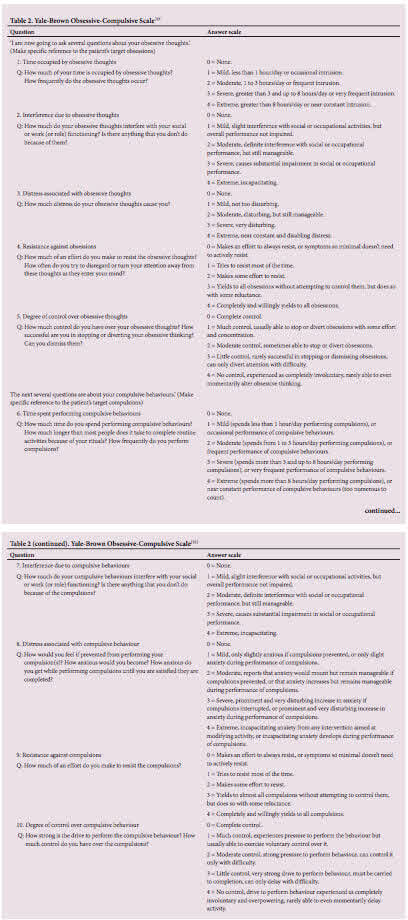
Most patients will not experience substantial improvement until 4 - 6 weeks after initiating medication, and some patients who will ultimately respond will experience little improvement by 8 - 10 weeks.[5,7] To determine response to medication, it is important to ask about change in those symptoms initially targeted for treatment. Side-effects of the medication should also be determined, with particular attention to those that patients may be reluctant to disclose (e.g.sexual dysfunction). It may be useful to complete a symptom rating scale (Table 2)[22] to help quantify response to medication. Patients who are intolerant of a particular medication can of course be switched to another agent. Within the SRIs, adverse effects may not be seen when an alternative SSRI or clomipramine is used.
When there is a poor response to medication, it is important to optimise dosage and duration of the medication. Although some patients with OCD respond to standard doses of SRIs, others require doses that are much higher than in depression. In adults, clomipramine should be increased to approximately 250 mg, and the SSRIs should be increased to maximal dosages (e.g. 60 - 80 mg of fluoxetine) bearing in mind recent black box warnings (e.g. citalopram should not be increased higher than 40 mg). Unfortunately, the likelihood of side-effects also increases at these doses. Electrocardiogram (ECG) monitoring may be necessary when children and adolescents, or patients with pre-existing heart disease, are treated with clomipramine.
Response to SSRIs in OCD may take rather longer than in many other disorders - up to 12 weeks. It is obviously important to give each patient a trial of medication that is of adequate duration. Patients therefore need to be educated that response may take a significant length of time and that they need to remain optimistic even when no change is seen at first.
At the end of a clinical trial of optimal dose and duration, patients should be thoroughly reassessed. There is growing recognition of the importance of residual anxiety symptoms in causing disability and predicting relapse, and of the consequent necessity of aiming for remission of symptoms as the endpoint of treatment.[23] Nevertheless, many OCD patients who are judged ‘responders’ to medication therapy may continue to experience obsessions and compulsions, albeit with less intensity. In clinical trials, a decrease of 25 - 35% on the Yale-Brown Obsessive-Compulsive Scale (Y-BOCS) may correspond to a categorical treatment response.[22]
Maintenance treatment
In patients where an SRI is effective, maintenance pharmacotherapy should be instituted. Rapid discontinuation of these agents risks the return of symptoms. Nevertheless, a maintenance dose of SSRIs in OCD may be lower than the dose initially required during acute treatment.[21] At least a year of maintenance pharmacotherapy is reasonable. When a decision is made to attempt discontinuation of medication, it is advisable to taper medication off slowly (e.g. by 25% every 2 months). Concomitant behavioural treatment (exposure therapy and response prevention) during pharmacotherapy may well increase chances of being able to discontinue medication without relapse.
Non-pharmacological treatment
Psycho-education as part of the management of OCD is crucial. Similarly, cognitive-behavioural therapy (CBT) is an important aspect of OCD treatment, whether used alone or in combination with medication.[17] CBT for OCD has been delivered in individual, group, and family therapy formats. The number and length of treatment sessions vary across different studies, but some guidelines recommend 13 - 20 weekly sessions for most patients.[7]
Managing partial and non-responders
Comparison of augmentation with switching strategies in OCD has not been well researched. Augmentation offers the advantage of retaining any possible gains from the first agent, but the potential disadvantages of polypharmacy (more side-effects, drug interactions).[24] Of all the augmentation strategies in the treatment of OCD, perhaps the most important is augmentation of pharmacotherapy with additional psychotherapy.[25]
Combined SRI and CBT treatment can be considered when the patient has a co-occurring disorder that is SRI-responsive or has a partial response to monotherapy. Combination of an SRI and CBT may also reduce the chance of relapse when medication is discontinued. Inpatients who have had a partial response to CBT monotherapy, it maybe useful to increase the intensity of treatments.[7]
However, when there is a partial response despite an optimum trial of medication, or when there are comorbid tics, it may be useful to consider augmentation. Certainly, in patients with comorbid tics, there is good evidence that augmentation of an SRI with a dopamine blocker can be effective.[26] About one-third to one-half of treatment-refractory OCD patients will have a meaningful treatment response to antipsychotic augmentation. The introduction of the new-generation antipsychotics has led to increased use of these agents in the augmentation therapy of OCD, and they appear useful in treatment-refractory patients even in the absence of comorbid tics.[27-29] Another possible strategy is to supplement an SSRI with a low dose of clomipramine,[30] although careful monitoring of adverse effects and ECGs may be warranted with such a combination. Other augmentation strategies have been suggested, but there are few positive controlled trials. There is also relatively little work on augmentation strategies in OCD-related disorders, although addition of a dopamine blocker may also be useful in some of these patients.[31]
When OCD does not respond to a clinical trial of optimal dose and duration, it is useful to reassess a number of factors. The presence of certain features may impact on the choice of the subsequent intervention.
Compliance
Clinicians often overestimate the compliance of their patients and it is often useful to check with patients and their families whether medication is being taken as prescribed. Many patients worry that medication is addictive or is a ‘crutch’.
Comorbid substance use
In patients who fail to respond to pharmacotherapy, the possibility of comorbid substance use should again be considered. There may be a need for withdrawal before tackling the OCD per se.[32,33]
Comorbid personality disorders
Although SSRIs may be useful, additional interventions such as psychotherapy may be crucial in patients with OCD and comorbid personality disorder. While improvement in OCD symptoms may reduce maladaptive behaviour in comorbid personality disorder, the personality disorder itself may need to be a major target of treatment.
Underlying medical disorder
Patients with obsessive-compulsive and related disorders who fail to respond to medication should be thoroughly reassessed for an underlying medical disorder. In OCD in children, the role of streptococcal throat infection may be particularly important.
Pharmacokinetic issues
Drug-drug interactions may result in a subtherapeutic dose of the prescribed antidepressant.
Psychosocial issues
Psychosocial circumstances that continue to complicate the course of OCD need to be assessed, as these may necessitate appropriate intervention. In particular, the participation of friends and family in rituals may serve to derail treatment.
After the failure of an adequate clinical trial of medication in a patient where reassessment sheds no light on any further unresolved factors, a different agent should be used. Although an SRI has less chance of being effective in patients who have already failed a number of trials of other SRIs, some of these patients (approximately one-third of non-responders to initial SRI monotherapy) will in fact ultimately respond to a new SRI.[34] Given the possible superiority of clomipramine in certain cases of OCD and depression, it may be argued that all OCD patients who have failed to respond to one or more of the SSRIs deserve a trial of clomipramine.[35] While results of studies correlating plasma drug levels and therapeutic response in OCD have been mixed, in the case of clomipramine obtaining drug levels at high doses may be useful. Anecdotal experience suggests that certain non-SRI agents, such as the classic monoamine oxidase inhibitors and venlafaxine, may on occasion be effective in treatment-resistant OCD.[36] Recent trials of intravenous clomipramine also show efficacy in treatment-resistant OCD.[37]
For patients who have failed multiple medication and behavioural treatments (including intensive partial or full hospitalisation programmes),[38] and where severity of the disorder is marked, neurosurgery should also be considered.[39] Several studies have suggested that specific lesions to or deep-brain stimulation of components of corticostriatal and related pathways may lead to significant reduction in OCD symptoms in treatment-refractory patients. Patients can be referred to specialised centres for such treatments.